ENEnglish
 LTLietuviškai
 DEDeutsch
 FRFrançais
 RUРусский
 ESEspañol
 PLPolski
 ITItaliano
 UKУкраїнська
 CSČeština
 PTPortuguês
 JA日本語
 LVLatviešu valoda
 ETEesti
 HUMagyar
 IDBahasa Indonesia
 TRTürkçe
 HIहिन्दी
 ELΕλληνικά
 ARالعربية
 THไทย
 VITiếng Việt
 RORomână
 MSBahasa Melayu
 BNবাংলা
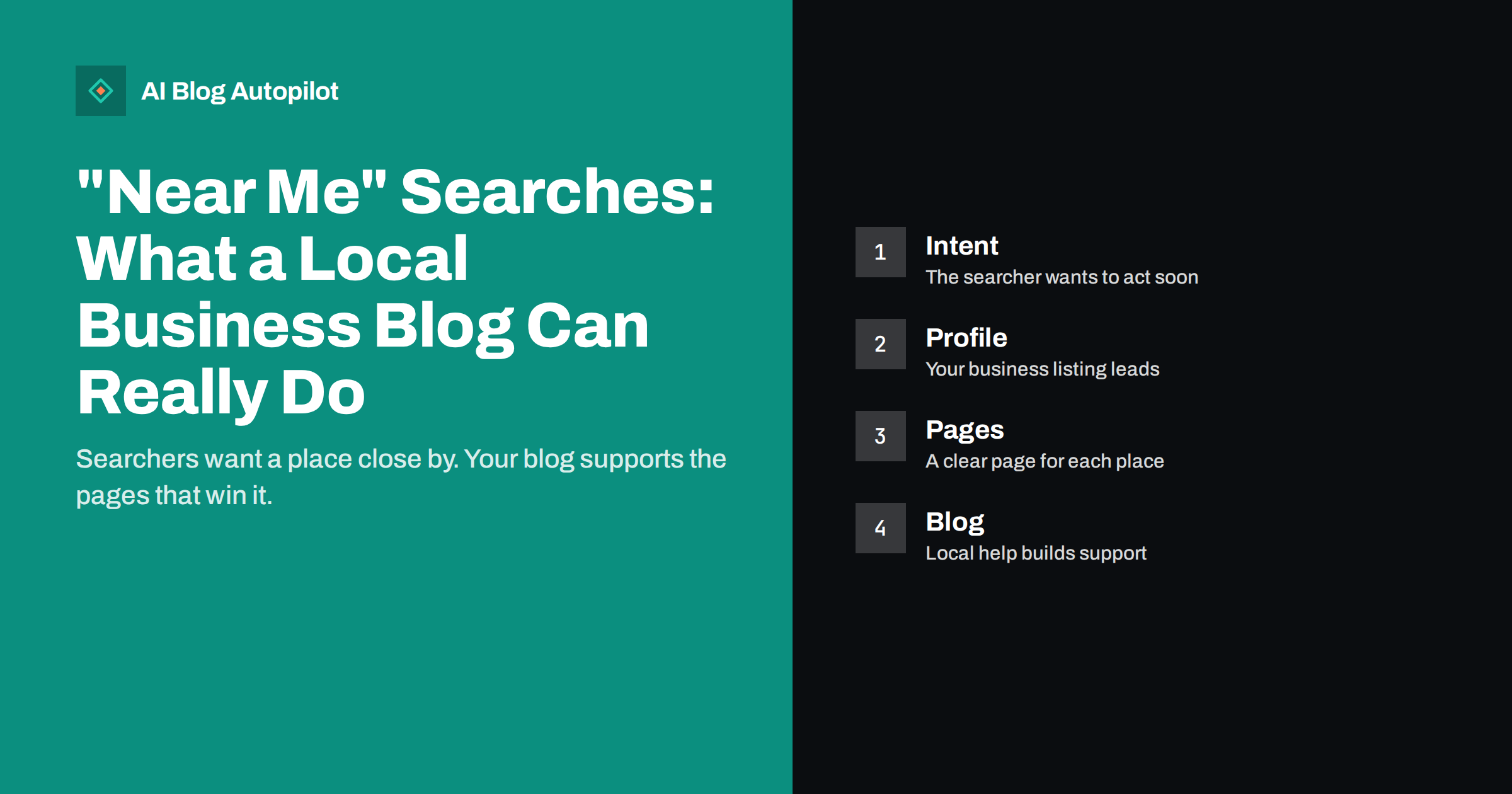
Short answer: a “near me” search asks for a nearby business, so results depend mostly on the searcher’s location, your business profile and listings, and clear location pages, not on a blog post. A blog helps indirectly: it answers local questions, shows real knowledge of the area, earns links and supports the pages that do the winning. Do not try to rank an article for “near me” itself; build the basics first and then use the blog around them.
Many small businesses hear that “near me” searches are growing and decide to write blog posts with the phrase in the title. The result is usually a page that reads oddly and ranks for nothing, because the phrase has no fixed place in it. The searcher’s phone knows where they are, and the results are built around that. Your task is to make it easy for the search engine to know where you are and that you are a good answer.
What these searches really are
A person who types “coffee near me” or “plumber near me” has a need that is close in time and place. They want an open business that they can reach, and they often act within hours, by calling, getting directions or visiting. That is strong buying intent, which is why these searches are valuable, but the searcher is not looking for an article.
Search engines use the searcher’s location and the details of nearby businesses to build a list, often shown as a map with a few places and then regular results. Nearby phrasing such as “in town”, “close to the station” or the name of an area works in the same way. The page type that matches is a business profile or a clear page about a place, as covered in search intent explained.
It follows that a blog post is a poor match for the phrase itself. A post about “how to choose a plumber” matches a different question, and that is fine, but it will not replace the profile and the service pages when someone needs help tonight.
Consider a small example. A family bakery in a market town has an incomplete profile, a home page that lists the address only in the footer and a blog with posts on recipes. A customer searching for a birthday cake nearby finds a competitor with fuller details and recent photographs. The bakery does not need a new strategy; it needs to fill in its categories and services, add a clear page for custom cakes with opening hours and order times, and then write posts that link to it, such as how far ahead to order and how to choose a size.
What decides who appears
The search engines describe three broad ideas for local results: relevance, distance and prominence. Relevance is how well your listing matches the search. Distance is how far you are from the searcher or the place they named. Prominence is how well known you are, which comes from reviews, links, mentions and your presence across the web. You cannot change the distance, but you can influence the other two.
Relevance starts with a complete and accurate business profile: the right categories, services, opening hours, address or service area, phone number and a few good photographs. Keep these details identical everywhere you appear. Our guide to Google Business Profile updates shows how to use posts and updates well.
Prominence grows slowly through honest reviews, mentions from local organisations and a website that people link to and read. This is where the blog begins to matter, because useful local content gives people reasons to link to you and recommend you.
The pages that do the work
For each place where you serve customers, have one page with a clear purpose: a title that names the service and the area, the address or service area, opening times, contact details, a map, photographs, a short description of what you do there and a way to book. Write it for people, not for the phrase. If you have several locations, give each its own page with distinct content, as described in location pages for several branches.
Service pages matter too. Someone searching for a service near them is helped by a page that explains the service, the price range if you can say it, the process and the areas you cover. Keep the pages simple and fast on a phone, since most of these searches come from mobile devices. See mobile-first blog layout for what to check.
Add structured data for the business where it fits, and keep the details in the markup equal to the visible text. A mismatch between the two creates confusion rather than help.
Where the blog fits
The blog is the place for the questions around the purchase. People ask what a service costs, how long it takes, how to prepare, what to look for in a provider and what is different in their area. Answer these with specific, honest posts, and link each to the relevant service or location page so that readers who are ready can act. Our overview in local business blog strategy shows the structure.
Local knowledge is a real advantage. A post on the rules and permits that apply in your town, a guide to seasonal problems in your area or a map of the best places for a certain activity is something that national websites cannot copy. Such pages earn links from local clubs, councils and neighbours, and those links support your prominence.
You can also cover events and projects in the community that you take part in. These show that you are a real part of the area, which is the core of the trust that local results try to measure. See event announcement posts for how to write them.
Another common problem is a mismatch between the site and the profile: a different phone number, an old address or opening times that differ by an hour. Searchers who find conflicting details lose trust, and automated systems that gather facts may pick the wrong one. Make one master list of your business details and copy from it whenever you update a page, a profile or a directory entry.
What not to do
Do not create dozens of near-identical pages for every town and street, changing only the name. These doorway pages offer nothing new and can harm the whole site. If you do not have a real presence or service in a place, do not pretend to. Write a page only when you can say something true and useful about it.
Do not stuff the phrase “near me” into titles and text. It is awkward to read and gains nothing, since the search engine already knows where the searcher is. Use the real place name where it helps a human reader.
Do not buy reviews or invent addresses. Fake locations and fake reviews are against the rules of the major platforms and can lead to the removal of your listing. A smaller number of honest reviews does more for you than a pile of doubtful ones, and the repair after a penalty is slow.
Think about service-area businesses as well, such as electricians or mobile groomers who travel to customers. If you have no public shop, set the service area on your profile instead of showing a home address, and describe the areas on a page of your site in plain words. Add examples of jobs in named neighbourhoods when you have the customers’ permission, without private details.
Reviews and answers
Ask satisfied customers for reviews, make it easy by sharing a direct link and reply to every review in a calm, specific way. Replies show new customers how you behave when something goes wrong, and they add words that match real needs. Do not offer rewards for positive reviews where the rules forbid it.
Answer the questions that appear on your profile and in your messages. If many people ask the same thing, such as parking, accessibility or booking, put the answer on your site as well, in a short post or a section of a location page. This keeps your information consistent and helps assistants that quote it, as explained in local business in AI answers.
Keep details fresh. Holiday opening times, a changed phone number or a new service should be updated on the profile, the site and the major listings at the same time. Out-of-date facts are among the most common reasons for lost local customers.
Measuring what matters
Look at the actions rather than rankings alone: calls, direction requests, bookings and form messages from your profile and your site. Mark these as goals in your analytics and track them by month. Search reports can show which queries bring impressions for your location pages, and the profile’s own reports show how people found you.
Avoid chasing a single ranking in a single spot. Local results change with the searcher’s position, so the rank you see at your desk is not the rank that a customer sees across town. Use several test points or the reports of the platform, and treat them as indications.
Review the numbers every quarter, and write posts that answer the questions behind the searches that matter most. If calls come mainly from the profile, put more effort there; if they come from a service page, improve it first.
How AI Blog Autopilot helps
AI Blog Autopilot writes full SEO articles for your WordPress blog from the topics, keywords, audience and tone you set, with FAQ sections, tags and SEO meta included, and it shares each one to your social networks. Add your area, your services and your audience to the topics, and use approval mode to read each article first and check the local details before it goes live. See the pricing page for plans.
Related reading
The bottom line
Win “near me” searches with an accurate profile, clear location and service pages and honest reviews, then use the blog to answer local questions, earn links and support those pages.
GYIK
Should I write a blog post titled near me?
No. The phrase has no fixed place, and the search engine already knows where the searcher is. Name real places and services instead.
Can a blog help local rankings?
Indirectly. It earns links, shows local knowledge and supports the pages and profile that do the winning.
Do I need a page for every town?
Only for places where you really operate. Near-identical pages for many towns add little and can harm the site.
Do reviews matter?
Yes. They influence prominence and give new customers confidence. Ask honestly and reply to each one.
How do I check my local visibility?
Track calls, direction requests and bookings, and use the reports in your profile and search tools instead of a single rank.