ENEnglish
 LTLietuviškai
 DEDeutsch
 FRFrançais
 RUРусский
 ESEspañol
 PLPolski
 ITItaliano
 UKУкраїнська
 CSČeština
 PTPortuguês
 JA日本語
 LVLatviešu valoda
 ETEesti
 HUMagyar
 IDBahasa Indonesia
 TRTürkçe
 HIहिन्दी
 ELΕλληνικά
 ARالعربية
 THไทย
 VITiếng Việt
 RORomână
 MSBahasa Melayu
 BNবাংলা
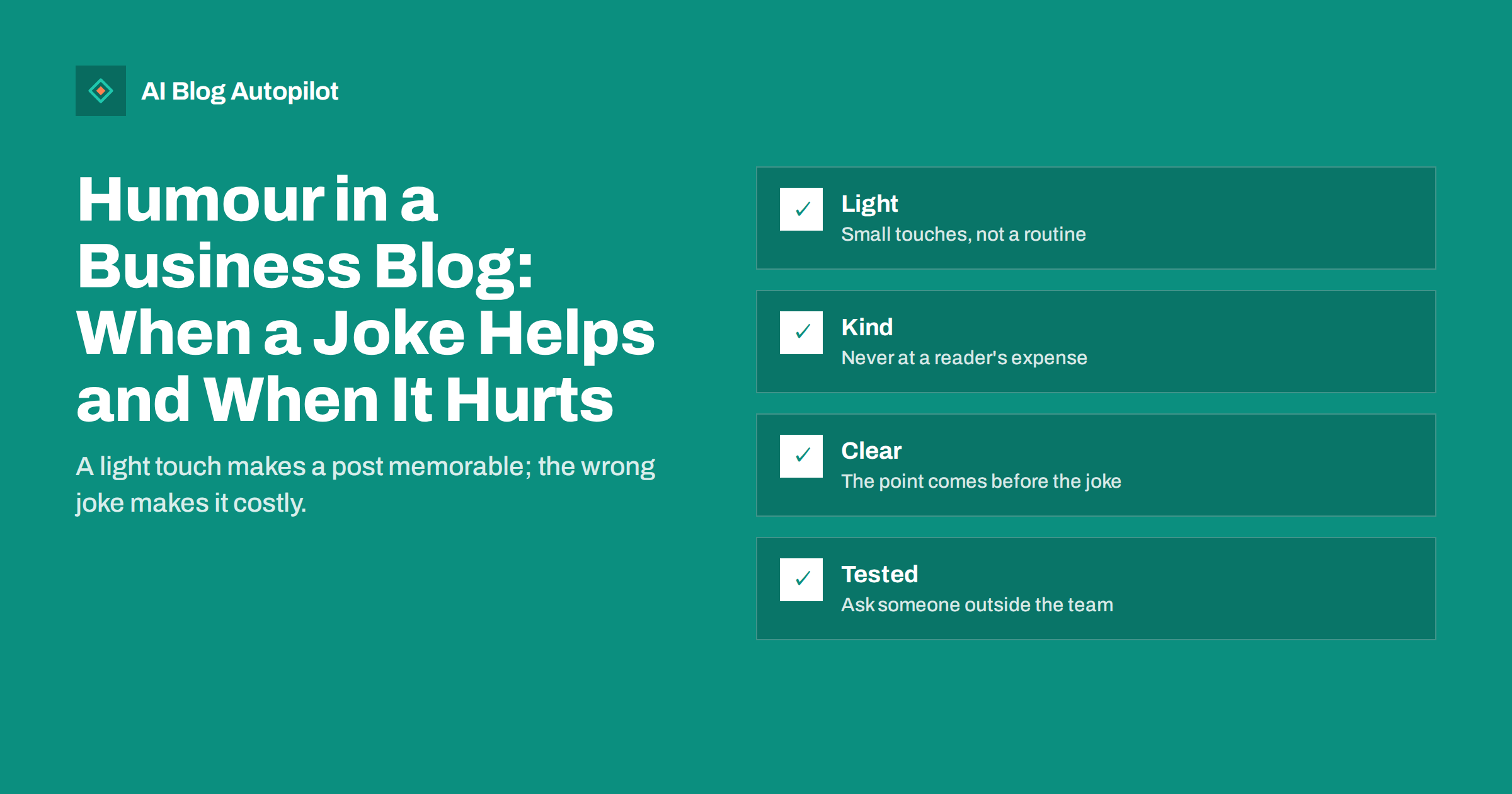
Short answer: humour helps a business blog when it is light, kind and in service of the point: a dry remark, a human aside, a vivid comparison. It hurts when it mocks readers, depends on a culture or a moment, hides the answer or jars with the subject. Keep the useful content first, use humour sparingly, test the tone with someone outside the team and remove jokes that need explaining.
A business blog does not have to be solemn. Readers remember pages that sound like a person, and a little humour makes a long explanation easier to finish. But a joke is a risk that a plain sentence is not: it can offend, confuse, date quickly or be translated badly, and it can make a serious business look careless. The question is not whether to be funny, but when a light touch serves the reader.
Decide what role humour plays for your brand
Start with your audience and your subject. A blog for a children’s entertainer, a craft brewery or a design studio can be playful in ways that suit the work. A blog for a clinic, a law firm or a financial adviser should be warm and clear, with humour used rarely and carefully. Think about what a reader expects from you when they arrive, and about the mood they are in: someone searching for help with a problem is seldom in the mood for a pun.
Write the decision into your style guide, with a short statement such as “friendly and dry, never sarcastic, no jokes about customers”. Add a few examples of acceptable and unacceptable lines. Our guide to editorial style guide basics shows what to include, and brand voice guidelines for AI content shows how to describe tone so that writers and tools follow it.
Different content needs different amounts. A behind-the-scenes post can be lighter than a guide on tax deadlines, and a social post can be lighter than a contract page. Define where humour is welcome and where it is not.
Let the humour grow from your own experience rather than from borrowed formulas. A short remark about the day a printer ate the invoices, or the time a launch went out with the wrong date, is more engaging than a generic joke because it is true and specific. It also shows that you can laugh at your own mistakes, which readers tend to like and which gives credibility to the serious parts.
Keep it light and in service of the point
The best humour in a business blog is small: a wry observation about a common frustration, a vivid comparison that makes an idea memorable, a self-deprecating remark about a mistake you made. It supports the explanation and does not replace it. If a reader would learn just as much with the joke removed, it is probably decoration, and that is fine in small amounts.
Put the answer first. A post that makes the reader wade through jokes before they learn what they came for will lose them, and search engines tend to prefer pages that satisfy the query quickly. Our guide to answer-first writing shows how to open with the useful part and then add personality below it.
Use analogies that clarify, not those that merely amuse. A comparison between a sitemap and a map of a city can make a technical idea easier to grasp, and it is also gently amusing. See examples and analogies in posts for ways to make them accurate as well as friendly.
Look at how your audience writes. If their messages are formal, a casual joke may seem out of place, and if they are relaxed, a stiff tone may seem cold. Reading comments, emails and reviews tells you which register they prefer. Match it, and stay a half-step more careful than you think necessary, because a reader forgives plain writing more easily than a joke that lands badly.
Never joke at the reader’s expense
A reader who feels mocked will not buy from you. Avoid jokes about people who make mistakes, who lack knowledge, who are older, younger, poorer, from another country or in a particular job. The reader of a beginner’s guide is often a beginner, and an article that makes fun of beginners tells them they are not welcome.
Take care with sarcasm, which is easily misread in writing. Words that sound playful when spoken can seem bitter on a page. If you are unsure, say the sentence plainly. The same applies to comments about competitors; our guide to mentioning competitors by name explains how to stay fair and factual.
Avoid humour about sensitive subjects such as illness, bereavement, money trouble, accidents, discrimination or disasters, and avoid it when your own customers might be affected by something that is happening. If in doubt, leave it out.
Think about accessibility too. Jokes that depend on wordplay, images of text or sound can exclude readers who use screen readers or who have a different reading style. A joke that needs the reader to see an image, for example, should be explained in the caption or alt text. The same discipline that makes your pages accessible keeps your humour inclusive.
Remember that humour travels badly
Jokes rely on shared knowledge, and your readers may not share it. Puns, idioms, pop-culture references, local sayings and slang often fail for readers who use English as a second language, and they are difficult to translate. Our article on writing for non-native English readers explains why plain wording matters, and the same holds for automated translations of your posts.
Humour also dates. A reference to a meme or an event can look odd a year later, and posts on a business blog are expected to last. Prefer jokes that rely on human experience, such as the feeling of a full inbox, over those that depend on a fashion of the moment.
Voice assistants and AI answers may extract sentences from your pages without the surrounding context, and a joke taken out of context can read as a statement of fact or as nonsense. Keep the key sentences literal and clear, as advised in definition sentences for AI.
Social posts deserve the same caution as the blog. A joke on a social network can be screenshotted and shared without context, and a reply to a complaint that is meant to be light can look dismissive. Keep a short list of subjects that the team never jokes about, and have a second person read anything sensitive before it goes out. The list protects both the brand and the people who write for it.
Do not let humour mislead
A funny claim is still a claim. Exaggerations such as “our software does everything” or “never lose a customer again” may be meant as jokes, but a reader, a regulator or a search engine may read them literally. Keep every statement about your product, prices, results and promises accurate, and mark clear jokes as jokes only when there is no doubt that they will be understood.
Be careful with satire about real people and organisations, and with any content that might be mistaken for news. Do not invent testimonials or statistics for comic effect, since screenshots circulate without context. A humorous piece that is shared as if it were fact can harm your reputation for a long time.
Test the tone before you publish
Ask someone outside the team to read a draft and mark any line that confused them or made them wince. Ask someone who is not a native speaker, and ask one person from your target audience. If a joke needs to be explained, it does not work. If two readers disagree about whether it is funny, it is probably not worth the risk.
Check the first sentence of the post and the title especially, because they appear in search results and social previews without the rest of the page. A clever title that hides the topic costs clicks, as explained in how to write a good headline. If you have a witty title, make sure the description says plainly what the page is about.
After publishing, look at how readers respond. Comments, shares, replies and the time spent on the page show whether the tone worked. Keep a note of which jokes landed, and learn from the ones that did not.
Consider letting a colleague who is naturally funny review posts for tone, but do not make one person the “funny one” for every page. Humour that depends on a single writer disappears when they leave, and readers notice the change. Writing the principles down in the style guide helps the voice survive changes in the team.
Use humour for small human moments
The places where humour is most welcome are the small human ones: the introduction to a long guide, a caption on a photograph, an error page, a thank-you message, a team profile or a note about a mistake you made. These moments show that real people run the business, which supports trust. Our guide to custom 404 pages for blogs shows one example, a place where a light touch helps a reader who is lost.
Keep the effect modest and the mood warm. A single line that makes a reader smile is better than a post built around a gag. And when the subject is serious, let the writing be calm and clear.
How AI Blog Autopilot helps
AI Blog Autopilot writes full SEO articles for your WordPress blog from the topics, keywords, audience and tone you set, with FAQ sections, tags and SEO meta included, and it shares each one to your social networks. You choose the tone, and approval mode lets you read each article first, so that you decide whether a light touch suits the subject. See the pricing page for plans.
Related reading
- Brand Voice Guidelines for AI-Assisted Content
- Editorial Style Guide Basics for a Business Blog
- Adjusting Tone for Different Readers Without Losing Your Voice
The bottom line
Use humour lightly and kindly, put the answer first, avoid jokes that exclude, travel badly or mislead, write your tone rules down and test the draft with someone outside the team.
GYIK
Should a business blog use humour at all?
Yes, in small doses where it suits the subject and the reader. Serious or sensitive topics call for a calm, clear tone.
What kind of humour is safest?
Gentle observations about shared experiences and self-deprecating remarks. Avoid mocking readers, competitors or sensitive subjects.
Do jokes hurt SEO?
Not directly, but a joke that hides the answer or confuses the title can lose clicks and readers. Put the useful content first.
How do I handle humour in several languages?
Prefer plain wording. Puns and idioms rarely survive translation, so review translated posts for tone.
How can I test a joke?
Ask someone outside the team, ideally a reader from your audience, which lines confused or bothered them. Remove any that need explaining.