ENEnglish
 LTLietuviškai
 DEDeutsch
 FRFrançais
 RUРусский
 ESEspañol
 PLPolski
 ITItaliano
 UKУкраїнська
 CSČeština
 PTPortuguês
 JA日本語
JA日本語 LVLatviešu valoda
 ETEesti
 HUMagyar
 IDBahasa Indonesia
 TRTürkçe
 HIहिन्दी
 ELΕλληνικά
 ARالعربية
 THไทย
THไทย VITiếng Việt
 RORomână
 MSBahasa Melayu
 BNবাংলা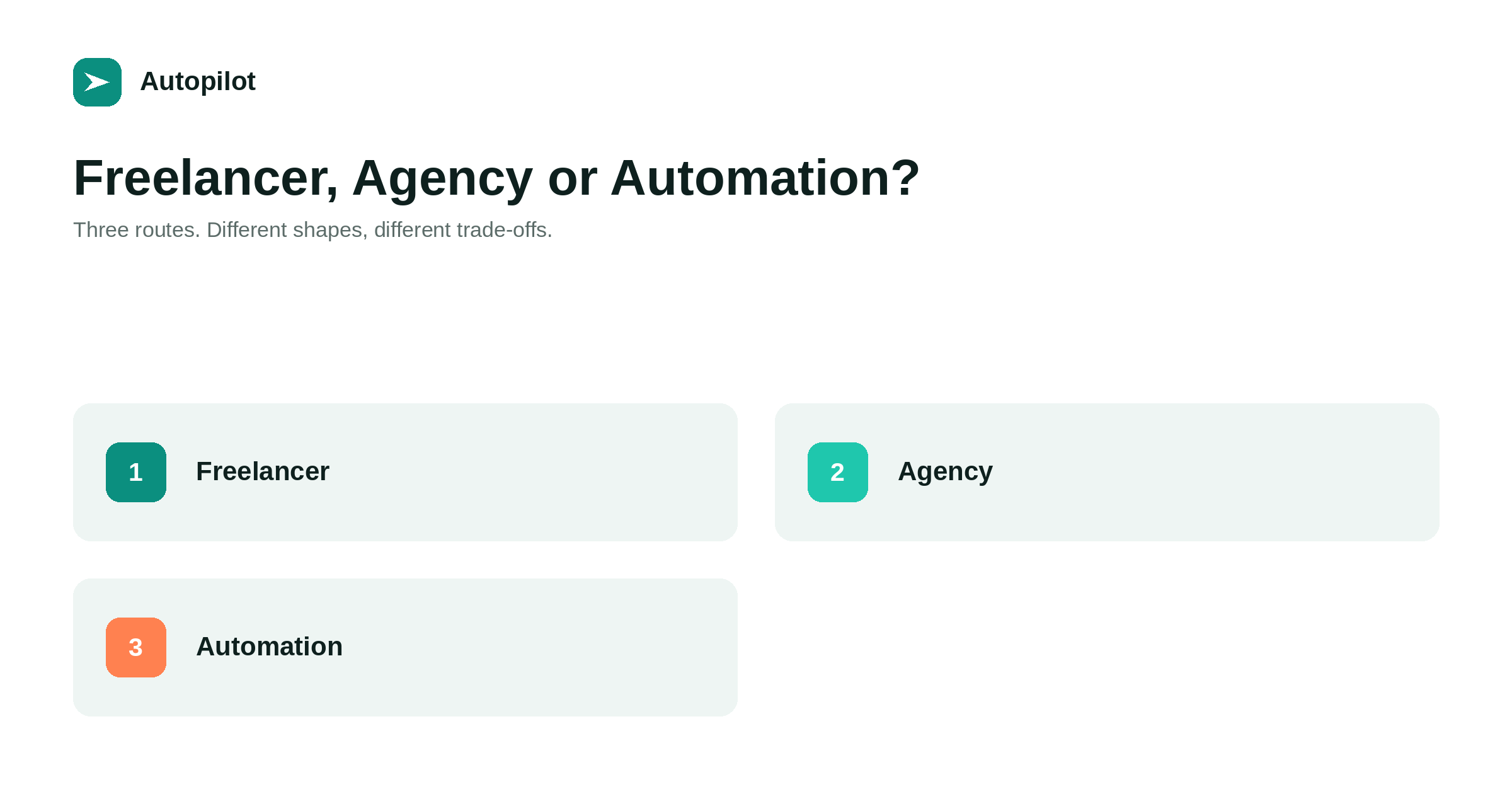
Short answer: a freelancer suits a business that needs a few deeply knowledgeable pieces and has time to brief and edit; cost is per article and quality depends heavily on the individual. An agency suits a business that wants production, editing and sometimes distribution managed for a monthly retainer, at the cost of briefing overhead and less direct control. Automation suits a business that wants consistent volume at a fixed cost and is willing to write clear instructions and review; it cannot supply first-hand experience on its own. Many businesses combine two.
Most businesses that want a blog end up choosing between three routes: hire a freelance writer, retain an agency, or use an automated tool. Each is right for somebody, and each is regularly chosen for the wrong reason.
The useful comparison is not which is best, but which fits your subject, your volume and the time you actually have.
The comparison at a glance
Across the factors that tend to decide it:
| Factor | Freelancer | Agency | Automation |
|---|---|---|---|
| Cost shape | Per article | Monthly retainer | Fixed monthly, set volume |
| Speed per article | Days | Days to weeks | Minutes |
| Subject knowledge | Varies widely | Generalist, can hire specialists | Research-based |
| Consistency of schedule | Depends on availability | Contractual | High |
| Your time per article | Briefing and editing | Briefing and approvals | Review and additions |
| Images and distribution | Usually extra | Often included | Usually included |
| First-hand experience | If they have it | Rarely | Only what you add |
No column wins every row, which is why the decision depends on which rows matter to you.
When a freelancer is the right answer
A good freelancer with real knowledge of your field is hard to beat for depth. They bring experience, can interview your team, and produce pieces that are genuinely original.
The route suits a business that needs a small number of substantial articles — flagship guides, original research, thought leadership — and has someone who can brief them and edit the result.
The drawbacks are consistency and scale. Good specialist freelancers are busy, per-article costs make volume expensive, and replacing one who leaves means starting over with a new person’s learning curve.
When an agency is the right answer
An agency takes on management as well as writing: planning, production, editing, often images, sometimes distribution and reporting.
It suits a business with budget but no internal capacity to manage content — nobody who can plan topics, brief writers or chase deadlines.
The costs are the retainer itself, the overhead of briefings and approval rounds, and some loss of direct control over voice and substance. Agencies write for many clients, and without strong direction the output can drift towards a house style that is not quite yours.
When automation is the right answer
Automation suits a business that wants a consistent volume of useful articles at a predictable cost, and is willing to put in two things: clear standing instructions, and review with some first-hand additions.
It is strongest where the subject is well documented and the value lies in clear, well-structured answers to many specific questions — the long tail described in long-tail keywords. It also handles the mechanical steps — images, formatting, publishing, social sharing — that other routes often charge for separately.
It is weakest where the article’s value is original experience or research the business has not supplied, because a tool can only work with what is published or what you give it.
Your time, honestly counted
Every route still needs time from someone in the business, and it is the most underestimated part of the comparison.
With a freelancer, it goes into briefing and editing, which can be substantial until they know your subject. With an agency, it goes into briefings, reviewing plans and approving drafts, often across several rounds. With automation, it goes into writing instructions once and then reviewing each article.
Estimate the minutes per article for each route before comparing prices. what a blog costs per month shows how to value that time properly.
Combining routes
The most effective setups often combine two.
- Automation for volume, a freelancer for flagships. Consistent coverage of specific questions, plus a few substantial original pieces a quarter.
- Automation for drafts, an in-house specialist for review. The specialist spends their time adding knowledge rather than writing from scratch — see hiring an in-house writer.
- An agency for strategy, automation for production. Less common, but workable for businesses that want planning help without paying agency rates for every article.
Questions that decide it
Four questions usually settle the choice.
How many articles a month do you need? Below four, a freelancer is often simplest. Above ten, automation or an agency becomes much more practical.
Who in the business can review? If nobody can, an agency’s editing is worth paying for — though someone still has to approve.
How specialised is the subject? Highly specialised or regulated fields need expert input whatever the route.
How predictable does the cost need to be? Fixed monthly pricing, as with AI Blog Autopilot from the Starter plan upward on the pricing page, suits a steady budget. None of the three routes can promise rankings or leads; they differ in how the work gets done.
Related reading
If this was useful, these cover the questions that usually come next.
- What a blog costs per month — counting every line honestly
- What the alternatives cost — the two-way version in more depth
- Hiring an in-house writer — the fourth option, for larger teams
The bottom line
A freelancer for depth in small numbers, an agency for managed production when nobody inside can run content, automation for consistent volume at a fixed cost when someone can direct and review. Count your own time on each route, not just the price, and consider combining two: automation for coverage and a person for the pieces that need original experience.
GYIK
Is it cheaper to use automation than a freelance writer?
Usually on production, images and distribution, especially at volume. Your review time remains on both routes, so compare minutes per article as well as the invoice.
When should I hire a content agency?
When you have budget but nobody inside the business who can plan topics, brief writers and manage production. You still need someone to approve what is published.
Can automated articles match a specialist freelancer?
On clear, well-documented questions, often yes after review. On pieces whose value is original experience or research, not unless you supply that material yourself.
Can I combine a freelancer with automation?
Yes, and many businesses do: automation for consistent coverage of specific questions, a freelancer for a few substantial original pieces each quarter.
How many articles a month makes automation worthwhile?
It depends on your subject and budget, but the case strengthens above roughly eight to ten articles a month, where per-article costs from other routes add up quickly.
Which option guarantees better rankings?
None. They differ in cost, speed and how much experience ends up in the article. Rankings depend on page quality, competition and search changes.