ENEnglish
 LTLietuviškai
 DEDeutsch
 FRFrançais
 RUРусский
 ESEspañol
 PLPolski
 ITItaliano
 UKУкраїнська
 CSČeština
 PTPortuguês
 JA日本語
 LVLatviešu valoda
 ETEesti
 HUMagyar
 IDBahasa Indonesia
 TRTürkçe
 HIहिन्दी
 ELΕλληνικά
 ARالعربية
 THไทย
 VITiếng Việt
 RORomână
 MSBahasa Melayu
 BNবাংলা
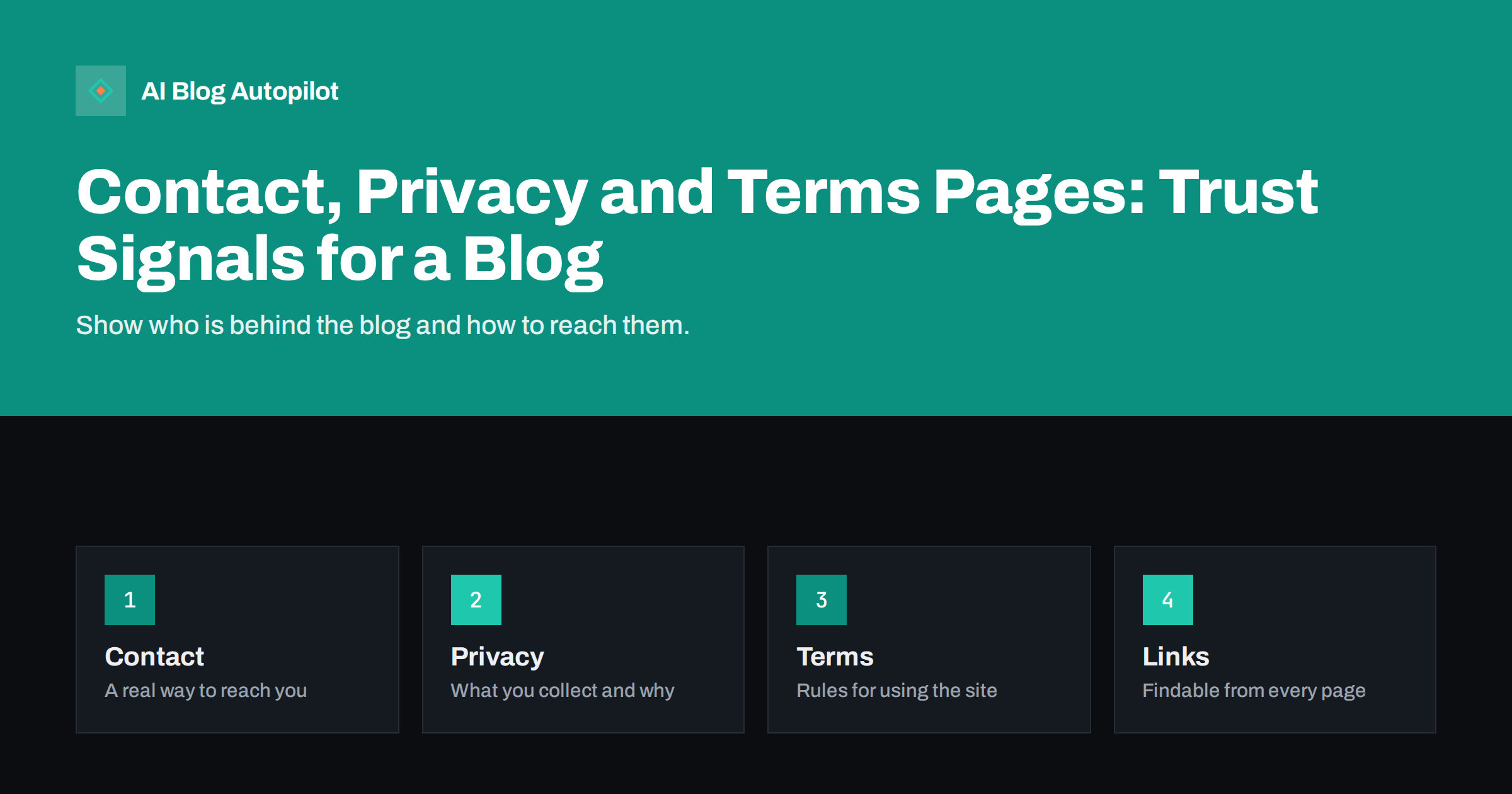
Short answer: a business blog should have a contact page with real details, a privacy policy that matches what the site does and, where relevant, terms of use. These pages do not rank on their own, but they are among the signals that show who runs the site and whether it can be trusted. Search quality guidelines ask raters to look for clear information about who is responsible for a site, and visitors look for the same thing before they sign up, buy or share personal data. Keep the pages accurate, easy to find and written in plain language.
New blogs often focus on articles and treat these pages as paperwork. That is understandable, but it misses their purpose. Each one answers a question that a careful visitor asks, silently, before deciding whether to trust you: Who are these people? Can I reach them? What happens to my data? What are the rules here? This article explains what each page should contain and how to link to it so that it works for people and for search.
Why these pages matter for trust
Trust is built from many small signals. Search engines publish quality guidelines for human raters, and those guidelines refer to experience, expertise, authoritativeness and trust, with trust described as the most important element. For a site that shares information or sells something, the guidelines look for clear details about who is responsible for the content and how to contact them. The raters’ scores do not change rankings directly, but they are used to evaluate and improve the systems that do, so the pattern they describe is a good guide to what the systems try to reward.
Visitors behave in a similar way. They glance at the footer, look for a contact route and, if they are asked for an email address, wonder where it will go. A site with no way to reach anyone and no information on data use feels anonymous, and anonymous sites are easy to leave.
The contact page
A contact page answers the question “can I reach a real person?” The more specific the answer, the stronger the signal. At a minimum, provide a working email address or a form that is monitored and answered. Add other details that suit your business and your legal obligations.
- Business name: the name under which you trade, written the same way across the site.
- Postal address or region: a full address if you serve customers in person or are required to show one, or at least the country and region.
- Email and, if relevant, phone: check them regularly, and say when you usually reply.
- Opening hours or response time: sets expectations and reduces repeated messages.
- Other routes: support centre, social profiles or a link to a booking page.
- Registration details: where the law of your country requires a company number or tax identifier on a business website, include it.
Make sure the form works, that messages reach a person and that spam filters do not swallow real enquiries. Test it every few months by sending yourself a message. Consider adding a short sentence on what to include in an enquiry, which saves time for both sides.
Be honest about what the page promises. If you answer within two working days, say two working days, and then do it. A stated response time that you miss is worse than none at all. If you cannot offer a phone line, do not hide that fact behind a vague “call us” link; a clear email route is better than a promise you cannot keep.
The privacy policy
A privacy policy explains what personal data your site collects, why, how long you keep it and what rights people have. Most blogs collect more than their owners realise: analytics cookies, comment data, email sign-ups, form submissions, embedded media that sets cookies and server logs. The policy must reflect what really happens, not what a template says.
- List what you collect: analytics, forms, newsletters, comments, advertising and any outside services that receive data.
- State the purpose: a short reason for each item, in plain words.
- Explain retention: how long each type of data is kept.
- Describe rights and contacts: how people can ask to see, correct or delete their data, and who to write to.
- Name outside services: the categories of provider that process data for you, such as analytics and email tools.
- Add a date: show when the policy was last updated and review it whenever your tools change.
Rules differ between countries, and this article is not legal advice. If you serve visitors in regions with strict data-protection laws, ask a qualified adviser to review the policy. A policy copied from another business that uses different tools is worse than a short, true one.
Write the first paragraph so that anybody can read it in half a minute: what you collect, why, and who to ask. Put the detail below it, grouped under clear headings. Readers who only want the summary will find it, and readers who need the detail will find that too. Avoid long blocks of legal wording where plain sentences would do.
Terms of use and related notices
Not every blog needs terms of use, but many benefit from them, especially if you accept comments, offer downloads or tools, run a membership or sell products. Terms set out the rules for using the site and limit misunderstandings. They can cover acceptable use, ownership of the content, permission to quote or share it, the limits of the information you provide, and how disputes are handled.
- Content ownership and reuse: say whether visitors may quote or republish your articles and how to credit you.
- Disclaimers: state clearly that articles are general information and not professional advice, where this is true.
- Affiliate and sponsored content: explain relationships that may affect what you recommend. Many places require clear disclosure.
- Cookie notice: a short page or section that lists cookies and how to change choices.
- Accessibility statement: optional but helpful, with a route for reporting problems.
Keep the language as plain as the law allows. A page that nobody can understand does not protect anyone. If you publish in several languages, translate these pages with care and have them checked, because a mistake in a legal notice is more serious than a mistake in a blog post.
Where to link them
The best contact page is useless if nobody finds it. Place the links in a consistent spot, and make them visible on every page, not only on the home page.
- Add the contact, privacy and terms links to the footer of every page, in the same order.
- Link the contact page from the main menu or from a clear button in the header.
- Link the privacy policy beside every form or sign-up box, with a short sentence of context.
- Mention the contact route at the end of long articles, where a reader with a question will look.
- Include the pages in your XML sitemap, and do not hide them with a noindex tag unless there is a clear reason.
These pages are usually not the ones you want to attract search visits, but they should not be blocked from being crawled. Search engines and AI tools that evaluate a site look for them, and a missing page can be read as an absence of accountability.
Tie them to the rest of the site
Trust signals work best together. A contact page that names the business, an about page that explains who writes the articles, author bios that show experience and an editorial policy that explains how content is checked all support one another. Keep names, addresses and descriptions consistent across them, and across your social profiles and business listings. Inconsistent details, such as different spellings of the company name, create doubt for readers and make it harder for search systems to connect the pieces.
Structured data can help. Organisation markup on the home or contact page can state the name, logo, contact details and official profiles. It is not a ranking switch, but it makes the facts machine-readable and consistent. Our guides on the about page and on the editorial policy page explain the companion pieces.
Maintaining the pages
These pages go stale quietly. An email address that no longer works or a policy that mentions a tool you stopped using damages the trust you are trying to build. Add a small checklist to your regular site review.
- Send a test message through the contact form and confirm that you receive it.
- Compare the privacy policy with your current plugins, forms and analytics setup.
- Check that dates and company details are current.
- Confirm that all links in the footer work and that the pages load on a phone.
- Update the date on any page you change, and keep a short record of what changed.
Do this twice a year, and also after any change of tools, hosting or company details. It is a small task, and it protects one of the cheapest and most overlooked parts of a blog’s credibility.
How AI Blog Autopilot helps
AI Blog Autopilot writes and publishes articles on your WordPress blog from the topics, audience and tone you set. The trust pages remain yours, since they describe your own business and obligations, and they work together with the articles it publishes. See the pricing page for plans.
Related reading
- The About Page a Business Blog Needs
- Writing an Editorial Policy Page for a Business Blog
- Privacy and Analytics on a Business Blog
- E-E-A-T on a Blog That Publishes Automatically
The bottom line
Contact, privacy and terms pages answer the questions that careful visitors and search systems ask before they trust a site. Give real contact details, describe your data practices truthfully, add terms where they apply, link the pages from every page and check them twice a year. They take little effort, and they make every article on the blog easier to believe.
GYIK
Do contact and privacy pages affect rankings?
Not directly, but they support the trust signals that quality guidelines describe, and visitors rely on them before sharing data or making a purchase.
What should a contact page include?
A monitored email or form, the business name, a postal address or region, response times and any registration details your country requires.
Does a small blog need a privacy policy?
If the site uses analytics, forms, comments or sign-ups, it collects personal data, and in many places a policy is required. Ask an adviser about your situation.
Do I need terms of use?
Not always, but they help if you accept comments, offer downloads, run memberships or sell products, or if you want to set rules for reuse.
Should these pages be indexed?
Usually yes. Do not block them from crawling, and include them in the sitemap unless there is a clear reason not to.