ENEnglish
 LTLietuviškai
 DEDeutsch
 FRFrançais
 RUРусский
 ESEspañol
 PLPolski
 ITItaliano
 UKУкраїнська
 CSČeština
 PTPortuguês
 JA日本語
JA日本語 LVLatviešu valoda
 ETEesti
 HUMagyar
 IDBahasa Indonesia
 TRTürkçe
 HIहिन्दी
 ELΕλληνικά
 ARالعربية
 THไทย
THไทย VITiếng Việt
 RORomână
 MSBahasa Melayu
 BNবাংলা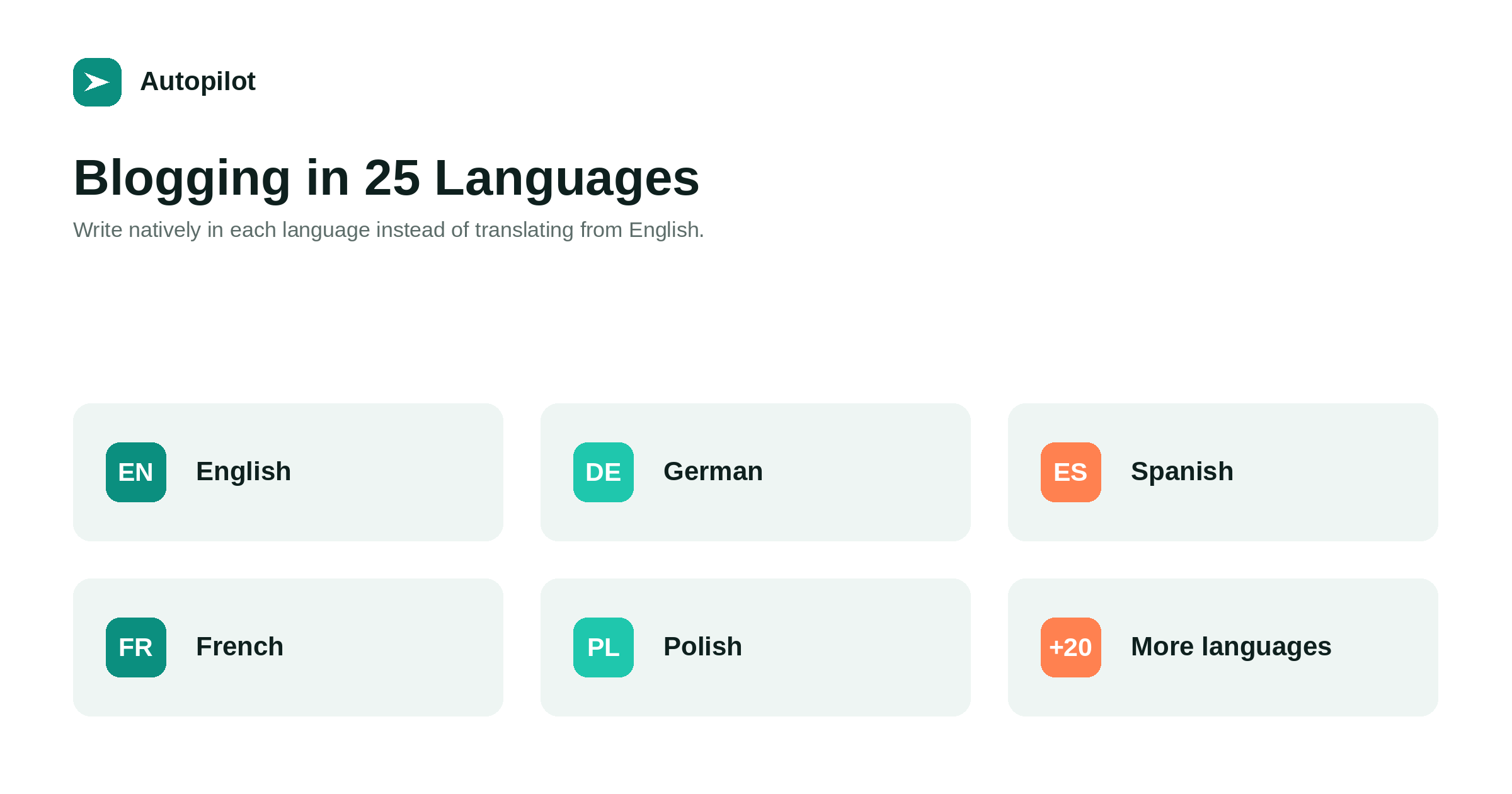
Short answer: write natively in each language rather than translating an English article, choose two or three markets instead of switching on everything, and set hreflang so each version points at its alternatives. A translated article inherits English idioms, English examples and English search intent, and it reads like a translation because it is one. Writing the same topic directly in the target language produces text that matches how people there actually search. Autopilot writes in 25 languages, with all of them available from the Pro plan.
Most international blogs are built the wrong way round: write in English, translate, publish, wonder why the German version gets no traffic. The reason is rarely translation quality. It is that a translated article answers an English question in German words.
People in different markets ask different things, phrase them differently, and care about different details. Getting that right is what multilingual content actually is, and it is a different job from translation.
Translation and native writing are not the same product
Take a simple example. An English article about invoicing software will discuss late-payment habits, common accounting tools and the tax terms an English-speaking reader knows. Translate it into Polish and every one of those references is slightly wrong — not incorrect, just not what a Polish reader was asking about.
Search phrasing diverges too. The literal translation of a keyword is often not the phrase people type; sometimes it is an English loanword, sometimes it is a longer descriptive phrase, sometimes it is a different concept entirely.
Writing natively means starting from the topic and the target language at the same time, so the examples, the idioms and the phrasing all belong to that market. It costs about the same as translating when a machine is doing the writing, which is what changed.
Choosing which languages are worth it
Twenty-five available languages is not an instruction to use twenty-five. Each one adds pages to maintain, questions in an inbox and a market whose competitors you do not know.
Three questions narrow it quickly. Where do enquiries already come from, even in small numbers? Where can you actually serve a customer — support, currency, delivery, contracts? And where is the competition thin enough that a good article can rank without years of work?
The third question is the one most people skip, and it is where the opportunity usually is. Competitive English queries are contested by sites with a decade of authority; the same query in a smaller language is often answered badly or not at all.
Start with two or three. Add more when the first ones are producing something.
The technical part: hreflang and canonicals
This is the piece that goes wrong silently, so it is worth doing once, properly.
hreflang tells search engines that several pages are the same content in different languages, so the right version is shown to the right reader. Every version must list every other version, including itself. A one-directional reference is ignored.
Canonicals stay within the language. The German page’s canonical points at the German page, not at the English original. Pointing every language at the English URL is a common and expensive mistake — it tells search engines the other versions do not need to be indexed.
Pick a URL structure and keep it. Subdirectories, subdomains or separate domains all work; changing your mind later is what costs.
Because the versions are independent pages, each one also needs its own title and meta description written in that language. Inheriting the English ones wastes the strongest signal on the page.
What the work looks like in practice
| Approach | Amit kap | Where it breaks |
|---|---|---|
| Machine translation of English posts | Fast, cheap coverage | English intent, odd idioms, wrong keywords |
| Human translation | Accurate text | Still answers the English question; expensive |
| Human writer per market | Best quality | Cost and coordination scale with markets |
| Native AI writing per language | Market-shaped text at one cost | Still needs someone who reads the language to review |
The last row is what Autopilot does, and the caveat in it is real: somebody should read a sample in each language. That does not have to be a full-time linguist — a partner, a customer or a contractor reading four articles a month catches tone problems early.
Support, not just content
One consequence of publishing in a language gets forgotten until the first enquiry arrives in it. An article that ranks does its job, and then somebody writes to you in Spanish.
Decide in advance what happens next. Answering in English is acceptable if you say so plainly somewhere on the page; answering slowly or not at all is worse than never having published in that language. This is a real argument for starting with two markets rather than ten: the content scales cheaply, and the conversations do not.
A sensible rollout
An order that avoids the usual mess:
- Pick two markets using the three questions above.
- Take your ten best English topics and write them natively in each language — not your newest ten, your best.
- Set hreflang and canonicals before publishing, not after.
- Have someone read four of them. Fix the tone once and it stays fixed.
- Give each language its own schedule. A market should not go quiet because another one is busy.
- Share each version to the right accounts — automatic sharing is easy to get wrong here, since posting a German article to an English-speaking audience helps nobody.
On plans: one language is included on Starter, three on Growth, and all 25 on Pro and Agency. The current limits are on the pricing page, and how often to publish applies per language rather than in total.
The bottom line
Multilingual blogging stopped being a budget question and became a judgement one. The cost of producing an article in another language has collapsed; what has not changed is the work of choosing markets you can serve, writing for how people there actually search, and wiring hreflang correctly. Do those three and extra languages compound like the first one did. Skip them and you get a large site in several languages that nobody searches for.
GYIK
Is writing natively really better than translating?
For search, usually yes, because the article is built around what that market asks rather than around an English question. For a legal notice or a specification, translation is the right tool.
Do I need separate domains for each language?
No. Subdirectories are the simplest and work well. What matters far more is that hreflang is correct and the structure does not change later.
Will duplicate content be a problem across languages?
No. The same content in different languages is not duplicate content. Problems come from canonicals pointing at the wrong language, not from the translations themselves.
How do I review a language nobody on my team speaks?
Ask a customer, a partner or a freelancer to read a sample rather than everything. You are checking tone and obvious errors, not proofreading.
Should every article exist in every language?
No. Some topics are local. Publishing your ten strongest topics per market beats mirroring everything and maintaining pages nobody in that market searches for.
How many languages does Autopilot support?
25 content languages. One is included on Starter, three on Growth, and all of them from Pro upwards.