ENEnglish
 LTLietuviškai
 DEDeutsch
 FRFrançais
 RUРусский
 ESEspañol
 PLPolski
 ITItaliano
 UKУкраїнська
 CSČeština
 PTPortuguês
 JA日本語
JA日本語 LVLatviešu valoda
 ETEesti
 HUMagyar
 IDBahasa Indonesia
 TRTürkçe
 HIहिन्दी
 ELΕλληνικά
 ARالعربية
 THไทย
THไทย VITiếng Việt
 RORomână
 MSBahasa Melayu
 BNবাংলা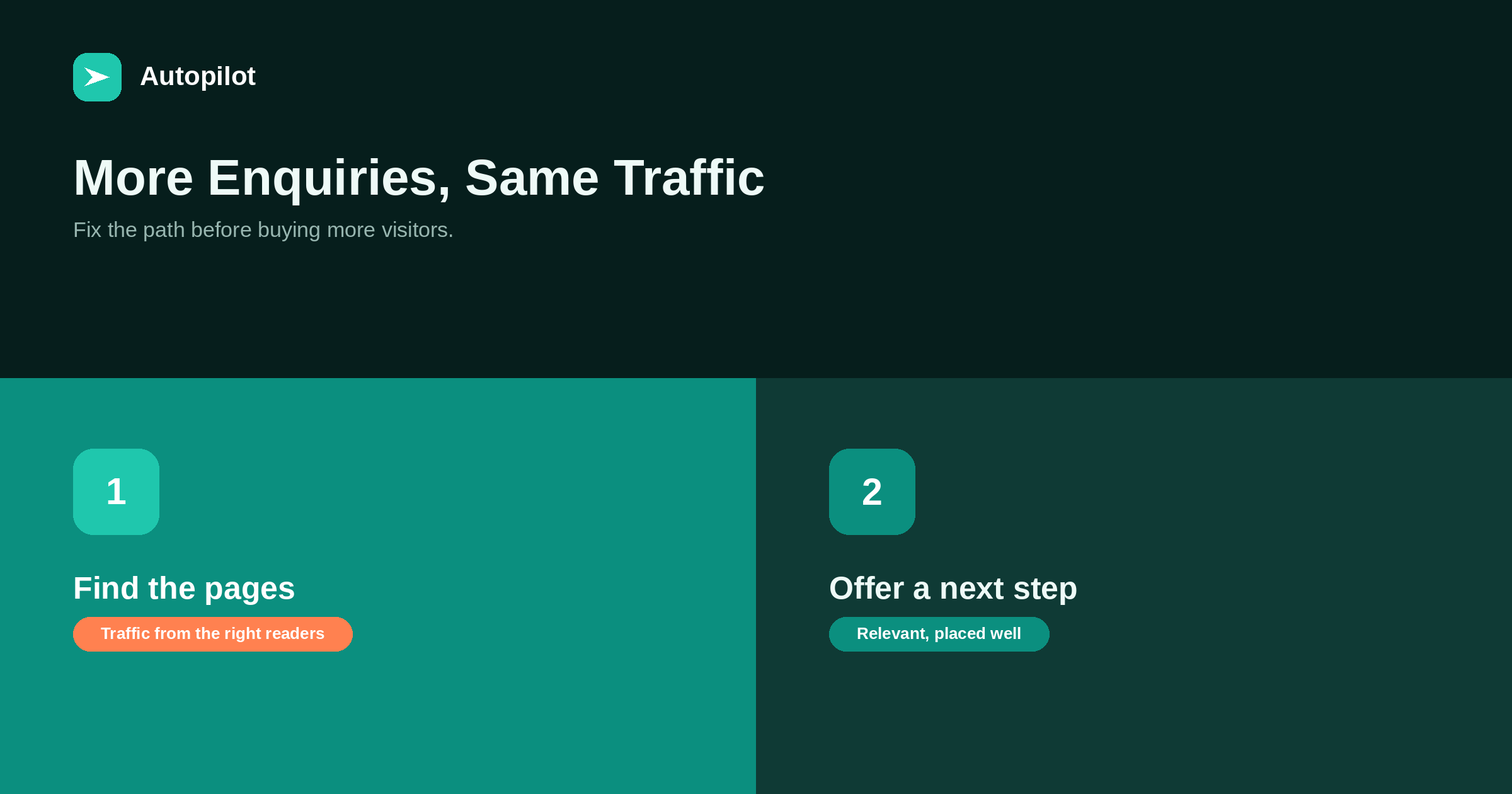
Short answer: start by finding the articles that already attract readers close to your offer, then check what those readers do next. Usually the answer is nothing, because the article offers no relevant next step, offers the wrong one, or buries it. Add one next step matched to the article’s subject and the reader’s stage, place it where the reader has just been helped, make the path from there to an enquiry short, and change one thing at a time so you can tell what worked. Doubling the rate at which readers act is often easier than doubling traffic.
When a blog is not producing enquiries, the instinct is to publish more and chase more traffic. Often the faster improvement is in what existing readers can do once they arrive.
Many business blogs have articles read by exactly the right people every month, with no clear way for those people to take a next step. Fixing that costs little and compounds across every future visitor.
Find the pages that matter
Not every article needs conversion work. Start with the ones that combine traffic with relevance to what you sell.
In your analytics, list articles by visits over the last three months. Mark each by how close its subject is to your offer: directly relevant, related, or unrelated. The directly relevant articles with steady traffic are where changes will matter most — usually a handful of pages.
Unrelated articles with high traffic are a different problem, covered in traffic against leads. Adding sales offers to them rarely helps.
See what readers do now
For each important article, look at what happens after the read.
| Signal | Where to look | What it tells you |
|---|---|---|
| Next page visited | Analytics, page path | Whether readers continue at all |
| Clicks on existing offers | Event tracking | Whether the offer is seen and wanted |
| Scroll depth | Analytics or heatmap | Whether they reach the offer |
| Enquiries from the page | Landing page reports | The outcome itself |
A common finding: most readers leave after the article without visiting anything else. That is the gap to close.
Offer a next step that fits
The next step should match both the article’s subject and how far along the reader is.
Someone reading how to choose between two approaches is close to a decision; a direct offer to talk, or a trial, fits. Someone reading a broad explanation is earlier; a related guide, a checklist or a newsletter fits better. A single generic book a demo button everywhere fits almost nobody.
calls to action that fit the article covers writing and placing the offer itself.
Place it where it is earned
An offer works best immediately after the reader has been helped — after the section that answered their question or solved the tricky step.
At the top of the article, before any help, it reads as advertising. Only at the very bottom, most readers never reach it. Mid-article, after a genuinely useful section, plus once at the end, is a pattern that suits most articles.
Shorten the path
Every step between reading and enquiring loses people. Check the path from the article’s offer to a submitted enquiry and count the steps.
- Does the offer link to a page that continues the same subject, or to a generic homepage?
- How many fields does the contact form ask for? Remove the ones you do not need.
- Does the form work properly on a phone?
- Is it clear what happens after submitting?
These are small fixes that affect every enquiry the blog will ever produce.
Change one thing at a time
If you change the offer, its position, the landing page and the form at once, and enquiries rise, you learn nothing about which change helped.
Change one thing, wait long enough for a meaningful number of visits — on a small blog that may be several weeks — and compare. Record each change and its result. With low traffic, formal split testing is often impractical; a careful before-and-after comparison, with seasonality in mind, is the honest alternative.
Internal links as conversion paths
Not every next step is an offer. Linking from an early-stage article to the more specific article a reader would need next keeps them on the site and moves them closer to a decision.
A broad explainer linking to a comparison, which links to a pricing page, is a conversion path built from ordinary internal links — internal linking as you publish covers doing this as you publish.
Keep it honest
Conversion work should make it easier for interested readers to act, not pressure uninterested ones. Pop-ups on arrival, fake countdowns and offers that do not match the article damage trust and are poor experiences on a phone.
No change guarantees a particular conversion rate; that depends on your market, offer and audience. What reliably helps is a relevant next step, well placed, with a short path behind it.
Related reading
If this was useful, these cover the questions that usually come next.
- Calls to action that fit the article — the offer itself
- Traffic against leads — why this matters more than volume
- Measuring whether a blog is working — setting up the measurement
The bottom line
Find the articles with traffic from readers close to your offer, see what those readers do next, and give them one relevant next step placed after they have been helped. Shorten the path to an enquiry, change one thing at a time, use internal links as a path, and avoid tactics that trade trust for clicks.
GYIK
How do I get more leads from my blog?
Start with articles that already attract relevant readers. Add a next step matched to each article’s subject and the reader’s stage, place it after the reader has been helped, and shorten the path to an enquiry.
Which blog posts should have calls to action?
Every article can have a next step, but conversion work matters most on articles with steady traffic that are directly relevant to what you sell.
Where should a call to action go in an article?
Immediately after a genuinely useful section, and once at the end. At the very top it reads as advertising; only at the bottom, most readers miss it.
How do I test changes on a low-traffic blog?
Change one thing at a time, wait several weeks, and compare before and after, allowing for seasonal effects. Formal split testing needs more traffic than most small blogs have.
Do pop-ups increase conversions?
They sometimes increase sign-ups while damaging trust and the mobile experience. A relevant offer placed in the article is usually better for a business blog.
Is it better to increase traffic or conversion?
Often conversion first: improving what current readers can do benefits every future visitor, and doubling a conversion rate can be easier than doubling traffic.