ENEnglish
 LTLietuviškai
 DEDeutsch
 FRFrançais
 RUРусский
 ESEspañol
 PLPolski
 ITItaliano
 UKУкраїнська
 CSČeština
 PTPortuguês
 JA日本語
 LVLatviešu valoda
 ETEesti
 HUMagyar
 IDBahasa Indonesia
 TRTürkçe
 HIहिन्दी
 ELΕλληνικά
 ARالعربية
 THไทย
 VITiếng Việt
 RORomână
 MSBahasa Melayu
 BNবাংলা
Short answer: A gym, yoga studio or fitness club can use AI Blog Autopilot to publish guides for beginners, seasonal motivation and answers to common questions, and to share each article to its social networks. Supply your classes, coaches and policies, keep health claims careful, review before going live and begin on Starter with eight articles a month.
Fitness businesses live on repeat visits and new sign-ups. January brings a rush, summer brings a different one and between them attendance drifts. The studios that fill their classes tend to be the ones that stay visible: they answer beginners’ questions, show who the coaches are and remind people why they started.
But a studio owner is also a trainer, a manager and often a cleaner. Writing a weekly article rarely survives a busy week. This guide shows how to use AI Blog Autopilot to keep a blog and social channels moving without taking time from classes. The product facts come from the home page, networks page and pricing page. Facts about your studio are yours to supply.
What people search for before they join
People who want to start exercising have worries. They ask whether they are fit enough, what to wear, what a first class is like, how much it costs, how often to go and whether classes suit their age or injuries. They compare studios by location, timetable, atmosphere and price.
An honest article that answers these questions removes the fear that stops people from booking. A guide titled what to expect at your first class, written in your voice, does more for sign-ups than a generic advertisement. It also shows search engines that your site covers the subject locally.
Existing members have questions too: how to progress, how to recover, how to fit training around work, what to eat on class days. Articles on these topics keep members engaged and give them something to share with friends. The article on Autopilot for local service businesses covers the common pattern for local businesses.
Topics that suit a studio
Start with beginners: first class guides, equipment explained, a four-week starter plan and how to choose between class types. Add seasonal topics: new-year routines, spring outdoor training, summer holiday maintenance and autumn restarts. Add profiles of coaches and classes, which help newcomers feel they know someone before they arrive.
Add practical guides: how to warm up, how to avoid common mistakes, how to build a home routine between classes and how to stay motivated. Add community content: member milestones, events and challenges, with consent from everyone mentioned. Add local touches such as nearby running routes and parks.
The home page says social-only mode creates tips, how-tos, product posts, questions and seasonal moments, each native to its network. Those categories fit a studio well: a tip for the week, a how-to for a movement, a post about a new class, a question for members and a seasonal push. The article on seasonal content planning helps you build a yearly plan.
Be careful with health and safety claims
Fitness content touches health, so accuracy matters. The home page says the writer is instructed never to make up statistics, quotes or sources, but you remain responsible for what is published under your name. Avoid medical claims, promises of results and advice on injuries or conditions beyond your qualification.
State in the brief that articles should not give medical advice, should suggest speaking to a doctor where relevant and should not promise weight loss or specific outcomes. Add your coaches’ qualifications, if you want them mentioned, and no others. Where an article discusses exercises, have a qualified coach read it before it goes live.
Different countries have different rules about health and advertising claims. Check what applies in your market, and keep the wording modest. The article on YMYL topics on a business blog explains why health content needs extra care.
Set up the brief and the networks
The home page says you give Autopilot topics with weight, keywords, audience and tone. For a studio, give the highest weight to the topics that bring new members: beginner guides and class explanations. Add a smaller weight to member content and general wellbeing.
Describe your audience in detail. A studio for new mothers, a powerlifting gym and a gentle yoga studio need different voices. Write the tone in a few words, such as welcoming, practical and encouraging, and list words to avoid, such as shaming language about bodies or weight.
Choose networks where your members already are. Many studios find Facebook and Instagram-style communities useful, while others use Telegram or Viber groups for class updates. Check the networks page for what is supported. It says each network gets its own text, length and timing, and that you connect each once in your account. Keep your name, address and timetable consistent on every profile.
A short weekly review
A studio needs a review habit that takes minutes. Choose a quiet time, such as Monday morning, and look at what is scheduled. Check the facts: class names, times, coaches, prices policy and any offers. Check the tone against your studio’s voice, and check that nothing sounds like medical advice.
Start with approval switched on, as the home page allows at any time. After a month or two, when articles need few changes, consider AUTO, the default. Even then, check the content map each week, the calendar and network matrix that the home page describes, to see that everything went out.
Share the work. A coach can check exercise content, the manager can check times and prices and the person who runs social media can look at the posts. The article on fact-checking AI content gives a routine you can adapt.
Plan, credits and results
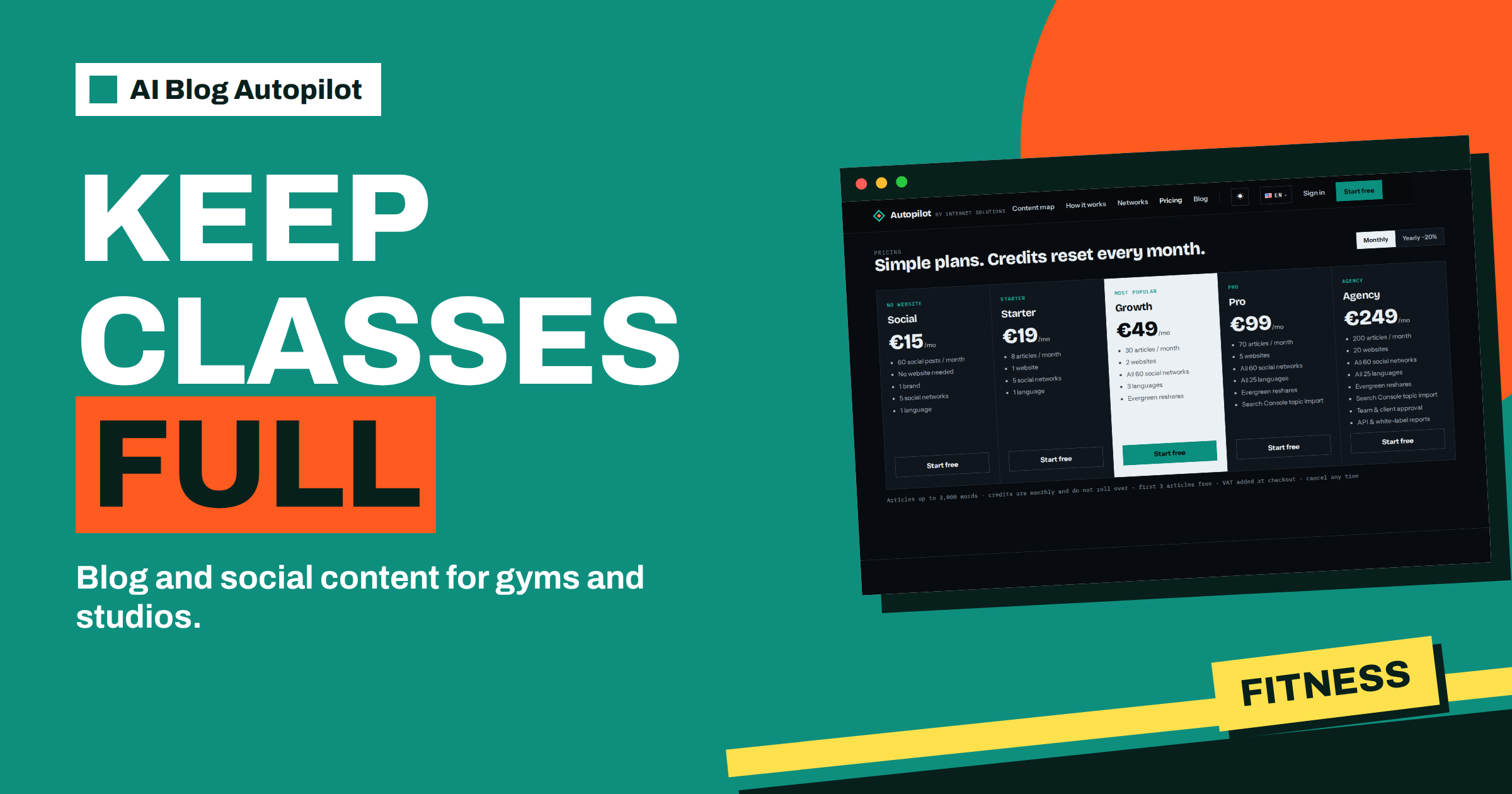
For most studios, Starter is the right start: 19 euros a month with 8 articles, 1 website, 5 social networks and 1 language, per the pricing page. If you have no website, Social at 15 euros offers 60 social posts a month. Credits reset every month and do not roll over, so plan to use them.
Measure in studio terms: trial class bookings, enquiries, sign-ups that mention an article and attendance on promoted classes. Ask new members how they found you and note the answers. Judge after three months, not three weeks, since search takes time to respond.
If an article about a first class brings several enquiries, give that topic more weight. If a topic brings nothing, reduce it. The article on choosing an AI Blog Autopilot plan helps you compare options when you grow.
Consider a short story. A small yoga studio has a simple website and a social page that gets an update when the owner remembers. She writes a brief with six topics: first class, choosing a class type, yoga for desk workers, breathing basics, recovery and seasonal retreats. She tells the product to avoid medical claims and to suggest asking a doctor about injuries. Her senior teacher reads every article for the first month and corrects two sequences. By the third month, the owner notices that new students often mention the first-class article, and the Monday morning review takes fifteen minutes.
The lesson is that the blog does its best work before the first visit. It answers questions in the studio’s own voice, so newcomers arrive less nervous and more likely to stay.
Using member stories and the community
Studios have something many businesses lack: a community. Members share progress, make friends and talk about their classes. Stories from that community make strong content, provided you have permission. Ask members whether they are happy to be mentioned, and use first names or initials if they prefer.
Put the stories into the brief as facts the writer can use, such as a class that started with five people and now fills two evenings, or a challenge that members completed together. Avoid exaggeration and never invent testimonials. A genuine small story is worth more than a polished invented one, and readers can tell the difference.
Encourage members to take part. A question post asking which class they would like added can bring dozens of replies, and the answers guide your timetable. When you act on a suggestion, say so in a later post. It shows that you listen, which is a good reason to join.
Handling the January rush and the summer dip
Fitness has a strong yearly rhythm. January and September bring new starters, summer brings travel and absences, and December brings a quiet spell. Use the brief to plan for it. In the weeks before a busy period, give more weight to beginner guides and trial offers. In quiet periods, give more weight to member content and ways to keep a routine.
Prepare early. Articles for January are best published in December, so that people searching for a new start find them first. Ask the product to favour those topics a few weeks ahead. The home page says Autopilot plans the month from your topics, so update the weights when the season changes.
Review your own figures from last year: which months brought new members, and which brought cancellations. Let the numbers guide your plan, and keep notes for next year.
Remember the practical side of timetables and offers. Class times, trial prices and holiday closures change, and an outdated post causes real frustration when someone turns up at the wrong hour. Keep one source of truth for times and prices, and update the fact sheet whenever they change. Where possible, link to your timetable page instead of repeating the times in each post.
Finally, keep your promises modest. A studio that says it will help people feel stronger and more confident in a few weeks is on safer ground than one that promises dramatic results. Honest, realistic language builds the kind of trust that keeps members for years.
How AI Blog Autopilot helps
The product writes the guides, adds FAQ, tags and SEO meta, runs a quality check and shares each article to your chosen networks with its own text and timing, so your attention stays on the people in front of you. Try it with the three free articles on AI Blog Autopilot, no card needed, and see the plans on the pricing page.
Related reading
- Autopilot for Local Service Businesses
- Seasonal Content Planning for a Business Blog
- YMYL Topics on a Business Blog: Health, Money and Legal Posts
The bottom line
A fitness studio should write for beginners first, keep health claims modest, give the product its classes and policies, let a coach check exercise content, begin on Starter with approval on and judge results by trial bookings.
GYIK
Is AI Blog Autopilot suitable for a small studio?
Yes. Starter lists 8 articles a month for 19 euros, and the Social plan works without a website.
Will articles give medical advice?
They should not. Say in the brief to avoid medical claims, and have a coach review exercise content.
Can I promote seasonal offers?
Yes, by adding them to the brief and checking the facts. Approval can be switched on to review each post.
Which networks suit a studio?
Choose where your members already are. The networks page lists social networks, messengers and team chats.
How long before it brings new members?
Search takes time. Judge after about three months using bookings and what new members mention.