ENEnglish
 LTLietuviškai
 DEDeutsch
 FRFrançais
 RUРусский
 ESEspañol
 PLPolski
 ITItaliano
 UKУкраїнська
 CSČeština
 PTPortuguês
 JA日本語
 LVLatviešu valoda
 ETEesti
 HUMagyar
 IDBahasa Indonesia
 TRTürkçe
 HIहिन्दी
 ELΕλληνικά
 ARالعربية
 THไทย
 VITiếng Việt
 RORomână
 MSBahasa Melayu
 BNবাংলা
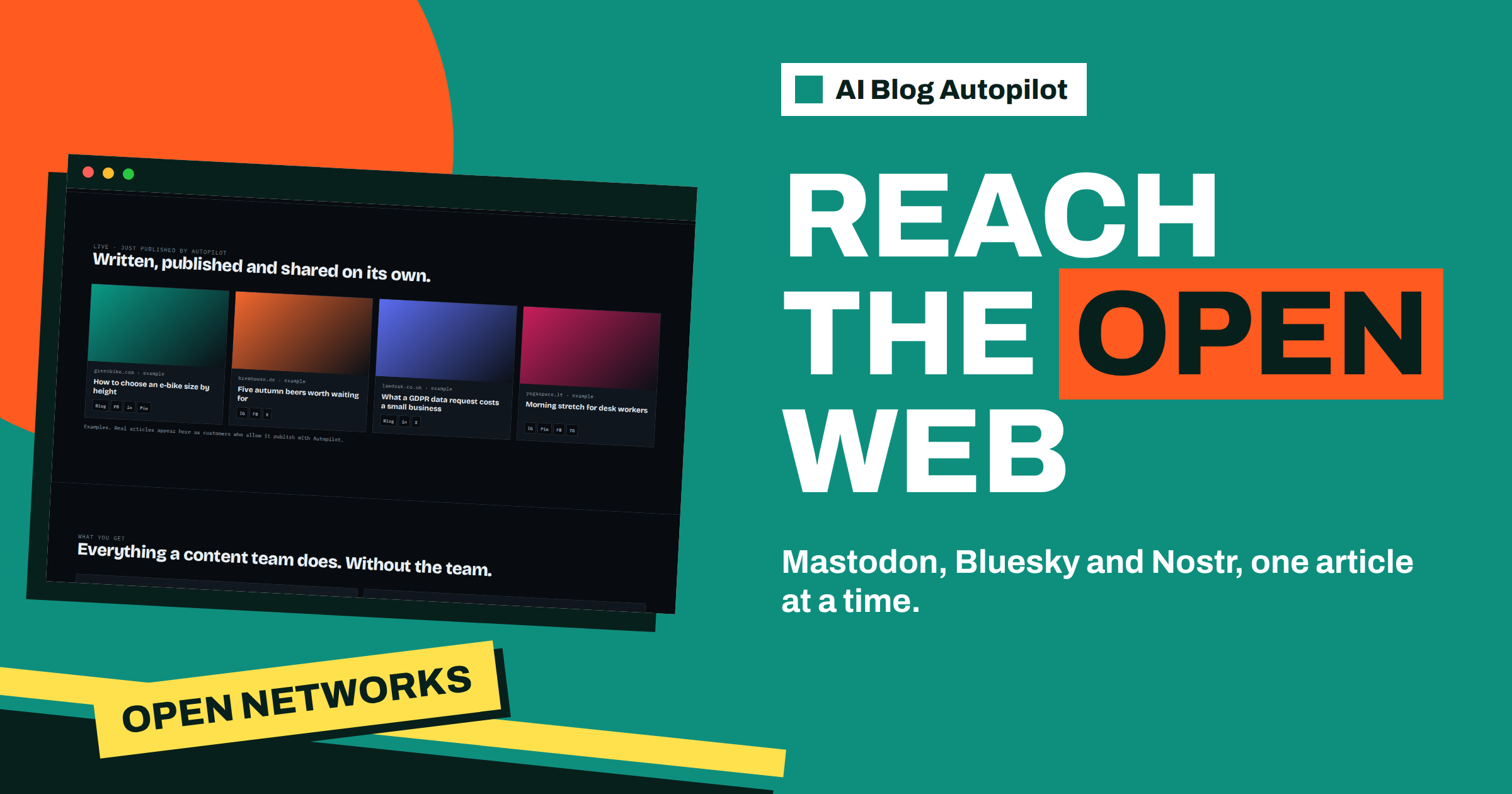
Short answer: The networks page of AI Blog Autopilot lists several open and decentralised networks among its social networks, including Bluesky, Mastodon, Misskey, Pixelfed, Nostr and Lemmy or PieFed. Each gets its own native post. They suit businesses whose readers value independence and privacy. Prepare real profiles, read each community’s rules and start with one network and a modest rhythm.
Social media is not only a handful of big names. Alongside them runs a growing set of open networks, where no single company owns the platform and people choose among many servers, or run their own. Their audiences are smaller, but they are often engaged, technical and wary of advertising.
This guide looks at the open networks on the AI Blog Autopilot list: what they are in plain terms, who should consider them, how to prepare and how to behave so that your posts are welcome. The product facts come from the networks page. For each network’s own rules, check the network itself, since communities set their own standards.
Which open networks are on the list
The networks page groups its supported networks by type. Under social networks it lists 15: Facebook, Threads, X, LinkedIn, Pinterest, Tumblr, Bluesky, Mastodon, VK, Misskey, Pixelfed, Nostr, Lemmy or PieFed, Draugiem.lv and Are.na. Several of these belong to the open or decentralised family.
Mastodon is a microblogging network made of many independent servers that can talk to each other. Misskey is a similar network with its roots in Japan. Pixelfed is a photo-sharing network in the same family, and Lemmy and PieFed are link-sharing and discussion platforms, like forums made of many communities. Nostr is a decentralised protocol where messages are signed with a key and relayed by many servers. Bluesky is another open-protocol network, with its own growing community.
The page also says you connect each network once in your Autopilot account and that no other tools are needed. That matters, because open networks are often awkward to automate by hand, with different servers and different login steps.
Who should consider open networks
These networks suit some businesses better than others. They fit software and technology companies, because many early users are developers and technical readers. They fit privacy-minded services, independent publishers, open-source projects, local communities, educators and creative people such as photographers and illustrators. They are less likely to bring quick sales to a mass-market shop.
The audience is usually smaller than on the big networks, but people there tend to read links and reply. A post that offers real information can do well, while a promotional post may be ignored or criticised. If your content is educational, honest and not pushy, you already write the kind of content these communities like.
Think about your goals. If you want brand reach among general consumers, the large networks come first. If you want trust among a technical or independent audience, open networks may be worth the small effort. The article on sharing blog posts on Bluesky, Threads and Mastodon gives a wider view of the audience.
How Autopilot writes for these networks
The networks page says Autopilot writes a separate text for every network. It gives examples: a short hook for X and Bluesky, a professional post for LinkedIn, a summary with bullet points for Telegram and a headline and summary for team chats. For open networks, the principle is the same: a post that suits the place, not a pasted link.
Short networks need a hook that fits a small space and makes a reader curious. Community networks such as Lemmy suit a clear headline and a brief description of why the article matters. Photo networks such as Pixelfed centre on images, so check that your articles have visuals worth sharing. The article on social media character limits lists the sizes to expect.
Timing follows the same logic as for other networks. The home page says that after your blog goes live, each network gets its post with its own delay, so every audience sees it when it is most active. You do not need to schedule each one by hand.
Prepare real profiles first
Open networks value authenticity, so set up your profile properly before posting. Use a clear name, a short description of what you do, a link to your website and an avatar that people recognise. Where servers exist, choose one with a sensible reputation and read its rules before joining. Some servers welcome businesses, while others restrict promotion.
Say who runs the account. A line such as “Posts from the team at…” tells readers they are speaking to a business, and builds trust. Avoid pretending to be an individual if the account is automated. Honest labelling is the norm on these networks, and breaking it can lead to blocks.
Consider a few human touches. Reply to comments when you can, follow people in your field and join conversations that are not about your articles. Autopilot handles the regular posts, but a profile that only broadcasts looks cold. The article on consistent social profiles offers a checklist for names, images and descriptions.
Read the rules and respect the community
Each server, community or relay has its own rules. Some ban automated posting unless the account is labelled as a bot. Some limit how often you can post links. Some prefer content warnings for certain topics. A few ask that businesses use a specific kind of account. Read the rules before you connect, and follow them.
Respect the culture. Open networks often grew out of a wish to escape advertising and tracking, so a loud sales pitch is out of place. Share something useful, such as a guide, a data point or an honest comparison, and let readers decide. If someone asks a question, answer it.
If a community asks you to stop or to change how you post, do so politely. A small audience that trusts you is worth more than a large one that resents you. The home page says approval can be switched on at any time, which helps while you learn what each community expects.
Start small and measure
Do not connect every open network at once. Pick one or two that match your readers, for example Mastodon and Bluesky for a technology business, or Pixelfed for a photographer. Run them for eight to twelve weeks before you decide whether to add more.
Measure with simple signs: visits to your site from each network, replies, shares and any enquiries that mention the post. The content map, which the home page describes as a calendar and a network matrix, shows each article and each post and links every cell to the live post. Open the posts and read the replies, since the comments tell you what readers think.
Review the results quarterly. If a network brings readers, keep it and consider giving it more attention. If it brings nothing, disconnect it and note why. The list of networks keeps growing, as the networks page says, so you can try another later.
Consider a short story. A small company sells open-source monitoring tools. Its customers are system administrators, many of whom use Mastodon and Bluesky. The company connects both networks in its Autopilot account, labels the profiles as run by the team and reads each server’s rules. Its articles on monitoring practice appear on the blog, and a few minutes later a short post appears on each network. In the first two months, Mastodon brings a handful of thoughtful visitors a week, and a few replies lead to ideas for new articles. Bluesky is quieter, so the team keeps it but gives it no extra effort.
The lesson is that open networks reward the right fit. For this company, where its readers already gather, a modest and honest presence works better than a loud one.
Handling replies and mentions
On open networks, a post is the start of a conversation. People reply, ask questions, correct details and sometimes disagree. Decide in advance who will read replies and how quickly they will answer. A weekly look is the minimum; a daily glance is better in the first months. Autopilot publishes the posts, but only a person can hold the conversation.
Answer politely and briefly, and thank people who point out a mistake. If a reply raises a good question, it may deserve its own article, so keep a short list of questions that come up. These make excellent topics for the next brief, and they show readers that you listen.
Be careful with criticism. Do not argue in public. Fix real errors, explain calmly when a reader has misunderstood and ignore trolls. On small networks, reputation travels fast, in both directions, and a patient answer is remembered.
Privacy and control
Many people choose open networks because they value control over their data. Respect that in how you behave. Do not collect or share personal details from replies, do not tag people without reason and do not add readers to lists without consent. A business that treats the audience’s privacy carefully fits the culture.
Think about your own control as well. Your account on an open network lives on a server run by someone else, or by you. If the server closes or changes its rules, you may need to move. Keep a note of your handles, and make sure your website links to each profile, so readers can find you if you change address. Keeping the home base on your own domain is the safe choice.
The home page says approval can be switched on at any time, and that AUTO is the default. For open networks, many businesses start with approval for a few weeks, read the posts together with the first replies and move to AUTO once they understand how the community responds.
How AI Blog Autopilot helps
The product lists open networks beside the large ones and writes a native post for each, with its own text and timing, so a small audience does not mean extra work. Try it with the three free articles on AI Blog Autopilot, no card needed, and see the plans on the pricing page.
Related reading
- Bluesky, Threads and Mastodon: Sharing Blog Posts There
- How Autopilot Writes for Each Network
- Social Media Character Limits: What to Expect
The bottom line
Use the open networks on the list when your readers are technical, independent or privacy-minded: prepare honest profiles, read each community’s rules, start with one or two networks, keep posts useful and measure before adding more.
GYIK
Which open networks does Autopilot list?
The networks page lists Bluesky, Mastodon, Misskey, Pixelfed, Nostr and Lemmy or PieFed among its social networks.
Do I need special tools to connect them?
The networks page says you connect each network once in your Autopilot account and no other tools are needed.
Will every network get the same text?
No. Each network gets its own text, length and timing.
Are open networks right for every business?
Not always. They suit technical, independent and privacy-minded audiences better than mass-market shoppers.
Can I check posts before they go out?
Yes. Approval can be switched on at any time, and AUTO is the default.