ENEnglish
 LTLietuviškai
 DEDeutsch
 FRFrançais
 RUРусский
 ESEspañol
 PLPolski
 ITItaliano
 UKУкраїнська
 CSČeština
 PTPortuguês
 JA日本語
JA日本語 LVLatviešu valoda
 ETEesti
 HUMagyar
 IDBahasa Indonesia
 TRTürkçe
 HIहिन्दी
 ELΕλληνικά
 ARالعربية
 THไทย
THไทย VITiếng Việt
 RORomână
 MSBahasa Melayu
 BNবাংলা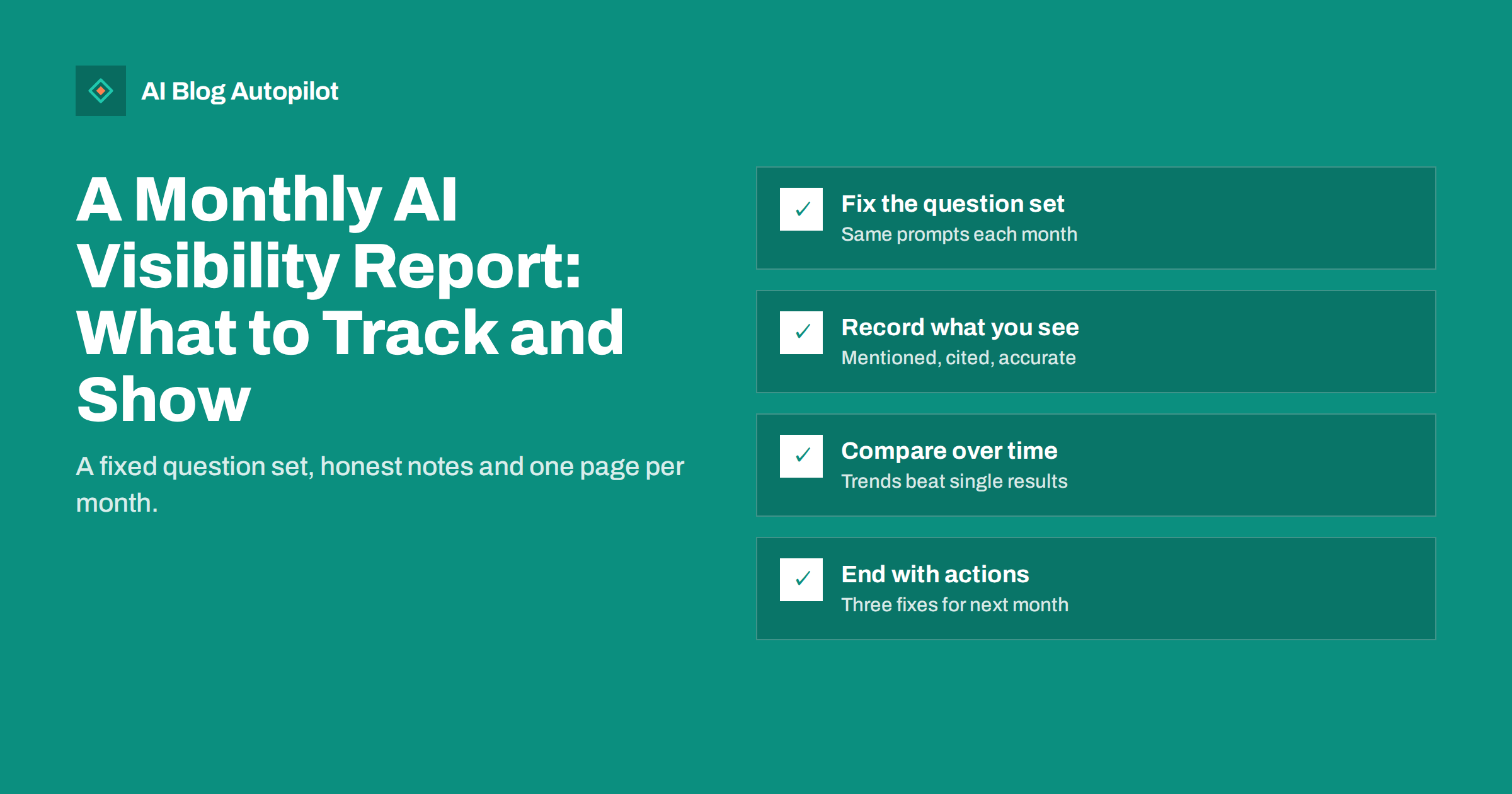
Short answer: a useful monthly AI visibility report is small and repeatable. Choose a fixed set of questions your customers really ask, run them on the same assistants each month, and record whether your business is mentioned, whether your site is cited, whether the description is accurate and which competitors appear. Add the traffic that reaches you from AI assistants, note changes you made, and finish with three actions for the next month. Treat single results with caution, because answers vary from run to run.
Many businesses want to know whether AI assistants talk about them, and few have a routine for finding out. Checking once and feeling pleased or worried is not a method. A short monthly report turns scattered impressions into a record you can compare, share with colleagues or clients, and use to decide what to fix. This article describes what to put in the report, how to collect the data honestly, and how to present it without overclaiming.
What the report is for
Before building anything, decide what decisions the report should support. Typical purposes are:
- Awareness: are we mentioned at all for the questions our customers ask?
- Accuracy: when we are described, are the facts right, such as what we do, where we work and what we charge?
- Sources: which pages of ours are cited, and which other sites are cited instead?
- Action: which content changes should we make next?
The report is not a ranking table. There is no single position to track, as with a classic results page, and answers differ by assistant, wording, location and time. The value lies in trends and in the specific errors you can correct.
Build a fixed question set
The question set is the backbone of the report. If it changes every month, you cannot compare months. Start with fifteen to thirty questions and keep them stable, adding new ones only deliberately and noting the date.
- Category questions: “What is the best way to do X?” or “Which tools help with Y?” These show whether you appear when the customer has not named you.
- Problem questions: the questions customers ask before they know a solution exists, in their own words.
- Comparison questions: “A versus B” and “alternatives to C”, including the competitors you are compared with.
- Brand questions: “What is [your brand]?”, “Is [your brand] good for Z?” and “How much does [your brand] cost?” These test accuracy.
- Local or niche questions, if relevant, with the place named.
Take the wording from real sources: your support inbox, sales calls, the search box on your site and the queries in Search Console. Group the questions by theme so that the report can show strengths and gaps.
Decide how to collect results fairly
Assistant answers are not identical each time, and some depend on whether the user is signed in, where they are and what was said earlier in the conversation. You cannot remove that variation, but you can limit it.
- Use the same assistants each month, and list them in the report.
- Start a new conversation for each question, with no earlier context.
- Use the same wording, device type and approximate location.
- Run each important question more than once, for example three times, and record how often you appear.
- Save the answer text and the cited links, with the date, so you can check later what was said.
- Record the settings, such as whether live web search was on, since it changes the behaviour.
If you do this for a client, tell them plainly that results vary and that the report shows patterns, not guarantees. Do not use automated scraping that breaks the terms of a service. Manual collection takes a little time and is acceptable at this scale.
The columns that matter
A spreadsheet with a row per question and per assistant is enough. Keep the columns few and clear.
- Question and theme.
- Assistant and date.
- Mentioned? Yes, no or partly, with how many of the runs mentioned you.
- Cited? Whether a link to your site appeared and which page.
- Accurate? Correct, partly wrong or wrong, with a short note on what was wrong.
- Position or prominence, if a list was given: first, among several, or last.
- Other brands and sources named, which shows who you compete with for attention.
- Notes, such as the tone, a missing fact or an out-of-date price.
Summarise the sheet in a few numbers: the share of questions where you were mentioned, the share where you were cited, the number of inaccurate statements and the pages cited most. Show the previous month beside the current one. Avoid decimals that suggest false precision when the sample is small.
Add traffic and business signals
Visibility in an answer is only part of the story. Add the data you already have, and label it as indirect.
- Visits from AI assistants, where your analytics can identify the referrer. Some visits arrive without a referrer, so treat this as a lower bound.
- Search Console impressions and clicks for the pages you have been improving.
- Brand searches, which often rise when people hear of you in an answer.
- Enquiries or signups that mention an assistant, if you ask customers how they found you.
Be careful about causation. A rise in brand searches may come from many causes, and you should say “alongside” instead of “because of”. The report earns trust when it is modest about what it knows.
Turn findings into actions
A report that ends with charts and no decisions will be forgotten. Finish with a short list of actions, ideally three, ranked by likely effect and effort.
- Fix wrong facts: if an assistant states a wrong price, update your pricing page clearly and check external listings that show the old figure.
- Fill content gaps: if you never appear for a category question, plan a page that answers it directly.
- Strengthen cited pages: the pages that are already cited deserve updates and clear structure.
- Improve technical access: if your pages seem not to be read, check that crawlers are not blocked by accident.
- Earn mentions: where competitors are mentioned because of reviews or articles on other sites, consider honest ways to be included.
At the next report, start by reviewing the previous actions and say whether they were done and what changed. That closing of the loop is what makes the report useful.
Presenting the report to a client or manager
People who read the report may not know how these assistants work, so add two lines of plain explanation at the top: what was tested and why results can differ from run to run.
Keep it to one or two pages. A headline summary comes first: what improved, what got worse and what you recommend. Then show the key numbers against last month, three examples of answers worth reading in full, and the action list. Put the detailed spreadsheet in an appendix for those who want it.
Avoid promises such as “we will get you into every answer”. No one controls these systems. Say what you can influence, namely clarity of your content, accuracy of your facts, the sources you earn and the structure of your pages, and report honestly on the rest. A calm, regular report builds more confidence than a dramatic one. If there is nothing new to report in a month, say so in a sentence and keep the series unbroken; a gap in the record is worse than a quiet month. Agree in advance who reads the report, who owns the actions and when the next review will take place.
A small example of one month’s findings
Suppose a regional tool-hire company tracks twenty questions across three assistants. In the first month the report shows that the company is mentioned in six of twenty category questions, cited in three, and described incorrectly twice: one assistant states an old delivery area and another lists a service the company stopped offering. Two competitors appear in most answers, usually because of a comparison article on a third-party site.
The actions that follow are concrete. The company rewrites its delivery page with the current area and the date it was checked. It removes the discontinued service from its own pages and from two directory listings it controls. It plans an honest comparison page that explains how its terms differ from competitors. In the second month the report shows mentions in nine of twenty questions and no inaccurate delivery statement, and traffic from assistants is still small but visible. The company cannot prove that its actions caused the change, and the report says so; it simply records what was done and what was observed.
This kind of record has another benefit: it shows where nothing changed. A question that never produces a mention after several months may be one where the business does not belong, or where the content needs a different approach. Knowing which is which saves effort.
Keep earlier reports. After half a year, the series itself becomes evidence of what worked, and it makes it easier to explain the work to a colleague, a client or a new team member who joins later.
How AI Blog Autopilot helps
AI Blog Autopilot writes full SEO articles with FAQ, tags and meta for your WordPress blog and shares them to your social networks, which helps you fill the content gaps your monthly report reveals. The report itself, and the judgement about what it means, stay with you. See the pricing page for plans.
Related reading
- Checking Whether AI Assistants Mention Your Blog
- How to Measure Whether a Blog Is Working
- Running Blogs for Clients as an Agency
- When AI Answers Get Your Business Wrong: What to Do
The bottom line
A monthly AI visibility report works when it is small, stable and honest. Fix your question set, collect answers in the same way, record mentions, citations and accuracy, add indirect traffic signals and end with a short action list. Compare months, not single results, and be modest about causes. In a short time you will know where you appear, where you are misdescribed and what to write next.
GYIK
How many questions should the report cover?
Fifteen to thirty is a manageable start. Keep them stable so that months can be compared, and add new ones deliberately.
Why do I get different answers to the same question?
These systems vary by wording, settings, location and run. That is why you repeat important questions and look at patterns instead of single results.
Can I automate the collection?
Be careful. Some services forbid automated queries in their terms, so check the rules. Manual collection is enough for a small monthly set.
Should I report AI visits as a firm number?
Treat it as a lower bound, because many visits arrive without a referrer. State clearly how the figure was measured.
What if the assistant says something wrong about my business?
Make the correct fact easy to find on your own site, check listings you control and re-test the question in the next report.