ENEnglish
 LTLietuviškai
 DEDeutsch
 FRFrançais
 RUРусский
 ESEspañol
 PLPolski
 ITItaliano
 UKУкраїнська
 CSČeština
 PTPortuguês
 JA日本語
 LVLatviešu valoda
 ETEesti
 HUMagyar
 IDBahasa Indonesia
 TRTürkçe
 HIहिन्दी
 ELΕλληνικά
 ARالعربية
 THไทย
 VITiếng Việt
 RORomână
 MSBahasa Melayu
 BNবাংলা
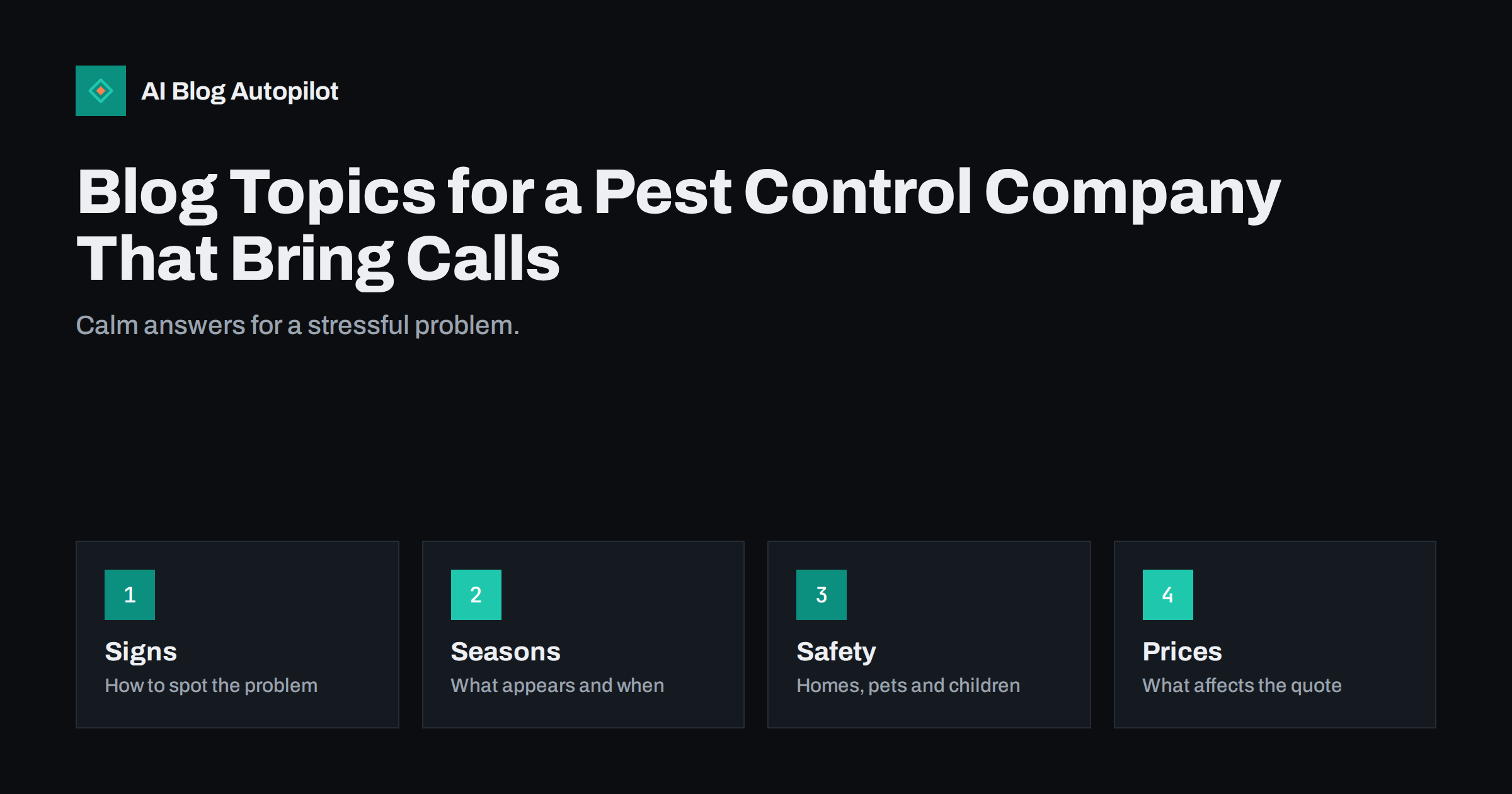
Short answer: a pest control company should blog about what people search when they find something in their home or business: how to recognise common pests, what time of year each appears, what is safe to try first, when to call a professional, what the visit involves and what affects the price. Write calmly, name your region, never promise that a pest will vanish, and leave dosing and chemical details to the product label and the technician.
Almost nobody reads about pests for fun. They read because they saw droppings, heard scratching, found bites or noticed a nest on the roof. They are disgusted, worried or embarrassed, and they want a clear answer fast. A company that has already published a calm, practical page is found at that exact moment and is trusted before the first call.
This guide groups topics by reader intent, explains how to use seasons and local conditions, and describes how to write about safety and prices without causing alarm or making promises you cannot keep. Check the licensing and advertising rules in your country before you publish.
Start with signs and identification
The first question is almost always what is this. Write one page per common problem in your area, such as ants, mice, rats, cockroaches, wasps, bed bugs, fleas, moths or pigeons. For each, show how to recognise the signs, where they are usually found, how they differ from similar things and how to take a clear photograph for a quote.
Use your own photographs where you can. Real images of droppings, nests or damage are far more useful than stock pictures, and they make the page stand out. Add short captions and descriptive alt text. Where a species is protected or must be handled only by trained people, say so plainly, so that readers do not take risks.
Be careful not to diagnose. Say what the signs often mean and what else could cause them, and invite readers to send a photo or book an inspection. A page that sounds certain about something it cannot see is a liability.
Do not forget prevention. Pages on how to keep pests out are among the most shared, and they bring readers who are not yet in trouble. Cover sealing gaps, storing food, managing waste, fixing leaks, trimming plants near walls and checking deliveries and second-hand furniture. Present them as a short checklist with a printable version, and invite readers to book an inspection if they find signs.
Follow the seasons
Pest problems follow the calendar, and so should the blog. Wasps and ants in summer, rodents moving indoors in autumn, moths in spring, bed bugs after holidays and travel. Make a twelve-month plan with the topics that matter in your area, and publish each a few weeks before the peak, when people begin to search.
Update the same page each year rather than creating a new one, and show the date of the last check. The guide on planning seasonal content without scrambling every year explains how to keep a simple calendar. Combine this with local weather: a mild winter or a very wet spring changes what customers see, and a short note about it makes the page feel alive.
Mention business and property types as well. A restaurant, a care home, a warehouse and a block of flats face different risks and rules. A page for each audience, written with its concerns in mind, brings more relevant enquiries than one general text.
Add a page about common myths. Many people believe that a clean home cannot have pests, that ultrasonic gadgets always work or that a single treatment always finishes the job. Correcting such beliefs politely, with evidence or a reference to official guidance, helps readers and makes the company look knowledgeable. Avoid shaming anyone, since embarrassment is already a barrier to making the call.
Write about monitoring and records too. Commercial customers such as restaurants, food producers and care homes need documented visits, reports and advice on prevention. A page that describes what is recorded, how reports are shared and how problems are escalated attracts business clients, who value reliability above price.
Explain what you do and what happens on the day
Customers fear the unknown. Describe the visit step by step: the phone call, the questions you ask, the inspection, the proposed plan, the treatment, the advice for afterwards and the follow-up. Say how long a typical visit takes, what the customer should prepare and whether anyone needs to leave the premises.
Explain methods in general terms. Prevention, exclusion, traps, baits and sprays all have roles, and explaining why one is chosen over another shows expertise. Avoid exact product names, quantities and mixing instructions, which belong in training and on labels, and avoid encouraging readers to attempt risky treatments themselves.
Describe guarantees honestly. If you offer follow-up visits, say what they cover and for how long. Do not claim that a problem will be solved permanently, because conditions outside your control may bring it back. Explaining what the customer can do to help, such as sealing gaps, storing food and fixing leaks, makes the result more likely and shows you care.
Explain what customers can do to prepare, in a short list that can be saved on a phone: clear access to the areas to be treated, secure food and dishes, cover fish tanks if the technician advises it, keep pets and children away for the stated time and follow the instructions given on the day. Such a list is practical, easy to share and shows that safety is part of the service, not an afterthought.
Write about safety for people, pets and the environment
Safety is the biggest concern after the pest itself. People ask whether a treatment is safe for children, pets, fish, food areas and bees. Answer in general terms: describe how products are chosen and applied, how long areas may need to stay empty, and what you do to protect people and the environment. Say that the technician will give instructions for each visit.
Link to official guidance where it exists, name the country and the year, and avoid claims such as completely safe or non-toxic unless they are verified and allowed in advertising where you work. Rules on biocides and on the wording of claims are strict in many places. When unsure, ask the regulator or your insurer.
Include a page about what to do in an emergency, such as an allergic reaction to a sting or a suspected poisoning, but keep it brief and point to local emergency numbers and medical advice. Add the notice style described in disclaimers and notices on a business blog, making clear that the page is general information.
Think about trust signals that suit the trade. Show real licences and memberships with years and links, describe how technicians are trained and equipped, and explain how you handle complaints. Avoid vague claims such as the best in town. The guide on using evidence in marketing content shows how to back every statement with something a reader can check. Keep copies of certificates and letters, and update the page when a licence is renewed or a membership ends.
Be honest about prices and timing
Price is a common search, and many companies avoid it. You do not need a price list, but you can explain what affects a quote: the pest, the size of the property, the severity, the access, the number of visits and any repair or proofing work. Give an example of how a quote is built without promising a figure.
Describe how fast you can respond, and be clear about the difference between an emergency call and a standard booking. If prices differ at night or on weekends, say so. A page that treats the customer as an adult reduces disputes later, and the structure suggested in writing honest articles about what things cost works well for this topic.
Include a section about what is not included and about situations where you advise the customer to contact another trade, for example a roofer or a drainage specialist. Referring a customer elsewhere when it is the right thing builds a reputation that no advertisement can buy.
Finally, write about the aftermath. After a treatment, customers wonder what is normal: why they still see a few insects for days, when to clean, when to call again and how to prevent a return. A calm page on what to expect in the first two weeks answers the questions that otherwise become anxious phone calls, and it gives satisfied customers something to share with neighbours.
Show local knowledge and make calling easy
Pest control is local. List the towns and districts you cover, and write about what is typical there: older buildings with gaps under the eaves, riverside areas, farmland nearby or dense apartment blocks. A page with local observations helps readers feel that you know their situation. The article on location pages for several branches explains how to give each town its own substance instead of copying the same text.
Make the next step obvious on every page: a phone number, a short form or a way to send a photo, with a line that says what happens next and when you will respond. Keep opening hours, address and service areas identical on the site and in your business profile. The guide on reusing blog posts in a business profile shows how to share seasonal posts locally.
Compare your plan with the topics in a blog for a construction or home services company and a blog for a groomer, kennel or pet shop, since many readers move between these trades, and link to them where it truly helps the reader.
How AI Blog Autopilot helps
AI Blog Autopilot can write and publish articles on your chosen topics, with FAQ sections, tags and SEO meta, and share them to your social networks. Give it your services and your area, and have a qualified technician check every safety statement, method and price before each article goes live. See the pricing page for plans and monthly credits.
Related reading
- Blog Strategy for a Local Business
- A Blog for a Construction or Home Services Company
- Turning Customer Questions Into Useful Blog Topics
The bottom line
Answer the first worried questions calmly, follow the seasons, explain safety and prices honestly and make calling or sending a photo easy.
FAQ
What should a pest control company blog about first?
Start with the common pests in your area, how to recognise the signs, what is safe to try and when to call a professional.
Should I give do-it-yourself treatment instructions?
Keep it general and point to product labels. Detailed dosing and mixing advice can be unsafe and may breach local rules.
Can I say a treatment is completely safe?
Only if it is verified and allowed in advertising where you work. Prefer describing precautions and following official guidance.
Should I publish prices?
You can give ranges with conditions and a date. If not, explain what affects the quote and how to request one.
How often should seasonal pages be updated?
Once a year before the peak, with the date of the last check shown on the page.