ENEnglish
 LTLietuviškai
 DEDeutsch
 FRFrançais
 RUРусский
 ESEspañol
 PLPolski
 ITItaliano
 UKУкраїнська
 CSČeština
 PTPortuguês
 JA日本語
JA日本語 LVLatviešu valoda
 ETEesti
 HUMagyar
 IDBahasa Indonesia
 TRTürkçe
 HIहिन्दी
 ELΕλληνικά
 ARالعربية
 THไทย
THไทย VITiếng Việt
 RORomână
 MSBahasa Melayu
 BNবাংলা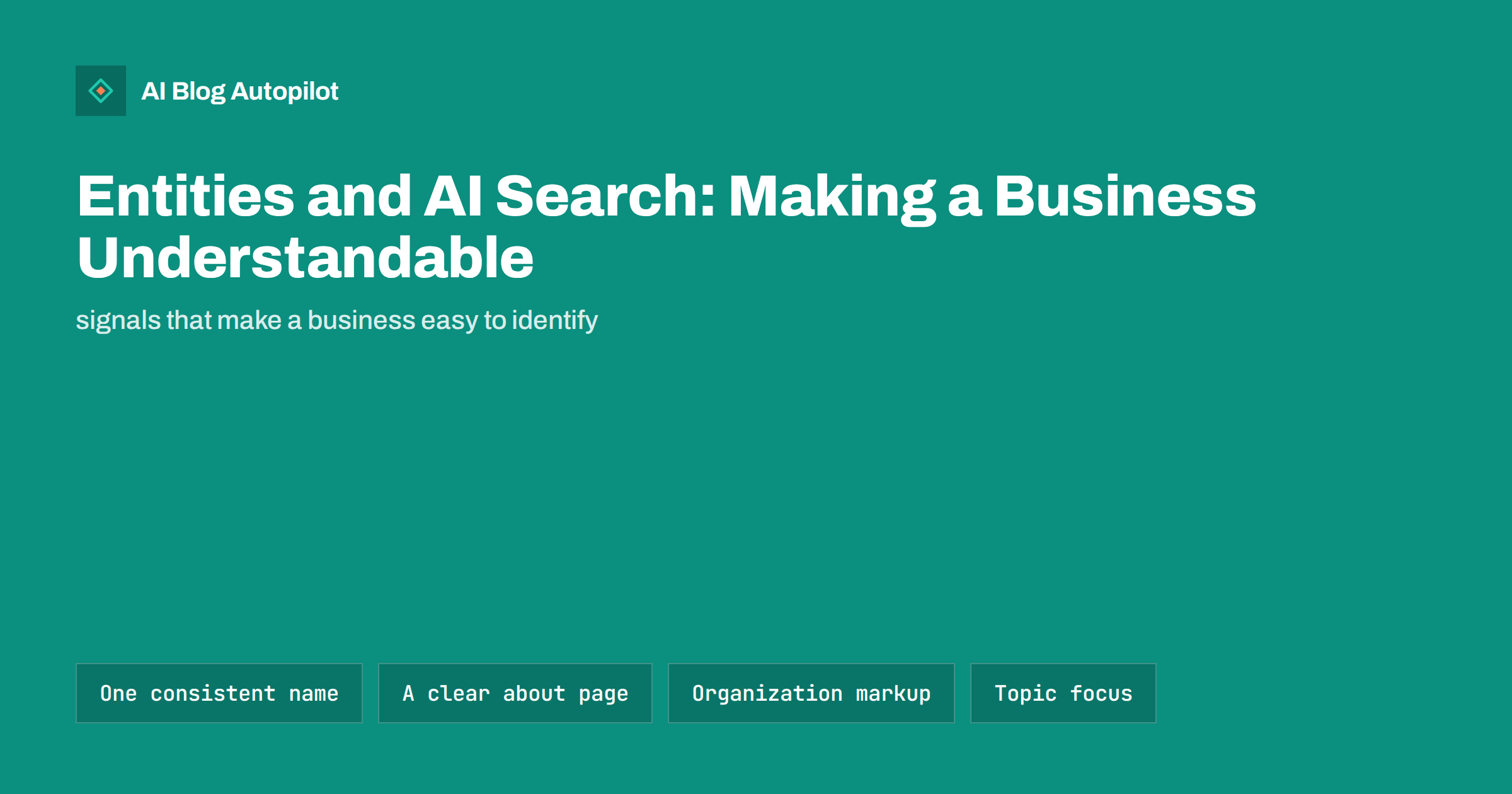
Short answer: an entity is a distinct, identifiable thing, such as a business, person, product or place, that search engines and AI systems can recognise and connect to facts. When your business is a clear entity, with a consistent name, a detailed about page, Organization structured data and matching profiles elsewhere, systems can describe it correctly and connect your content to it. A blog helps by covering your core topics in depth, so your business becomes associated with them. None of this guarantees mentions in AI answers, but vague or inconsistent information makes accurate mentions much less likely.
Classic SEO was built around keywords: the words people type and the words on your page. Modern search and AI assistants still use words, but they also build a model of things in the world and the relationships between them. Your business is one of those things.
If that model is clear and accurate, answers about your field are more likely to describe you correctly. If it is fuzzy, with three versions of your name, no clear description of what you do and conflicting details across the web, systems have to guess, and they may guess wrong or leave you out.
What an entity is
An entity is something that exists as a distinct thing and can be described with facts: a company, a person, a book, a city, a software product, a concept. Entities have attributes, such as a founding date, a location or a price, and relationships, such as “founded by”, “located in” or “is a type of”.
Search engines have long maintained large databases of entities, often called knowledge graphs, which power things like information panels. AI assistants learn about entities from the text they are trained on and, when they search the web, from the pages they retrieve. In both cases, a business that is described clearly and consistently is easier to recognise.
A keyword is a string of letters. An entity is the thing the string refers to. “Apple” the fruit and “Apple” the company share a keyword but are different entities; context tells systems which one a page is about.
Why entities matter more in AI search
When an AI assistant answers a question such as “which tools help small bakeries manage orders” or “who offers bookkeeping for freelancers in Vilnius”, it is not matching a keyword to a page. It is trying to identify relevant entities and say something true about them.
That creates a few practical consequences for a business:
- Being recognisable matters. If systems cannot tell what your business is and does, they cannot recommend or describe it.
- Consistency matters. Conflicting details, such as different descriptions, addresses or names across sites, make it harder to be confident about any of them.
- Association with topics matters. A business that publishes clear, accurate content about a subject is more likely to be connected with that subject.
- Accuracy is not guaranteed. AI answers can be wrong. Clear information on your own site gives the best chance that what they say is correct.
Start with a consistent name and description
The simplest entity signal is also the one most often broken: using the same name for the business everywhere.
- Pick one form of the name and use it on your site, in your logo text, in structured data, on social profiles and in directory listings. If you have a legal name and a brand name, show both clearly on the about page and say how they relate.
- Write a one-sentence description of what the business does, for whom and where. Use it, or a close version, as the basis for your about page opening, social profile bios and directory descriptions.
- Keep key facts identical across places: address, phone, founding year, main service areas. A mismatch between your site and a directory is exactly the kind of conflict that causes confusion.
This is not a trick. It is the same information a new customer or a journalist would want, stated the same way wherever they look.
Make the about page do real work
Your about page is the main place where your site describes the business as an entity. Many about pages are vague mission statements. A useful one answers concrete questions:
- What is the business called, and what does it do, in plain words?
- Who runs it, and what is their relevant experience?
- Where is it based, and where does it operate?
- When was it founded, and what has it done since?
- What products or services does it offer, and for whom?
- How can someone contact it, and where else does it have official profiles?
Write these as normal sentences, not a list of buzzwords. A reader, a search engine and an AI system all benefit from the same clarity.
Author pages work the same way for people. If your blog posts are written or reviewed by named experts, a short page for each, with their role and background, helps connect the content to real expertise.
Add Organization structured data
Structured data describes facts in a machine-readable format. For a business, the most relevant type is Organization, or a more specific subtype such as LocalBusiness. Its properties are listed at schema.org/Organization, and Google explains which ones it uses in its organization structured data guide.
The useful basics for most businesses are:
- name and, if relevant, legalName.
- url: your homepage.
- logo: a stable image URL.
- description: a short factual description.
- sameAs: links to your official profiles on other sites, such as social networks or a business registry. This property explicitly says “these profiles are the same entity as this site”.
- address and contactPoint, where appropriate.
Most SEO plugins for WordPress let you fill these in once, and they output the markup on your homepage. Check the result with a structured data testing tool, and make sure every value matches what the visible pages say. Markup that contradicts the page is worse than none.
Keep off-site profiles in line
Entities are understood partly through what other sources say. You cannot control the whole web, but you can keep your own footprint consistent:
- Official social profiles with the same name, description and link to your site.
- Business directories and maps listings relevant to your field and country, with identical details.
- Industry associations, marketplaces or partner pages that list you, kept up to date when something changes.
- Press mentions and interviews, where you can ask for the correct name and link.
You do not need to be everywhere. A handful of accurate, official profiles that clearly match your website is more useful than dozens of half-finished listings with outdated details.
When details change, such as a move or a rebrand, update these places together rather than letting old versions linger for years.
Use your blog to build topical association
Entity clarity says who you are. Your blog says what you know about. Over time, a body of accurate, detailed articles on your core subjects helps connect your business with those subjects.
A few principles make this work:
- Stay close to what you actually do. A bookkeeping firm writing about tax deadlines, invoicing and payroll builds a coherent picture. The same firm writing about travel tips dilutes it.
- Cover topics in depth. Several connected articles on one subject, linked together, say more than scattered single posts.
- Name things precisely. Refer to products, standards, laws and places by their proper names, so systems can connect your content to the right entities.
- Show your connection to the topic. Where it is true, mention your experience: how long you have worked in the field, what kind of clients you serve, what you have observed. Never invent it.
- Keep content accurate and current. Outdated facts make a source less trustworthy for any system that relies on it.
Common mistakes
- Several names in use. An old brand name in the footer, a new one in the logo and a third in directory listings.
- A vague about page that never says plainly what the business does.
- Structured data copied from another site or left with placeholder values.
- Contradictory facts between the site, profiles and listings.
- Off-topic content published to chase traffic, which blurs what the business is known for.
- Expecting instant results. Entity understanding builds slowly, and there is no switch that makes AI systems mention you.
How AI Blog Autopilot fits
AI Blog Autopilot plans articles from the topics, keywords, audience and tone you set, writes long-form SEO articles on your WordPress blog, and shares each one to your social networks. Setting topics that match what your business genuinely does keeps the blog focused, which supports the topical association described above. The entity basics, meaning your name, about page and structured data, remain yours to set up once. You can learn more on the AI Blog Autopilot home page.
Related reading
- Structured Data for a Blog: What Is Worth Adding
- The About Page a Business Blog Needs
- Topical Authority: What It Means in Practice
- How to Get Your Blog Cited by AI Search
The bottom line
Search engines and AI assistants understand the web as a set of entities and relationships. Make your business an easy entity to recognise: one consistent name, a concrete about page, accurate Organization markup with links to your official profiles, matching details elsewhere, and a blog that covers your real areas of expertise in depth. It is slow, unglamorous work, and it gives every AI answer that mentions you a better chance of being right.
FAQ
What is an entity in SEO?
An entity is a distinct, identifiable thing, such as a business, person, product, place or concept, that search engines can recognise and connect to facts and other entities. Unlike a keyword, which is just a string of words, an entity is the real thing those words refer to.
How do I make my business an entity for search engines?
Use one consistent name everywhere, publish a detailed about page, add Organization structured data with links to your official profiles, and keep details identical across directories and social profiles. Over time, accurate content on your core topics strengthens the picture.
Does structured data make AI assistants mention my business?
Not on its own. Structured data helps systems read facts about your business accurately, but whether an assistant mentions you depends on many factors, including relevance, reputation and what other sources say. It improves the chances of accurate mentions rather than guaranteeing any.
What is the sameAs property used for?
In Organization structured data, sameAs lists URLs of your official profiles on other sites, such as social networks or registries. It tells systems that those profiles represent the same business as your website.
Can blog content help with entity recognition?
Yes. A consistent body of accurate articles on your core subjects helps associate your business with those topics. Staying close to what you actually do, naming things precisely and keeping facts current all make that association clearer.