ENEnglish
 LTLietuviškai
 DEDeutsch
 FRFrançais
 RUРусский
 ESEspañol
 PLPolski
 ITItaliano
 UKУкраїнська
 CSČeština
 PTPortuguês
 JA日本語
JA日本語 LVLatviešu valoda
 ETEesti
 HUMagyar
 IDBahasa Indonesia
 TRTürkçe
 HIहिन्दी
 ELΕλληνικά
 ARالعربية
 THไทย
THไทย VITiếng Việt
 RORomână
 MSBahasa Melayu
 BNবাংলা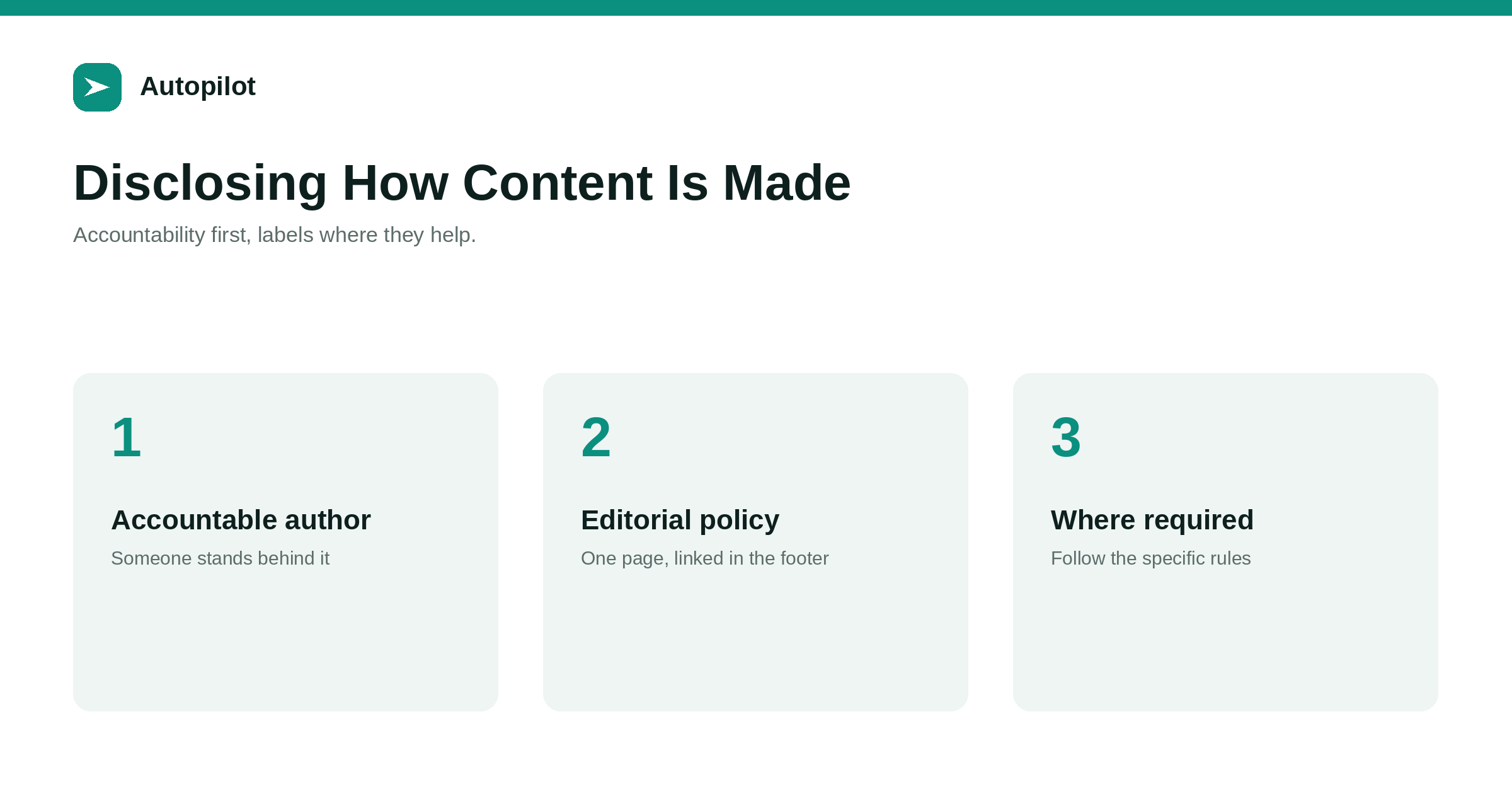
Short answer: general search guidance does not require labelling automated content; it asks whether content is helpful and who stands behind it. Some jurisdictions, industries, platforms and publications do have disclosure rules, and some audiences want to know. A practical approach for most businesses: make sure a real person or the organisation is accountable for every article, publish an editorial policy explaining how content is produced and reviewed, link it from the footer, follow any specific rules that apply to you, and never mislead readers about who wrote something.
As more content is produced with automated drafting, a practical question follows: should readers be told? The answers people give range from always, on every post, to never, it is nobody’s business.
The more useful answer depends on what rules apply to you, what your audience expects, and above all on not misleading anyone. This is a practical overview, not legal advice.
What search guidance says
General search guidance focuses on whether content is helpful and reliable, and on who is responsible for it, rather than on how it was produced. It suggests considering disclosure where readers would reasonably expect it, and it is explicit that automation used mainly to manipulate rankings is spam.
what search engines actually say about AI content covers the guidance in more detail. The short version: a label is not required for search, but accountability matters.
Where rules may apply
Some contexts have specific requirements or expectations.
| Context | Why it may differ |
|---|---|
| Certain jurisdictions | Laws on transparency or advertising |
| Regulated industries | Rules on advice in finance, health, law |
| Platforms and marketplaces | Their own disclosure policies |
| Publications you contribute to | Editorial policies on automated content |
| Images of people or events | Risk of misleading readers |
Check what applies in your markets and industry. Rules in this area are developing, so check again periodically.
Never mislead
Whatever you decide about labels, one principle holds: do not mislead readers about who wrote something or what it is.
That rules out inventing a human author with a photograph for automated articles, presenting a generated image as a photograph of a real event, and claiming personal experience that nobody had. bylines and author pages covers honest bylines.
Accountability over labels
What readers most need is to know who stands behind an article: who they can hold responsible, who checked it, who to contact if it is wrong.
A named reviewer, or the organisation as author with real contact details, provides that. A label saying generated with AI, on its own, tells readers little about whether the content is reliable. Accountability tells them more.
An editorial policy page
A single page describing how content is produced is a practical middle path.
- How topics are chosen.
- How articles are drafted, including any automation.
- How they are reviewed and by whom.
- How facts are checked.
- How corrections are handled.
Link it from the footer. It answers the question for anyone who wants to know, without a label on every post.
When a per-article note makes sense
Some articles warrant a note: pages giving advice in regulated areas, articles with generated illustrations that might be mistaken for photographs, or content in contexts where readers clearly expect to know.
Keep the note short and factual, such as drafted with automated tools and reviewed by a named person. Consistency matters: whatever you decide, apply it the same way across similar articles.
Detection is a separate question
Disclosure is sometimes confused with whether content can be detected as automated. Detectors estimate predictability, not authorship, and they are unreliable — what AI detectors measure explains why.
The disclosure decision should rest on honesty, rules and reader expectations, not on whether anyone could tell.
What readers actually want to know
When readers ask how content is produced, they are usually asking something more specific: can I trust this? Is it accurate? Did someone who knows the subject check it? Is anyone responsible if it is wrong?
An honest answer to those questions is more reassuring than a label. An editorial policy that says articles are drafted with automated tools, reviewed by a named specialist, fact-checked against primary sources and corrected openly when errors are found gives readers what they need to judge.
It also gives your team a standard to meet. A policy that describes review and fact-checking only helps if those steps actually happen.
Being consistent across channels
Whatever you decide for the blog should be consistent with how you describe your content elsewhere: on social profiles, in sales material, in answers to customers. A business that says one thing on its editorial policy page and another in a sales call creates exactly the distrust disclosure is meant to prevent.
Review the policy once a year, and whenever your process changes significantly, such as adopting a new tool or changing who reviews articles.
Disclosure in client work
Agencies and freelancers producing content for clients face a related question: should the client know how the content is produced? The answer is almost always yes. Clients are publishing under their own name and carry the responsibility; they need to know what they are approving. Agreeing the process in writing at the start, including any automation and the review that follows, avoids misunderstandings later — running blogs for clients covers the workflow.
Corrections
Whatever you disclose, say how errors are corrected. A visible note on a corrected article, stating what changed, shows that someone is responsible and paying attention.
Deciding
For most business blogs: make every article accountable, publish an editorial policy, follow specific rules where they apply, add per-article notes where readers would expect them, and never mislead.
Transparency does not guarantee trust or rankings. It removes a reason for distrust, which is the part within your control.
Related reading
If this was useful, these cover the questions that usually come next.
- Bylines and author pages — who signs the article
- What AI detectors measure — the question people confuse with this
- Experience, expertise and trust — why accountability matters
The bottom line
Search guidance does not require labels, but accountability matters, and some jurisdictions, industries and platforms have their own rules. Make every article accountable to a real person or the organisation, publish an editorial policy linked from the footer, add per-article notes where readers would expect them, and never mislead about authorship.
FAQ
Do I have to label AI-assisted content?
General search guidance does not require it, but some jurisdictions, industries, platforms and publications have their own rules. Check what applies to you.
Does disclosing AI use hurt rankings?
There is no indication that honest disclosure harms rankings. Search guidance focuses on whether content is helpful and who is responsible for it.
What is an editorial policy page?
A page explaining how content is chosen, produced, reviewed, fact-checked and corrected, usually linked from the footer.
Can I use a made-up author for automated articles?
No. It misleads readers. Use a real accountable person or the organisation as author.
When should an individual article carry a note?
When readers would reasonably expect it, such as advice in regulated areas or generated images that could be mistaken for photographs.
Is disclosure the same as detectability?
No. Disclosure is about honesty and rules; detectors are unreliable estimates of predictability.