ENEnglish
 LTLietuviškai
 DEDeutsch
 FRFrançais
 RUРусский
 ESEspañol
 PLPolski
 ITItaliano
 UKУкраїнська
 CSČeština
 PTPortuguês
 JA日本語
JA日本語 LVLatviešu valoda
 ETEesti
 HUMagyar
 IDBahasa Indonesia
 TRTürkçe
 HIहिन्दी
 ELΕλληνικά
 ARالعربية
 THไทย
THไทย VITiếng Việt
 RORomână
 MSBahasa Melayu
 BNবাংলা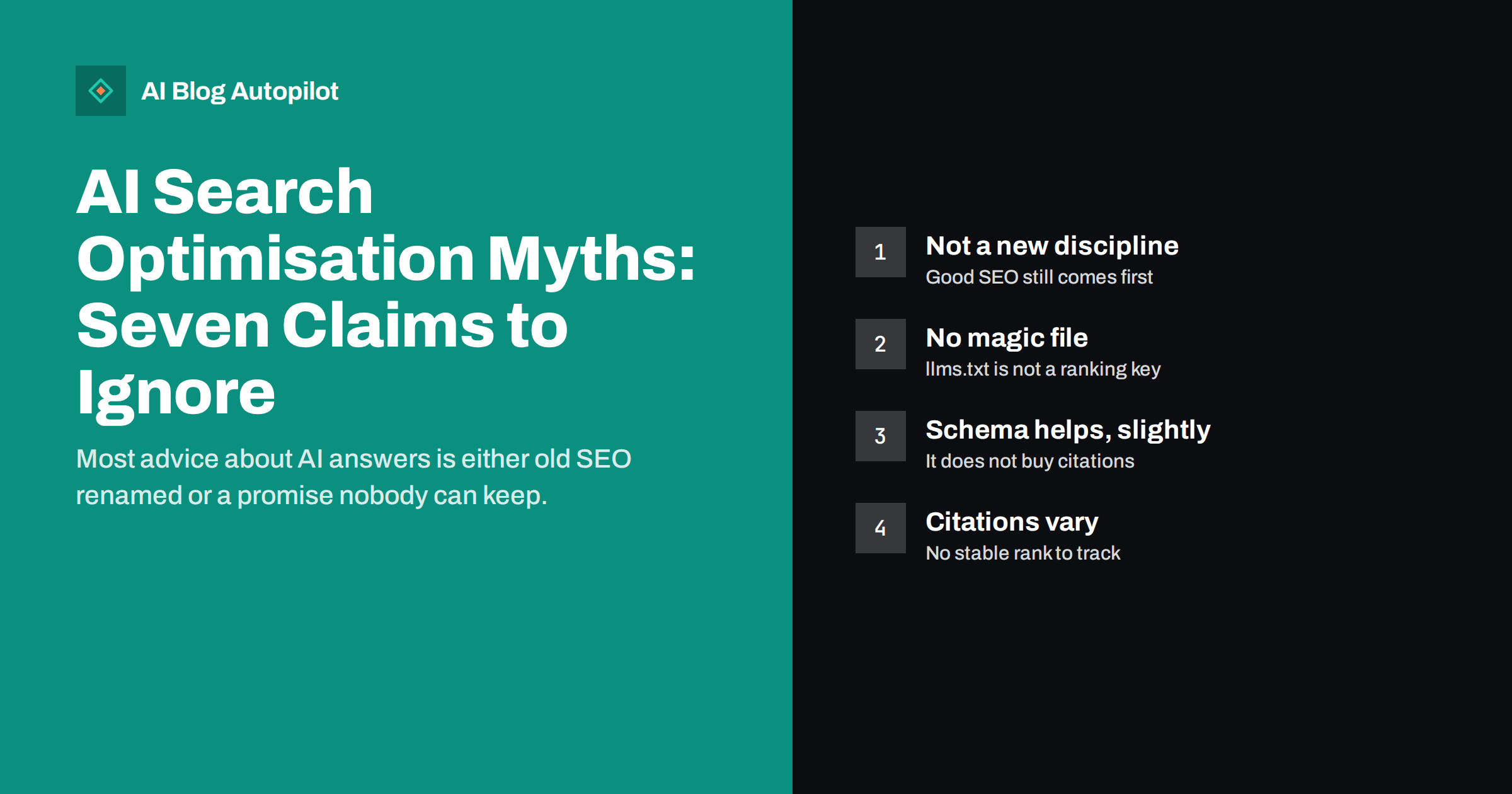
Short answer: most myths about AI search optimisation promise a shortcut: a special file, a markup trick, a new kind of keyword or a tool that tracks exact “AI rankings”. In practice, answer engines draw on pages that are crawlable, clearly written, well structured and trusted, which is what good SEO has always aimed for. Write answer-first content with clear definitions and specific facts, keep your pages technically accessible, and build a reputation that others mention. Treat any claim of guaranteed AI citations with suspicion.
AI answers in search engines and assistants have created a new vocabulary and a new market for advice. Some of it is useful. A lot of it repackages old ideas under new names, and some of it is simply wrong. For a small business or a blogger with limited time, following the wrong advice means spending effort on things that do nothing. Here are seven claims you will hear often, why they mislead, and what to do instead.
Myth 1: AI search needs a completely separate strategy
New acronyms such as GEO, AEO and LLMO suggest that optimising for AI answers is a separate discipline that replaces SEO. It is not. Answer engines that search the web generally retrieve pages through a search index, then choose passages to use or cite. A page that is not crawled, not indexed or not trusted is unlikely to be used, however well it is written for AI.
What changes is emphasis, not foundations. Clear answers near the top of sections, self-contained passages, precise definitions and well-supported facts matter more than before, because they are easier to lift into an answer. But those are also habits that help readers and featured snippets. Google’s own guidance on creating helpful, reliable, people-first content applies to AI features in its search results as much as to classic results.
Do instead: keep a single content strategy, and add answer-first structure to it.
Myth 2: An llms.txt file gets you cited
The llms.txt proposal describes a plain-text file that lists a site’s key pages for language models. It can be a tidy summary of your site, and it does no harm. But it is a proposal, not a standard that search engines have committed to, and adding it does not make an assistant use your content.
Robots.txt rules matter more. If you block the crawlers that AI services use to fetch pages, those services may not be able to read your site at all. Check which bots you allow, and make that decision deliberately rather than by accident through a security plugin or CDN setting.
It is also worth remembering that different services use different crawlers for different jobs. Some fetch pages to train models, others fetch pages live to answer a question and cite sources. Blocking one does not necessarily block the other, so read each service’s documentation before deciding. A blanket block may keep your content out of answers you would actually like to appear in.
Do instead: make sure your important pages are crawlable and indexable. Add llms.txt if you like, but do not expect it to change results.
Myth 3: Schema markup gets you into AI answers
Structured data helps search engines understand what a page is: an article, a product, an organisation, a FAQ. That understanding can support rich results and may help systems interpret your content correctly. It does not, by itself, cause an AI answer to quote your page.
Answer engines mostly use the visible text of a page. Markup that describes content that is not on the page, or that exaggerates it, can even break search engine guidelines. Adding every possible schema type to every post is busywork.
Do instead: use accurate Article, Organization and, where relevant, Product or FAQ markup that matches the visible content, and put the effort you save into the text itself.
Myth 4: You must write for prompts instead of keywords
People ask assistants longer, more conversational questions than they type into a search box. Some advice concludes that you should stuff pages with long question phrases or write in the style of a chatbot.
The useful part of this idea is that conversational queries reveal real needs, including follow-up questions. Covering those questions well is valuable. But stuffing headings with every possible phrasing makes articles harder to read, and answer engines are good at matching a question to a passage that answers it in normal language.
Do instead: research the questions people actually ask, answer each clearly in a section with a descriptive heading, and cover the natural follow-ups. Write for a person, not for a prompt.
Myth 5: Only very short answers get used
Because AI answers are short, some advice suggests trimming articles down to brief answers. That throws away what makes a page worth citing. Assistants often combine several facts, steps or caveats from different sections, and they prefer sources that cover a topic in enough depth to be trusted.
The better model is a short direct answer followed by depth: a two to four sentence summary at the top, then sections that explain the steps, exceptions, examples and evidence. Each section should make sense on its own, so it can be used without the rest of the article.
Do instead: lead with the answer, then go deep. Length is not the goal, but completeness is.
Myth 6: You can track your AI ranking precisely
Tools now offer to track how often your brand appears in AI answers. Some of them are useful for spotting trends. But AI answers are not a fixed list of ten results. The same question can produce different answers depending on wording, location, conversation history, the model version and simple randomness.
This means a single check proves very little, and a precise “AI rank” is not a stable thing to measure. Treat visibility tracking as a sample: ask a consistent set of questions at regular intervals, record whether you appear and which sources are cited, and watch for direction rather than exact numbers.
Be careful with tools that turn a handful of answers into a single visibility score. The number looks precise, but it depends on which questions were asked and how often. If you use such a tool, look at the questions behind the score, make sure they match what your customers really ask, and compare the same set month by month rather than switching between reports.
Do instead: combine occasional manual checks with analytics. Visits referred by AI assistants are a more concrete signal than any score.
Myth 7: Being cited always brings traffic
A citation in an AI answer is good for visibility, but many people read the answer and never click. This is similar to zero-click searches in classic results, only stronger. Expecting each citation to send visitors leads to disappointment and to the wrong conclusions about what works.
Citations still have value. They put your brand in front of people at the moment they are researching, and they build familiarity that can lead to direct visits or branded searches later. Pages that offer something an answer cannot fully provide, such as a detailed checklist, a calculator, original data or a clear next step, are the ones most likely to earn the click.
Do instead: measure brand searches and direct visits alongside referrals, and give readers a reason to visit beyond the summary.
What actually helps
Once the myths are cleared away, the practical list for a blog is short and familiar:
- Technical access. Pages load, are crawlable by the bots you choose to allow, are indexed and have clean canonical URLs.
- Answer-first writing. A clear summary at the top and self-contained sections with descriptive headings.
- Clear definitions and specifics. Precise statements of what something is, what it costs, how long it takes or what the steps are, with sources where facts need support.
- Freshness where it matters. Outdated facts are a reason not to use a page. Review articles whose facts change.
- Reputation. Mentions of your business on other trusted sites, reviews and consistent information about who you are.
- Consistency over time. A site that covers its topic thoroughly is more likely to be used than one with a single lucky article.
None of these items is new or secret, and that is the point. The sites that appear in AI answers are mostly the ones that did the basics consistently for a long time. A practical routine is to review your ten most important articles every quarter: check that the opening answer is still correct, that facts and figures are current, that each section can be understood on its own, and that the page is indexed. Then publish new articles that fill the questions your existing posts do not yet answer.
How AI Blog Autopilot helps
AI Blog Autopilot writes long-form articles planned around real search queries, with a direct answer, FAQ, tags and SEO meta, and publishes them to your WordPress blog at a steady pace. The writer is instructed never to invent statistics, quotes or sources, and an automatic quality check reviews each article before it goes live. See the pricing page for plans.
Related reading
- GEO, AEO and LLMO Explained
- How AI Search Picks Which Pages to Cite
- AI Crawlers, robots.txt and llms.txt
- Does Schema Markup Help a Blog Appear in AI Answers?
The bottom line
AI search rewards much of what good SEO always rewarded: accessible pages, clear answers, accurate facts and a trusted reputation. There is no special file, markup type or phrase list that guarantees citations, and no stable AI ranking to chase. Put your effort into answer-first articles with depth, keep pages crawlable and current, earn mentions elsewhere, and judge progress by trends in visibility and real visits rather than single checks.
FAQ
Is AI search optimisation different from SEO?
Mostly in emphasis. Answer engines still depend on pages being crawlable, indexed and trusted. What matters more now is answer-first structure, self-contained sections and precise facts, which also help readers and classic search.
Does llms.txt help my site appear in AI answers?
There is no evidence that it does on its own. It is a proposal rather than an adopted standard. Allowing the relevant crawlers in robots.txt and keeping pages indexable matters more.
Will adding schema markup get my blog cited by AI?
Accurate structured data helps search engines understand a page, but it does not guarantee citations. Answer engines rely mainly on the visible text, so the quality of the content matters more than the markup.
Can I track my position in AI answers?
Only roughly. AI answers vary with wording, location, context and model updates, so there is no fixed position. Regular sample checks and referral visits in analytics show trends better than any single result.
Why does an AI citation not bring me visitors?
Many people read the answer and do not click. Citations still build visibility and brand familiarity. Pages that offer more than a summary, such as tools, checklists or original data, are more likely to earn the visit.