ENEnglish
 LTLietuviškai
 DEDeutsch
 FRFrançais
 RUРусский
 ESEspañol
 PLPolski
 ITItaliano
 UKУкраїнська
 CSČeština
 PTPortuguês
 JA日本語
JA日本語 LVLatviešu valoda
 ETEesti
 HUMagyar
 IDBahasa Indonesia
 TRTürkçe
 HIहिन्दी
 ELΕλληνικά
 ARالعربية
 THไทย
THไทย VITiếng Việt
 RORomână
 MSBahasa Melayu
 BNবাংলা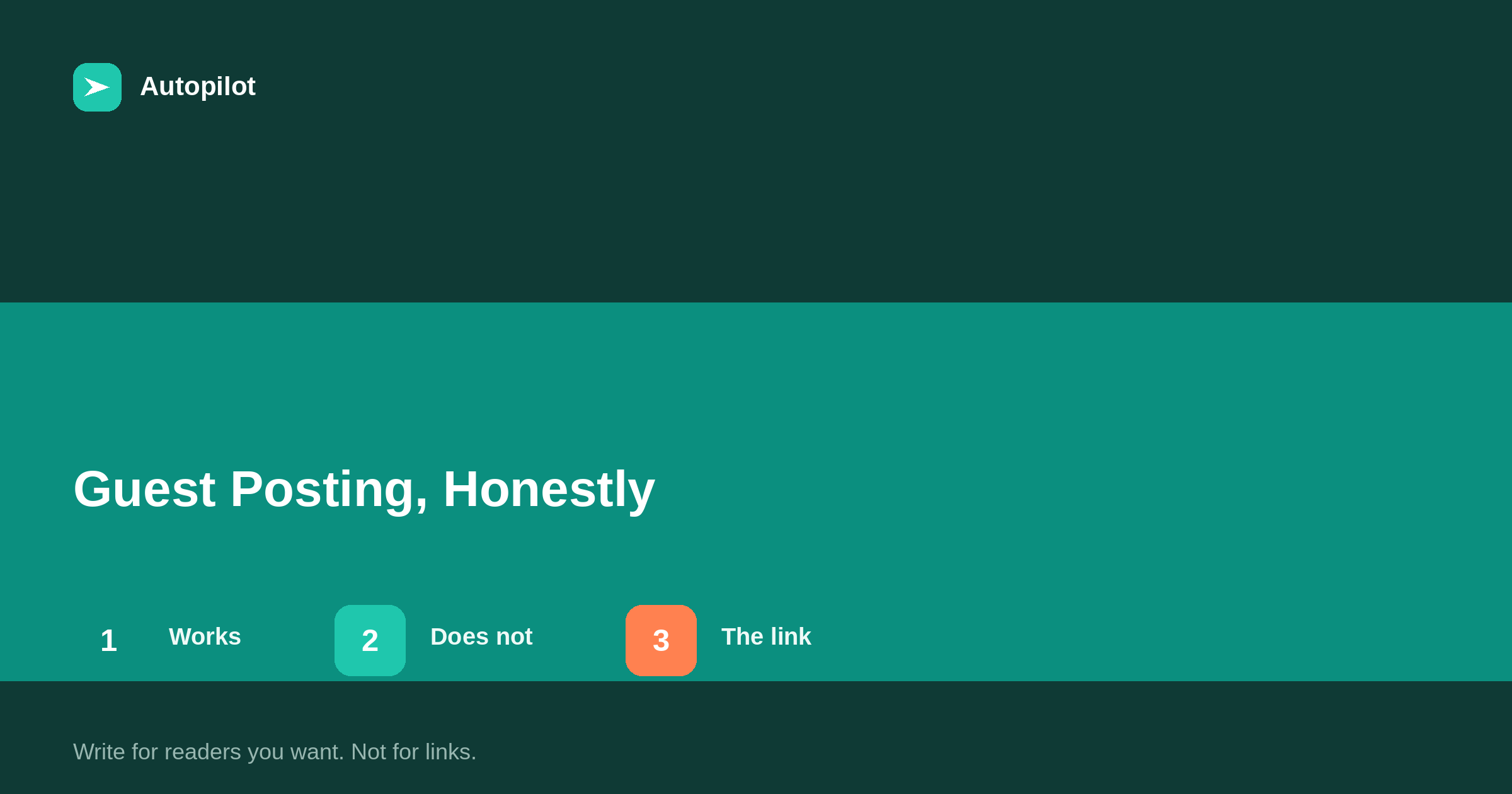
Short answer: guest posting still works when the goal is readers and credibility: a genuinely useful article, written for a respected publication whose audience overlaps with your customers, with a byline and perhaps a link. It does not work, and breaches search guidelines, when the goal is links: producing many thin articles for any site that accepts them, with keyword-rich links back. The test is whether you would write the article if the link were marked nofollow. If yes, it is the useful kind.
Guest posting has a mixed reputation because it describes two quite different activities under one name. One is writing for a publication your customers read. The other is a link-building tactic that search engines specifically warn against.
They look similar from the outside. The difference is in who the article is really for.
The useful kind
Writing a substantial article for a respected publication in your field, whose readers overlap with your customers, does several things at once.
- It reaches new readers who already trust that publication.
- It builds credibility for the named author and the business.
- It can bring referral visits from readers who want more.
- It may include a link, which is a bonus rather than the purpose.
This kind of guest post is rare and takes effort, which is exactly why it carries value.
The kind to avoid
The link-building version looks different on every dimension.
| Factor | Useful guest post | Link scheme |
|---|---|---|
| Publication | Respected, relevant, selective | Accepts anything, often any subject |
| Audience | Overlaps with your customers | Irrelevant or nonexistent |
| Article | Substantial and original | Thin, often spun or generated |
| Links | Natural, often in the bio | Keyword-rich anchors in the body |
| Scale | A few a year | Dozens or hundreds |
| Payment | None, or clearly marked | Paid to appear editorial |
Search guidelines list large-scale guest posting campaigns with keyword-rich links as a link scheme. Links from such campaigns may be ignored, and a pattern of them can harm a site.
The nofollow test
A simple question separates the two: would you still write this article if the link to your site were marked nofollow, passing no ranking value?
If yes, because the readers and the credibility are worth it, it is the useful kind. If no, because the link was the only point, it is the scheme, whatever the publication calls it.
Many respected publications do mark contributor links as nofollow or sponsored. That is not a reason to avoid them; the readers are the same either way.
Finding the right publications
Start from where your customers read, not from lists of sites that accept guest posts.
Industry publications, association newsletters and blogs, the blogs of companies that serve the same customers without competing with you, and respected independent writers in your field. Look at whether they publish outside contributors, what those articles are like, and who reads them.
A publication that accepts every submission is, for that reason, not worth writing for.
Pitching and writing
Pitch a specific article, not a general offer to write. Say what the article will argue, why it suits their readers, and what you bring that others do not — usually experience, data or a specific perspective.
Then write the best article you can: original, useful, and written for their audience rather than yours. Do not republish something from your own blog, and do not submit a lightly edited version of one — that creates duplicate content and disappoints the editor. adding something original covers what makes an article worth publishing somewhere respected.
Bylines and links
The author bio is usually where a link belongs: a sentence on who you are and a link to your site or a relevant page. A link in the body is appropriate only where it genuinely helps the reader, and the editor will decide.
Use a real named author with relevant expertise. A guest post under an invented name, or a generic company byline on a personal-opinion piece, undermines the credibility the post was meant to build — see bylines and author pages.
Automation has no place here
Guest posts are the one kind of content where automated volume works directly against the goal. The value lies in the article being genuinely yours, written for a specific audience with specific expertise.
Tools can help with research and structure, as for any article, but a guest post that reads like a generic summary will be rejected by any publication worth writing for — and the ones that accept it are not worth the link.
Writing for your own site instead
The effort that goes into one excellent guest post could also produce one excellent article on your own site. It is worth asking which serves you better.
Guest posting wins when the publication’s audience is one you cannot otherwise reach, or when appearing there confers credibility your own site cannot. Your own site wins when the article’s value is long-term search traffic, since a page on your domain keeps working for you in a way a page elsewhere does not. Many businesses find a mix works: most effort on their own blog, with a few guest posts a year chosen for the audience.
Expectations
A few good guest posts a year, in publications your customers read, is a realistic and worthwhile aim. They build credibility and occasionally bring customers directly.
No guest post guarantees rankings, and offers of guaranteed placements with guaranteed links are almost always paid schemes. Judge guest posting by the readers it reaches, not by the links it produces.
Related reading
If this was useful, these cover the questions that usually come next.
- Earning links honestly — the wider context
- Digital PR for a small blog — the other way into publications
- What search engines actually say about AI content — the guidelines in full
The bottom line
Write substantial, original articles for a few respected publications your customers read, under a real name, with the link in the bio as a bonus. Avoid sites that accept anything, keyword-rich links and volume campaigns. Apply the nofollow test: if the article is worth writing without the link’s ranking value, it is the useful kind.
FAQ
Is guest posting still worth it?
Yes, when the goal is reaching readers and building credibility through respected publications in your field. Not when the goal is producing links at scale.
Is guest posting against Google’s guidelines?
Large-scale guest posting campaigns with keyword-rich links are listed as a link scheme. Writing a genuine article for a relevant publication is not.
Where should the link go in a guest post?
Usually in the author bio. A link in the body belongs only where it genuinely helps the reader, at the editor’s discretion.
Can I republish my blog post as a guest post?
No. Write an original article for the publication’s audience. Republished or lightly edited posts create duplicate content and disappoint editors.
Is a nofollow guest post worthless?
No. The readers and credibility are the same. If an article is only worth writing for a followed link, it is probably the scheme kind.
How many guest posts should a small business write?
A few a year in well-chosen publications. Quality and relevance matter far more than number.