ENEnglish
 LTLietuviškai
 DEDeutsch
 FRFrançais
 RUРусский
 ESEspañol
 PLPolski
 ITItaliano
 UKУкраїнська
 CSČeština
 PTPortuguês
 JA日本語
 LVLatviešu valoda
 ETEesti
 HUMagyar
 IDBahasa Indonesia
 TRTürkçe
 HIहिन्दी
 ELΕλληνικά
 ARالعربية
 THไทย
 VITiếng Việt
 RORomână
 MSBahasa Melayu
 BNবাংলা
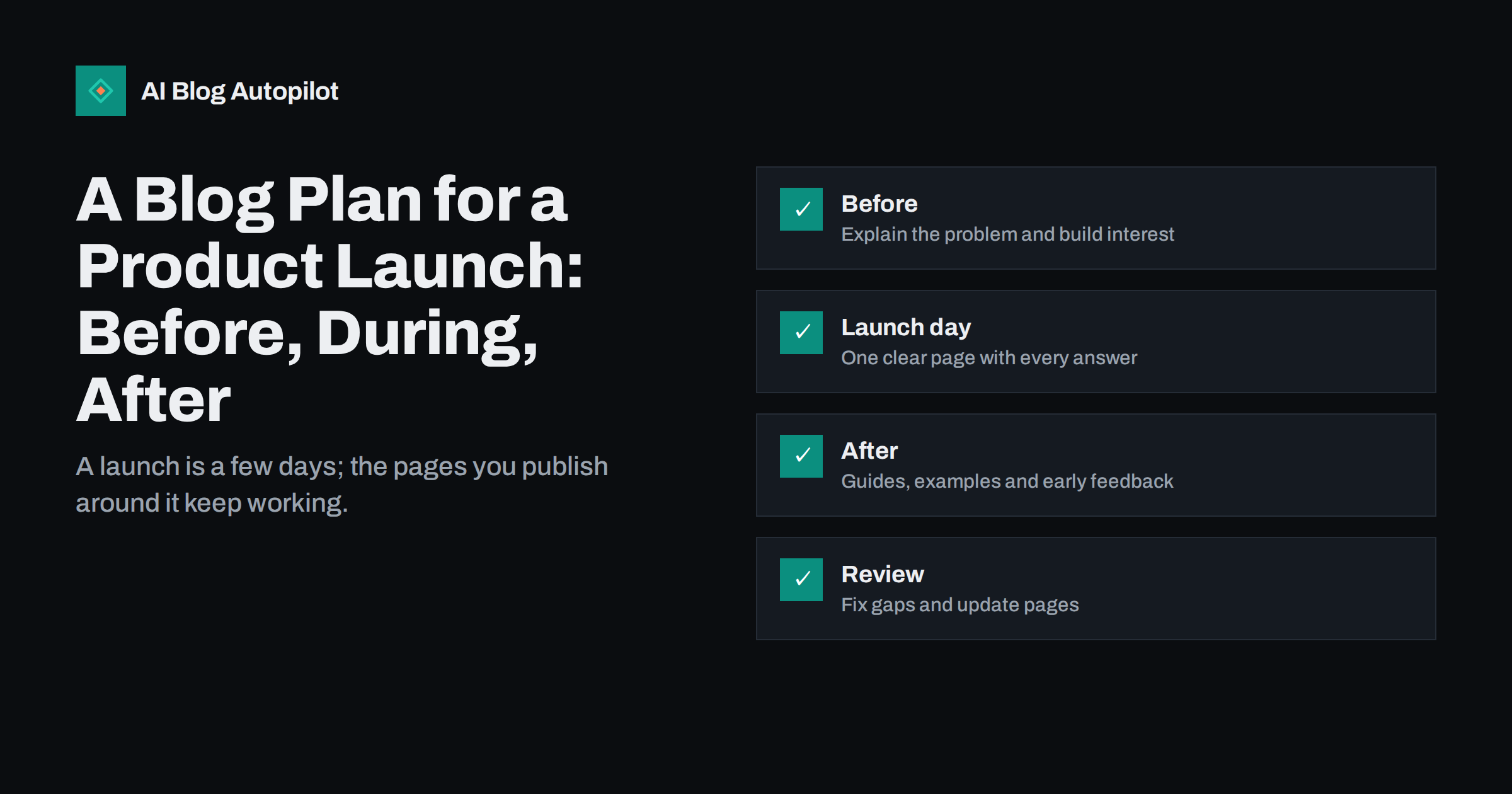
Short answer: plan the blog around a launch in three stages. Before launch, publish pages that explain the problem and prepare readers; on launch day, publish one clear page with what the product is, who it is for, what it costs and how to start; afterwards, publish guides, examples and honest early feedback, and keep updating the same pages. Write every claim so that it will still be true next month.
A product launch feels like an event, but for search engines and for most buyers it is the start of a long period of questions. People arrive on launch day, but they also arrive six months later, looking for the same page. A blog plan that treats the launch as a beginning, not an announcement, produces pages that keep bringing readers long after the excitement has gone.
Decide what the launch must achieve
Before writing, decide what success looks like: sign-ups, orders, demo requests, a waiting list or simply understanding. Choose one main action for the launch page and make every article lead towards it. A launch with five competing goals produces pages that ask the reader to do five things and leads to none of them.
Write down the audience, the problem the product solves, the three facts that matter most and the questions you expect. Check each fact against the product itself and against what the team is allowed to say, particularly for prices, availability and features that are not yet ready. Claims that go beyond what exists create refunds and complaints later.
Agree who approves the wording and by when. Launches often slip, and pages that are written around a date become wrong in a day. Use phrases such as “available now” only when they are true, and keep dates in one place that every page draws from.
Publish before launch: the problem, not the product
In the weeks before launch, write about the problem your product addresses. These pages attract people who are looking for help and do not yet know you exist. Explain the problem, the usual solutions and their limits, and mention the upcoming product only where it fits naturally. Our guide to funnel-stage blog topics shows how to match pages to what readers need at each step.
Consider a waiting-list or early-access page, with an honest description of what to expect and when. Do not promise a date that you cannot keep. Explain what subscribers will receive and how often you will write to them, and make unsubscribing simple. Overpromising before launch is one of the quickest ways to lose goodwill.
Prepare supporting pages in advance so that they are ready on the day: a short guide for getting started, a page of frequently asked questions, a pricing page and a comparison with the alternatives people already use. Writing them in advance reduces mistakes made in the rush.
Add a short list of who the product is not for. Readers who are a poor fit will leave anyway, and honest guidance saves them time and saves you refunds and negative reviews. This kind of plain statement also helps AI assistants describe your product accurately, as our article on honest fit statements explains.
Make launch day one clear page
On the day, publish a single page that answers the basic questions: what is it, who is it for, what does it cost, what is included, how do I start and where can I get help. Put the short answer at the top and the main action immediately after. Link to the supporting pages but do not scatter the essential facts across several posts.
Use a stable address that you can keep for years, rather than one that contains a date or a version number. Update the page as the product changes and add a short log of what has changed, so that returning readers can see it is current. The advice in product update posts applies here: announce changes in a separate short post, and keep the main page as the single source of truth.
Avoid empty superlatives. Readers and search engines value specific statements: the number of features, the supported platforms, the price per month and the limits of each plan. If something is missing, say so and, if you plan to add it, say only what you are sure of.
Record what you posted and when, with the link used in each place. After a week, compare the results, keep what worked and drop what did not. Do not delete posts that performed poorly; leave them and learn from them. Plan one or two reminders at sensible intervals, not a daily stream, since readers who have already seen the news will not thank you for repeating it every morning.
Share the launch without spamming
Plan the sharing as carefully as the page. Prepare different text for each network, with a different angle for each audience, and space the posts across several days rather than posting everything at once. Our guide to the best time to share blog posts explains how to choose times, and UTM tags for social shares shows how to see which channels worked.
Email your list with a short note and one link. Tell people why they are receiving it and what to do next. If you have partners, customers or advisers who are happy to mention the launch, give them a short summary and the correct link, and let them write in their own words. Do not ask for reviews or posts that you would not be comfortable reading aloud.
Be ready to answer. Assign someone to watch comments and messages for the first days and to reply honestly, including to criticism. Our article on handling negative comments on social posts gives sensible rules.
Prepare support and sales before the traffic arrives
A launch sends visitors to pages that were written by people who already know the product, and the visitors do not. Ask someone who has never seen it to read the main page and the getting-started guide and to say where they got stuck. Fix those places before the day. Check the forms, the checkout, the confirmation emails and the help pages, because a broken step wastes the attention that the launch worked so hard to attract.
Brief everyone who talks to customers. Sales, support and social media staff should have the same short document with the facts, the prices, the limits and the approved answers to likely questions. Update it when something changes, and link from it to the public pages, so that people give the same answer in every channel. Our guide to support articles that reduce tickets explains how to turn repeated questions into help pages.
Publish after launch: guides, examples and early feedback
The weeks after launch are where most of the lasting value is created. Write guides for the first tasks, examples of how people use the product, answers to the questions that arrive and short notes on what has changed because of feedback. Each page answers a real question and can bring readers for years.
Share early results carefully. A small number of users or a short time is not enough for broad claims, and numbers presented without context mislead. Say what the sample is, what you measured and what you do not yet know. A modest, honest account of early feedback earns more trust than a bold claim, and it is easier to update.
Consider a short case study when a customer is happy to be named, using the structure in how to write a case study. Check every number with them and give them the final text to approve before it goes live.
Check what people typed into your search box and into Google when they arrived. The words they used may differ from the words in your launch page, and adding those words naturally to headings and answers is one of the quickest improvements you can make. Our guide to internal search and what readers type shows how to use that data.
Review and update, do not abandon
A month after launch, review the pages. Which ones brought sign-ups, which questions are still unanswered, which statements have become outdated? Update the main page, fix gaps, merge pages that overlap and remove or redirect those that no longer serve a purpose, following the advice in content pruning.
Write a short internal note about what worked and what did not, with dates and numbers, while the memory is fresh. The next launch will start from this note instead of from nothing, and the team will not repeat the same mistakes about timing, approval or wording.
Keep the plan realistic
A launch is stressful, so set a plan that the team can keep. Choose a small number of pages, write them ahead, schedule them and test every link before the day. Check the schedule and time zones, because a page that appears at the wrong hour can confuse customers and partners. Our guide to scheduling posts in WordPress lists the checks.
Leave room for corrections. If you find a mistake, fix it quickly and say so, as described in how to handle corrections on a blog. Customers forgive an honest correction, but they do not forgive a page that stays wrong.
How AI Blog Autopilot helps
AI Blog Autopilot writes full SEO articles for your WordPress blog from the topics, keywords, audience and tone you set, with FAQ sections, tags and SEO meta included, and it shares each one to your social networks. While your team prepares the launch, guides and supporting articles keep appearing on schedule. Approval mode lets you read each article first, which matters for prices, features and dates. See the pricing page for plans.
Related reading
- Product Update Posts That Readers Actually Open
- Blog Topics for Each Stage of the Buying Funnel
- How to Write a Case Study
- Scheduling Posts in WordPress: Time Zones and Missed Schedules
The bottom line
Treat a launch as a beginning. Publish problem-led pages before it, one clear page on the day, guides and honest feedback after it, and keep the main page current instead of replacing it.
FAQ
How early should I start publishing before a launch?
About four to six weeks ahead, with pages about the problem. Search engines need time to find and rank new pages.
Should the launch page change after launch day?
Yes. Keep the same address, update the facts and add a short log of changes, so returning readers see it is current.
How do I avoid overpromising?
Describe only what exists now, give dates only when confirmed and have someone check every price and feature.
Can I share early results?
Yes, with context: say how many users, how long and what you measured. Avoid broad claims from small samples.
What should I do if the launch date moves?
Keep dates in one place, update them everywhere and tell subscribers honestly. Avoid wording that depends on a fixed date.