ENEnglish
 LTLietuviškai
 DEDeutsch
 FRFrançais
 RUРусский
 ESEspañol
 PLPolski
 ITItaliano
 UKУкраїнська
 CSČeština
 PTPortuguês
 JA日本語
 LVLatviešu valoda
 ETEesti
 HUMagyar
 IDBahasa Indonesia
 TRTürkçe
 HIहिन्दी
 ELΕλληνικά
 ARالعربية
 THไทย
 VITiếng Việt
 RORomână
 MSBahasa Melayu
 BNবাংলা
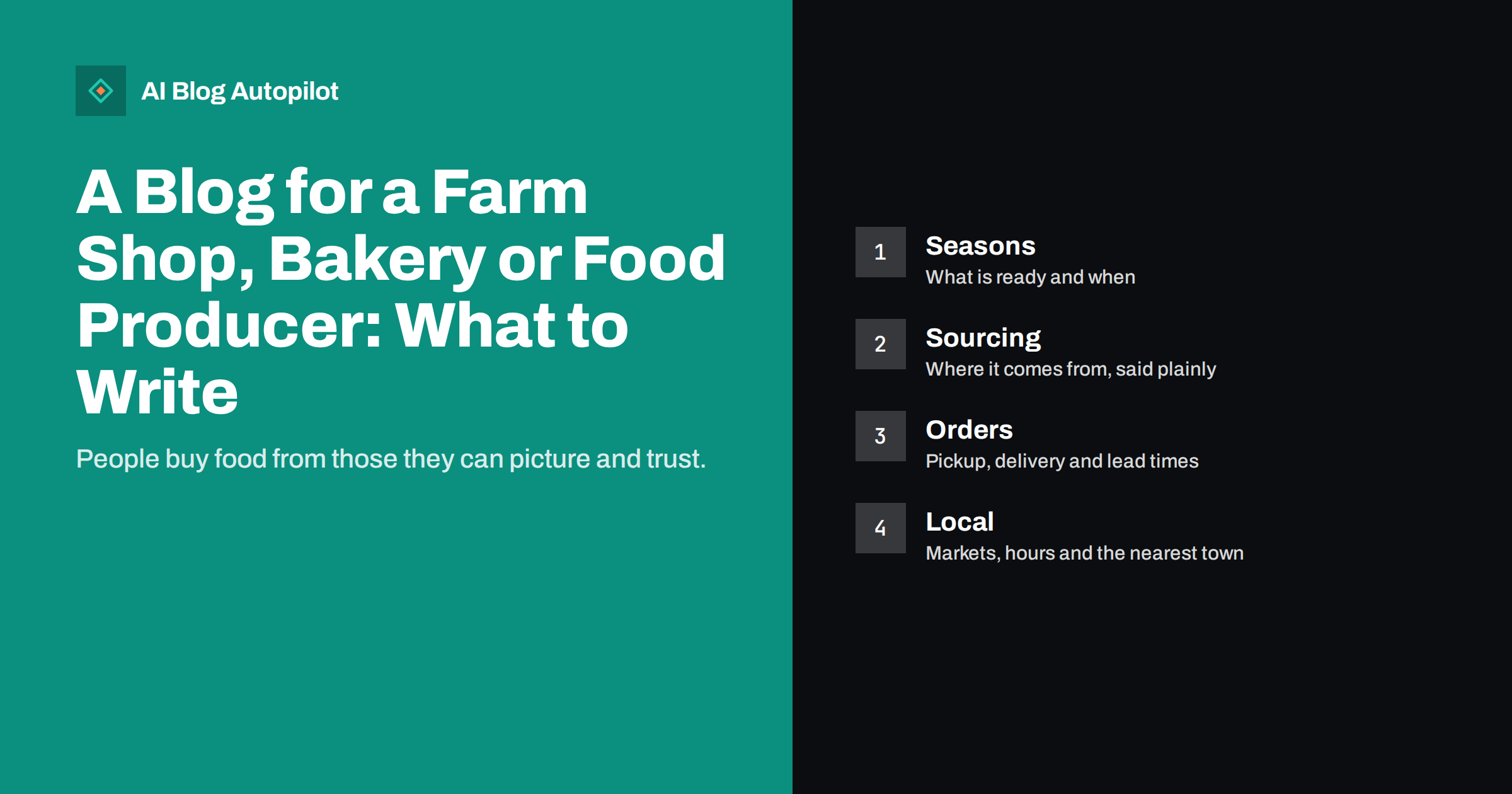
Short answer: a food business blog works best when it answers the questions buyers ask before they order: what is in season, where the ingredients come from, how to store and serve the product, and how to collect or receive an order. Write about real products, real people and real timings, keep every claim you can prove, and link each article to the page where the reader can buy.
A farm shop, bakery, dairy, brewery or small producer already has plenty to write about. The difficulty is that most owners are busy at the counter or in the kitchen, so the blog is left to social media posts that disappear within a day. A short library of useful pages on your own site stays findable for years, and it supports local searches such as “fresh bread near me” or “farm eggs delivery”.
Write about the seasons first
Food is the most seasonal product there is, and seasons give you a natural calendar. A page about what is ready in early summer, what the harvest looks like in autumn or which bakes appear before the holidays answers a question people already have. Plan the year in advance, using the approach in our guide to seasonal content planning without the scramble, and publish each seasonal piece a few weeks before the products arrive, so that search engines and customers can find it in time.
Keep a permanent page for each major season and update it every year instead of creating a new address each time. The older page keeps its history and its links, and the update gives readers a reason to come back. Mention dates only when you are sure of them, and say “usually” where the weather decides.
Explain sourcing without exaggeration
Customers care where food comes from, but they are also tired of vague promises. Describe the farm, the fields, the mill or the suppliers in concrete terms: what you grow yourself, what you buy in, how far it travels and why you chose that supplier. If a word such as organic, free range or local has a legal or common meaning in your country, use it only when it applies to the product in question and you can show the evidence.
Photographs help a great deal here. Pictures of your own kitchen, field or shelves are worth more than stock images, and our article on image captions in blog posts explains how to caption pictures so that they help readers and search. Add a short caption naming the place and the season, and write alt text that describes the picture plainly.
Help people store, cook and serve
Practical advice turns a customer into a repeat customer. Explain how long fresh bread keeps, how to freeze it and how to refresh it in the oven. Describe how to store cheese, how to cook a joint of meat from your butcher counter or how to use an unfamiliar vegetable from the weekly box. These pages are exactly what people search for after buying, and they reduce the number of questions you answer by phone.
Use the format that suits the subject. A recipe card works for a cake, a short checklist for storage, a table for cooking times. For advice on structure, see our guide to writing a how-to article. Add allergen information carefully and keep it consistent with the labels on the product, because a mistake here matters far more than a missing keyword.
Answer ordering questions clearly
Many food businesses lose orders because the practical details are hard to find. Create one page for each way a customer can buy: collection from the shop, local delivery, a weekly box, a market stall or a wholesale order. State the lead time, the cut-off hour for the next day, the area you serve, the minimum order and what happens if nobody is at home. Do not publish prices or terms that you are not sure you can keep, and update the page when something changes.
Special orders deserve their own explanation. A bakery that makes cakes for birthdays or weddings should explain how far ahead to ask, what information is needed and how a quote is given. Our article on a blog for a restaurant, café or hotel covers similar booking questions, and the same principles apply to a producer who takes advance orders.
Be useful to local searchers
Most of your customers live within a short drive, so local details matter. Mention the village, the market days, the nearby car park and the opening hours on the relevant pages, and keep your business profile in step with the website, as discussed in our guide to business profile updates. Write about local events where you take part, such as a farmers market, a food festival or a school fair, and say what you will bring.
Avoid creating a separate near-identical page for every town in the area. One strong page that explains your delivery area, with real details, is better than many thin pages that repeat each other. If you serve several branches or stalls, give each a page with its own hours, its own address and something unique, such as a photograph of the actual counter.
Think about the reader who has never visited you. They may be a visitor passing through the area, a new resident or someone looking for a gift. For them, a short page that says what you are known for, where to park, what to buy first and how to pay removes the small doubts that stop a first visit. Add a map link, a photograph of the entrance and a note about accessibility, such as steps or a wide door, because these details help people plan and are often missing from small business websites.
Tell the story of the people
Customers like to know who is behind the product. Short posts about the baker who starts at four in the morning, the family history of the farm or the way a new recipe was tested give the business a face. Keep them genuine and specific, and ask for permission before naming or photographing staff or customers. Our guide to storytelling in business blog posts shows how to do this without turning it into advertising.
Seasonal staff, apprentices, suppliers and regular customers can all feature, provided they agree. A post about a new product should explain why you made it and what went wrong in the first tests, because honest stories are remembered. Do not overload every article with a sales message. One clear link to the product page is enough, and readers will follow it when they are ready.
Handle reviews, questions and complaints in public
Food buyers read reviews before they visit, and a blog can support them. Collect the questions that appear in reviews and messages, such as “do you have gluten-free options” or “can I order for Saturday”, and answer each one on a page that you can link to. A calm, factual reply to a complaint, written once and linked from your answers, shows that you take problems seriously. Never invent testimonials or copy the reviews of another business, and do not publish a customer’s name or order without clear permission.
If a product sells out quickly, say so on the page and explain how you decide who gets it, for example first come first served or by advance order. Honest notes about limited supply prevent disappointment and make the product look as special as it really is.
Keep a simple publishing rhythm
A food business has busy and quiet weeks, so choose a rhythm you can keep in the busiest week as well. Two articles a month is enough if each answers a real question. Build a list of topics from the questions customers ask at the counter, by phone and in messages, as described in our article on turning customer questions into topics. Write the answer once, publish it, and point to it the next time somebody asks.
Review the pages every season. Remove products you no longer make, update opening hours and change dates. A page that promises a product you stopped selling two years ago creates disappointment and wasted visits.
Gift boxes, hampers and festive orders deserve a careful plan, because they bring a large share of the year’s income in a short time. Publish the gift guide early, list what each box contains, explain the last day for delivery before the holiday and describe how to add a message. Update the page each year, keep the old address and avoid showing products that are no longer available. A clear, early page also gives you something useful to share in your newsletter and on social networks.
Finally, measure what matters. Count the orders, calls and visits that start on your blog pages, not only the number of readers. If a storage guide brings many visitors but no orders, it still helps your reputation, and if an ordering page brings few visitors but many sales, you have found a page to improve and promote. Review the numbers every quarter and decide what to write next based on them.
How AI Blog Autopilot helps
AI Blog Autopilot writes full SEO articles for your WordPress blog from the topics, keywords, audience and tone you set, with FAQ sections, tags and SEO meta included, and it shares each one to your social networks. For a producer with no time to write, that means the seasonal guides and storage advice keep appearing while you work. Approval mode lets you read each article first, which is important for allergen notes, dates and sourcing claims. See the pricing page for plans.
Related reading
- Blog Strategy for a Local Business
- Planning Seasonal Content Without Scrambling Every Year
- A Blog for a Restaurant, Café or Hotel: What to Write
- Storytelling in Business Blog Posts
The bottom line
A food blog does not need to be clever. It needs to say what is available and when, where it comes from, how to enjoy it and how to buy it. Write those pages honestly, update them every season and link each one to the place where a customer can order.
FAQ
What should a farm shop or bakery blog about?
Seasonal products, sourcing, storage and serving advice, ordering and delivery details, and short stories about the people who make the food.
How often should a small food business publish?
Two useful articles a month is enough. Choose a rhythm you can keep during your busiest week, and update seasonal pages every year.
Can I use words such as organic or local?
Only when they truly apply to the product and you can show the evidence. Where a word has a legal meaning in your country, follow it exactly.
Should I write a page for every town I deliver to?
No. One strong page that explains your delivery area, with real details, is better than many near-identical pages.
Do I need professional photographs?
Not necessarily. Clear pictures of your own kitchen, field or shelves, with honest captions, are more convincing than stock images.