ENEnglish
 LTLietuviškai
 DEDeutsch
 FRFrançais
 RUРусский
 ESEspañol
 PLPolski
 ITItaliano
 UKУкраїнська
 CSČeština
 PTPortuguês
 JA日本語
 LVLatviešu valoda
 ETEesti
 HUMagyar
 IDBahasa Indonesia
 TRTürkçe
 HIहिन्दी
 ELΕλληνικά
 ARالعربية
 THไทย
 VITiếng Việt
 RORomână
 MSBahasa Melayu
 BNবাংলা
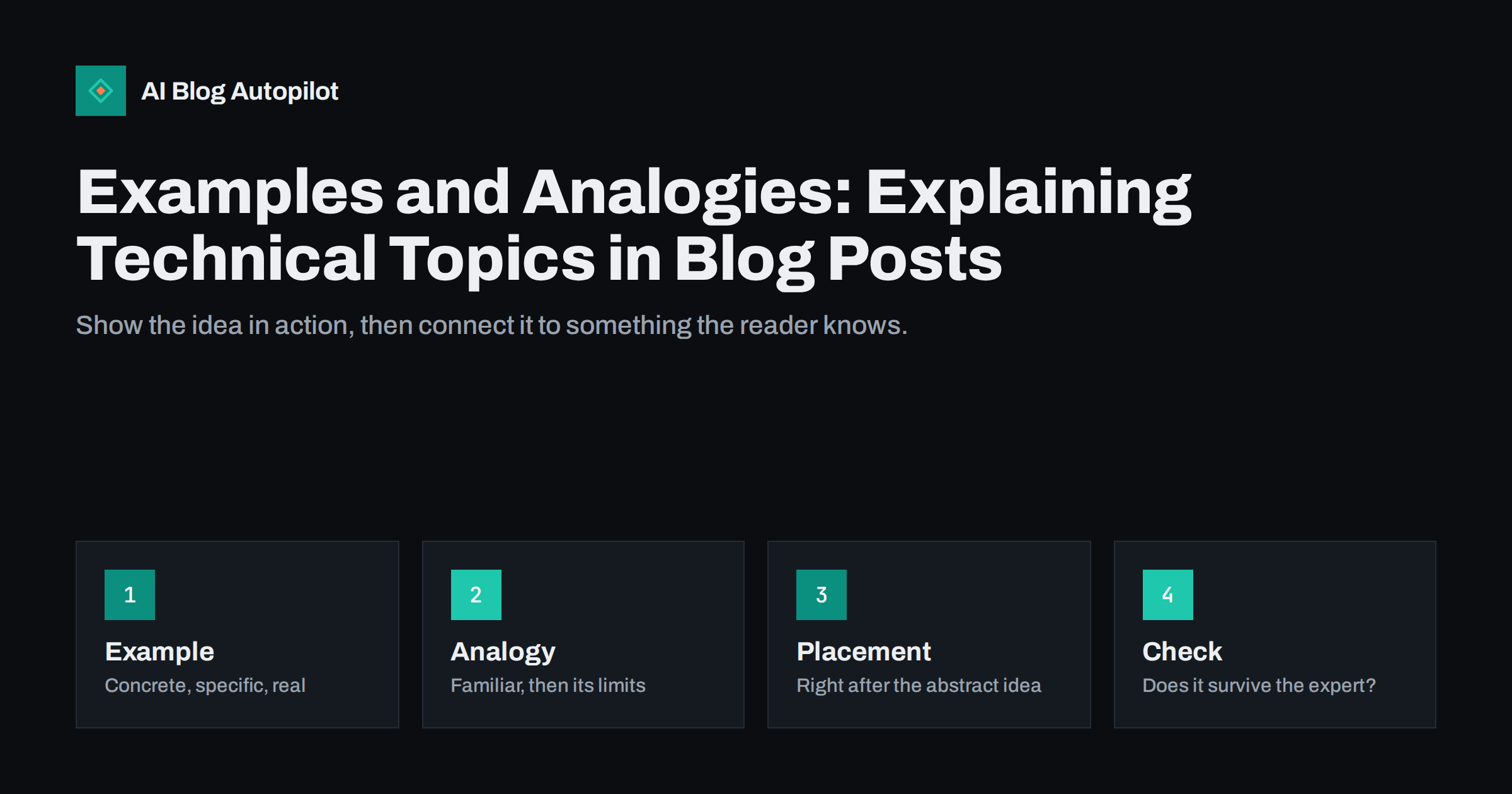
Short answer: an example shows an idea applied to a concrete case; an analogy explains an unfamiliar idea by comparing it with a familiar one. Both make technical articles readable, and both fail when they are vague, generic or stretched too far. Use a specific example immediately after every abstract statement that matters, choose analogies that match the structure of the idea rather than its surface, say where the analogy stops working, and prefer real cases from your own work over invented ones. Then check each example with someone who knows the subject, because a wrong example teaches the wrong lesson more effectively than a wrong sentence.
Business blogs explain technical things to non-technical readers all day: how a redirect works, what a canonical tag does, why a backup strategy matters, what an API is. The articles that succeed are rarely the ones with the most complete definitions. They are the ones where the reader can picture the idea. That is what examples and analogies do, and it is also where automated drafts are weakest, since they tend to produce generic examples (“a company might”) and worn analogies (“think of it like a library”). This article covers how to choose, place and test both, so that explanations land.
What examples do that definitions cannot
A definition tells the reader what something is. An example lets them see it. Most readers cannot hold an abstract definition in mind until they have seen at least one instance of it, which is why explanations that pile up definitions without examples feel exhausting even when every sentence is correct. Examples also do quiet work for search and AI answers: a passage that defines a term and then shows a concrete case is more likely to be understood, quoted and matched to the questions people ask, because questions are usually about cases, not definitions.
Examples carry a second benefit for a business. A real example from your own work is evidence of experience that a competitor cannot copy, and it makes the article distinguishable from the dozens of near-identical explainers on the same topic.
Choosing a good example
Not every example helps. The useful ones share a few properties.
- Specific: named objects, numbers and outcomes. “A bakery with 40 product pages” beats “a business with many pages”.
- Typical: the example should represent the normal case, not a rare edge case, unless the article is about edge cases.
- Short: one or two sentences for a point, a paragraph for a process. If the example needs its own section, it is a case study, which is a different thing.
- Self-contained: the reader should not need extra context from elsewhere to understand it.
- Honest: real examples are best; invented ones must be plausible and labelled as illustrations, never presented as things that happened.
- Relevant to the reader: use the industries and situations your readers are in, not whatever industry is easiest to write about.
When you have a choice, a before-and-after pair is the strongest form: the situation without the idea, then the situation with it. “Before the canonical tag, the product appeared in search under three different URLs and the links were split between them; after it, one URL collected them all.”
Choosing an analogy that fits
An analogy maps something the reader knows onto something they do not. The analogy works if the structure matches, not merely the surface. A library is a weak analogy for a search index if the only match is “a place with lots of items”, and a strong one if you use it to explain that the catalogue is separate from the shelves, that a book not in the catalogue cannot be found, and that cataloguing takes time after a book arrives. Test an analogy by asking which parts of the real idea it explains, which parts it does not, and whether any part of it suggests something false.
- Write down the idea’s parts and the relationships between them.
- Find a familiar system with the same parts and relationships.
- Check each mapping: does every important element of the idea have a counterpart?
- Identify where the analogy breaks, and plan to say so.
- Prefer analogies from everyday life over ones from other technical fields, unless your readers share that field.
Avoid the analogies everyone uses unless you can extend them in a useful way; readers have seen the plumbing, the highway and the recipe too many times to notice them.
Saying where the analogy stops
Every analogy is wrong somewhere, and the reader will eventually push it past its limit. Say where that is. “A redirect is like mail forwarding, with one difference: the post office forwards for a year, while a redirect should stay in place for as long as anyone might use the old address.” That single sentence prevents the reader from concluding that redirects can be removed after a while. The habit also signals honesty, which matters for technical subjects where readers are wary of being oversimplified at. If you cannot find a boundary, you probably have not thought the analogy through; if the boundary is so close that the analogy explains almost nothing, drop it and use an example instead.
Where to place them
Placement is as important as choice. The rule is simple: the example or analogy goes immediately after the abstract statement it supports, in the same paragraph or the next one. Readers who meet an abstract claim and then have to read three more paragraphs before seeing a case will have lost the thread. Other placement habits that help:
- Open a difficult section with the example, then state the general idea it illustrates. For hard concepts, concrete first works better than abstract first.
- Use one analogy per concept, and keep using it throughout the article rather than introducing a new one for each section.
- Mark examples clearly, with “for example” or a short lead-in, so that the reader knows the register has changed.
- Put long worked examples in their own subsection with a heading, so that skimmers can find or skip them.
- Do not end a section on an analogy. End on the real idea, so that the reader leaves with the accurate version.
Examples in automated drafts
Drafts produced with software tend to have a recognisable pattern: examples that are generic (“imagine a small business that sells products online”), analogies that are the most common ones for the topic, and a habit of offering several weak examples where one strong one would do. Editing for this is one of the highest-value passes you can make.
- Search the draft for “for example”, “imagine”, “think of it as” and “like a”. Each is a candidate for improvement.
- Replace generic examples with specific ones from your own work, your customers or your industry, with numbers where you have them.
- Delete worn analogies or extend them with a specific, accurate detail that makes them earn their place.
- Cut duplicate examples that make the same point.
- Check every example for accuracy, since an invented example can be subtly wrong in a way that a subject expert will spot immediately.
Give the tool better material to begin with: a brief that includes two or three real examples and the analogy you prefer produces drafts that need far less of this editing. Our article on writing a content brief explains what to include.
Testing examples and analogies
Two readers can tell you whether your explanation works: someone who does not know the subject and someone who knows it well. The first tells you whether the example made the idea clear. The second tells you whether it is correct and whether the analogy suggests anything false. If you have access to only one, choose the expert, because clarity errors are embarrassing but accuracy errors are expensive. After publishing, questions in comments, support tickets and sales calls show you where explanations still fail; those are the places to add or improve an example in the next refresh.
A quick self-test works when no second reader is available. Cover the example and read the definition alone: if you would not understand it without the example, the example is doing real work. Then cover the definition and read the example alone: if it could illustrate several different ideas, it is too generic and needs a detail that ties it to this one. Finally, read the analogy as if you believed it literally and list what you would conclude; anything false on that list needs a sentence that marks the boundary.
Common mistakes
- The example that needs its own explanation, drawn from a field the reader does not know.
- The analogy that is pushed into every section until it explains nothing.
- Invented examples presented as real, with made-up figures and company names that look like case studies.
- Examples that contradict the text because the draft was edited and the example was not.
- Numbers without units or context, which make examples look precise while saying nothing.
- Humour that replaces explanation, which is fine as seasoning and useless as structure.
How AI Blog Autopilot helps
AI Blog Autopilot writes SEO articles from the topics, keywords, audience and tone you set, and its writer is instructed never to make up statistics, quotes or sources. The best way to get specific examples into those articles is to put them in your topic notes and audience description, and to use approval mode so that an expert on your team can check each example before the article goes live. Plans are on the pricing page.
Related reading
- How to Write a How-To Article People Can Actually Follow
- Writing for Non-Native English Readers Without Dumbing Down
- Readability: Writing So People Finish the Article
- How to Write a Content Brief an AI Can Actually Use
The bottom line
Examples show an idea; analogies connect it to something known. Use a specific, typical, honest example right after every abstract point that matters, choose analogies whose structure matches the idea and say where they stop working, keep one analogy per concept and end sections on the accurate version. Edit automated drafts to replace generic examples with real ones, check everything with an expert and let reader questions show you where the next example is needed.
FAQ
How many examples should a technical article have?
At least one for every abstract point the reader must understand. One strong, specific example is better than three vague ones making the same point.
Are invented examples acceptable?
As labelled illustrations, yes, if they are plausible and accurate. Never present an invented example as a real case or give it fake figures that look like data.
What makes an analogy good?
Its structure matches the idea, not just its surface. It should explain the relationships between the parts, and the article should say where it stops applying.
Where should an example go in a paragraph?
Immediately after the statement it supports. For hard concepts, lead with the example and then state the general idea.
How do I improve examples in an automated draft?
Search for “for example”, “imagine” and “like a”, replace generic cases with real ones from your work, delete repeats and have a subject expert check accuracy.