ENEnglish
 LTLietuviškai
 DEDeutsch
 FRFrançais
 RUРусский
 ESEspañol
 PLPolski
 ITItaliano
 UKУкраїнська
 CSČeština
 PTPortuguês
 JA日本語
JA日本語 LVLatviešu valoda
 ETEesti
 HUMagyar
 IDBahasa Indonesia
 TRTürkçe
 HIहिन्दी
 ELΕλληνικά
 ARالعربية
 THไทย
THไทย VITiếng Việt
 RORomână
 MSBahasa Melayu
 BNবাংলা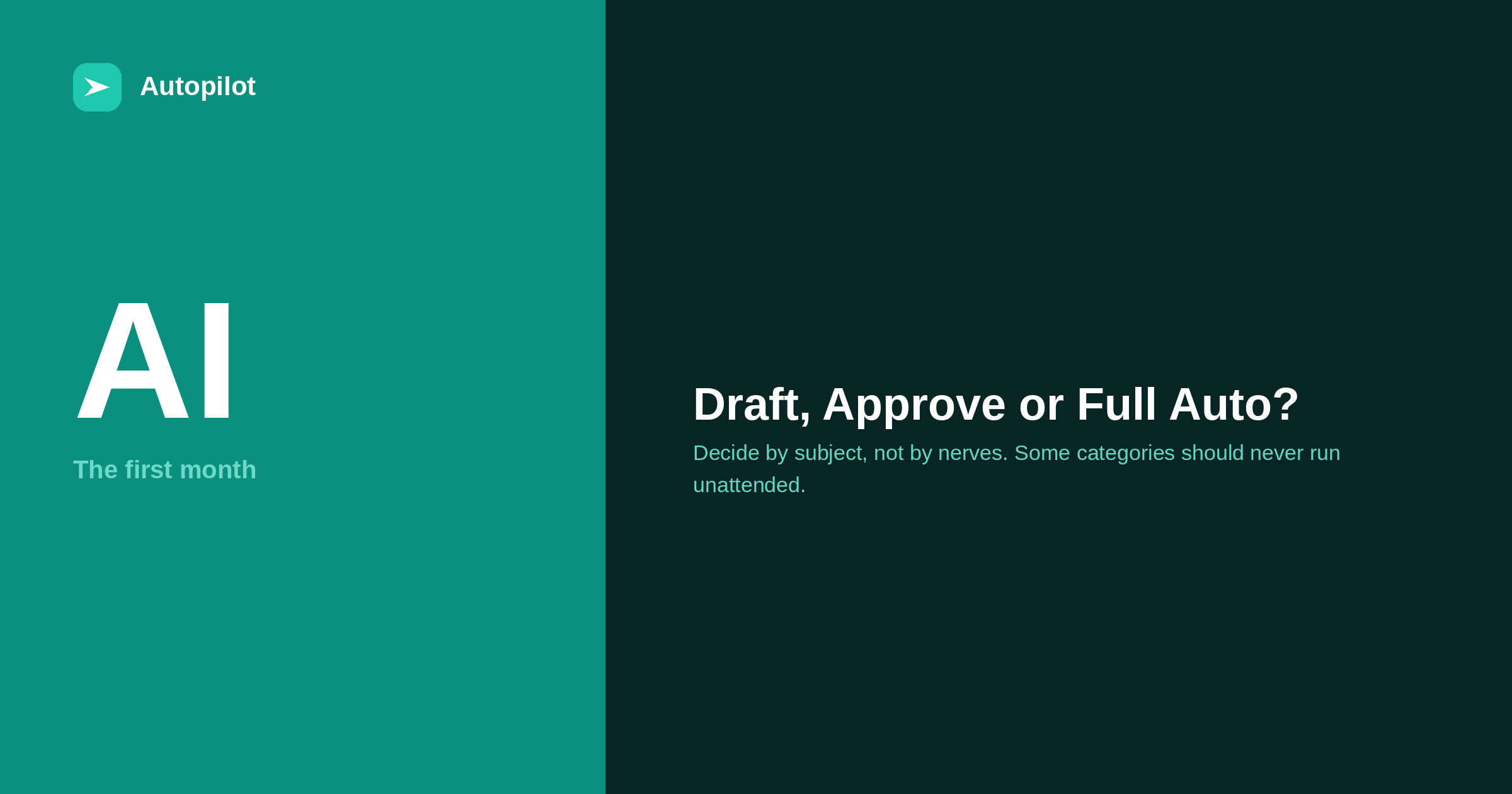
Short answer: start with everything as drafts, move to category-based approval once you can see the pattern, and let only low-risk explanatory topics run fully unattended. Decide by subject rather than by confidence: anything touching prices, regulated advice or claims about your own product keeps a reviewer permanently, and anything that is a straightforward explanation of a known subject can run without one. The failure mode to avoid is approving thirty articles a month one at a time, because that process collapses and takes the review with it.
Every team automating a blog has the same argument in the first week: does someone read these before they go live?
The unhelpful answers are "of course, always" and "no, that defeats the point". The useful answer depends on the subject, and it changes over time.
The three settings
Everything as drafts. Nothing publishes until a person clicks. Correct for the first month, because you are still learning what the output looks like and the cost of reading ten articles is small.
Approval by category. Some subjects publish directly; others wait. This is where most teams settle, and it is the only one that survives at volume.
Fully unattended. Everything publishes, and a sample gets read afterwards. Appropriate for explanatory content where a wrong sentence is embarrassing rather than damaging.
Moving between them should be a decision you make on evidence, not a default you discover because nobody configured anything.
Deciding by subject, not by nerves
The question is not how much you trust the writing. It is what a wrong sentence would cost.
| Subject | Setting | Why |
|---|---|---|
| Explainers and how-to guides | Unattended | Errors are visible and cheap to fix |
| Comparisons with competitors | Review | Claims about others carry legal weight |
| Anything with prices | Review | Prices change and wrong ones are costly |
| Your own product’s features | Review | Nothing external can verify these |
| Regulated subjects | Review, by a qualified person | Health, legal, financial |
| Local or seasonal content | Unattended | Low risk, high volume |
Written down like this, the policy is two sentences and anyone can apply it. Held in someone’s head, it becomes a case-by-case argument every week.
What a review should actually check
Reviewing is not proofreading. Reading for typos is the least valuable thing a reviewer does.
- Are the specifics right? Every number, date, price and product claim.
- Does it answer the question? Not: is it well written. Does it answer it.
- Does it contradict anything we published before? The most common problem at volume.
- Does it sound like us? Voice drifts slowly and nobody notices in a single article.
- Do the links go where they say? Covered in internal linking as you publish.
That is five minutes per article, not thirty. A review that takes thirty minutes is a rewrite, and if articles need rewriting the brief is wrong, not the reviewer.
Why per-article approval collapses
At two articles a month, approving each one is trivial. At thirty, it is a part-time job, and the predictable sequence follows: the reviewer falls behind, a backlog forms, approvals become rubber stamps, and the review provides no protection while still costing the delay.
A rubber-stamp process is worse than no process, because it produces confidence that nothing was checked.
The way out is to approve topics rather than articles. If the topic was approved and the category is low-risk, the article does not need a gate. Reserve genuine review for the categories where the decision table says it matters, and the workload stays proportionate however much you publish — which is the same logic behind choosing a cadence in how often to publish.
Sampling: the habit that catches drift
Even with unattended categories, read some of the output. Four articles a month chosen at random is enough to notice the things that develop slowly: a tone that has crept somewhere odd, a structural tic repeating, two articles converging on the same subject.
Sampling has a property per-article approval lacks: it is sustainable. A habit that survives the busy months provides more protection than a rigorous process that gets abandoned in March.
Writing the policy down
Two sentences, somewhere everyone can see them. For example: everything in explainers and how-to publishes directly; anything mentioning prices, competitors or our own features waits for review by a named person. Four articles a month are read at random regardless of category.
Autopilot supports either mode — articles can arrive as drafts for approval or publish directly — and team and client approval flows are available on the Agency plan, with the current tiers on the pricing page. The policy matters more than the mechanism, because a tool cannot tell you which of your subjects are risky. Only you know that.
Who should be the reviewer
The reviewer should be whoever knows the facts, not whoever has the most senior job title. For product claims that is usually someone in the product team; for anything regulated it is someone qualified; for tone it is whoever wrote the standing brief. Routing every article to one busy person because they are senior produces the backlog described above, and the person reviewing rarely has the knowledge that would catch the error that matters.
Related reading
If this was useful, these cover the questions that usually come next.
- Writing a brief an AI can use — fixing the brief instead of the article
- Planning a month of articles — approving topics rather than articles
- What Google actually says — why accountability matters more than authorship
The bottom line
Decide review by subject and write the policy in two sentences. Draft everything for the first month, then let explanatory categories publish directly and keep a real gate on prices, product claims, competitor comparisons and anything regulated. Approve topics rather than articles, and read a random sample every month. That is a process that still exists in six months, which is more than can be said for approving thirty articles one at a time.
FAQ
Should I review every article at the start?
Yes, for about a month. That is enough to see the pattern and to decide which categories are safe to run without a gate.
What should never publish unattended?
Anything with prices, claims about your own product, comparisons naming competitors, and anything regulated. Those need a person who knows the current facts.
How long should a review take?
About five minutes: specifics, whether it answers the question, contradictions, voice and links. If it takes thirty, the brief needs fixing rather than the article.
Is unattended publishing risky for SEO?
Not by itself. The risk is publishing pages with no purpose or wrong facts, which is equally possible with a reviewer who is not reading carefully.
What if the reviewer falls behind?
That is the signal to change the policy, not to work through the backlog. Move low-risk categories to unattended and keep review for where it earns its cost.
Can different categories have different rules?
Yes, and they should. A single rule for every subject is either too strict for explainers or too loose for anything commercial.