ENEnglish
 LTLietuviškai
 DEDeutsch
 FRFrançais
 RUРусский
 ESEspañol
 PLPolski
 ITItaliano
 UKУкраїнська
 CSČeština
 PTPortuguês
 JA日本語
JA日本語 LVLatviešu valoda
 ETEesti
 HUMagyar
 IDBahasa Indonesia
 TRTürkçe
 HIहिन्दी
 ELΕλληνικά
 ARالعربية
 THไทย
THไทย VITiếng Việt
 RORomână
 MSBahasa Melayu
 BNবাংলা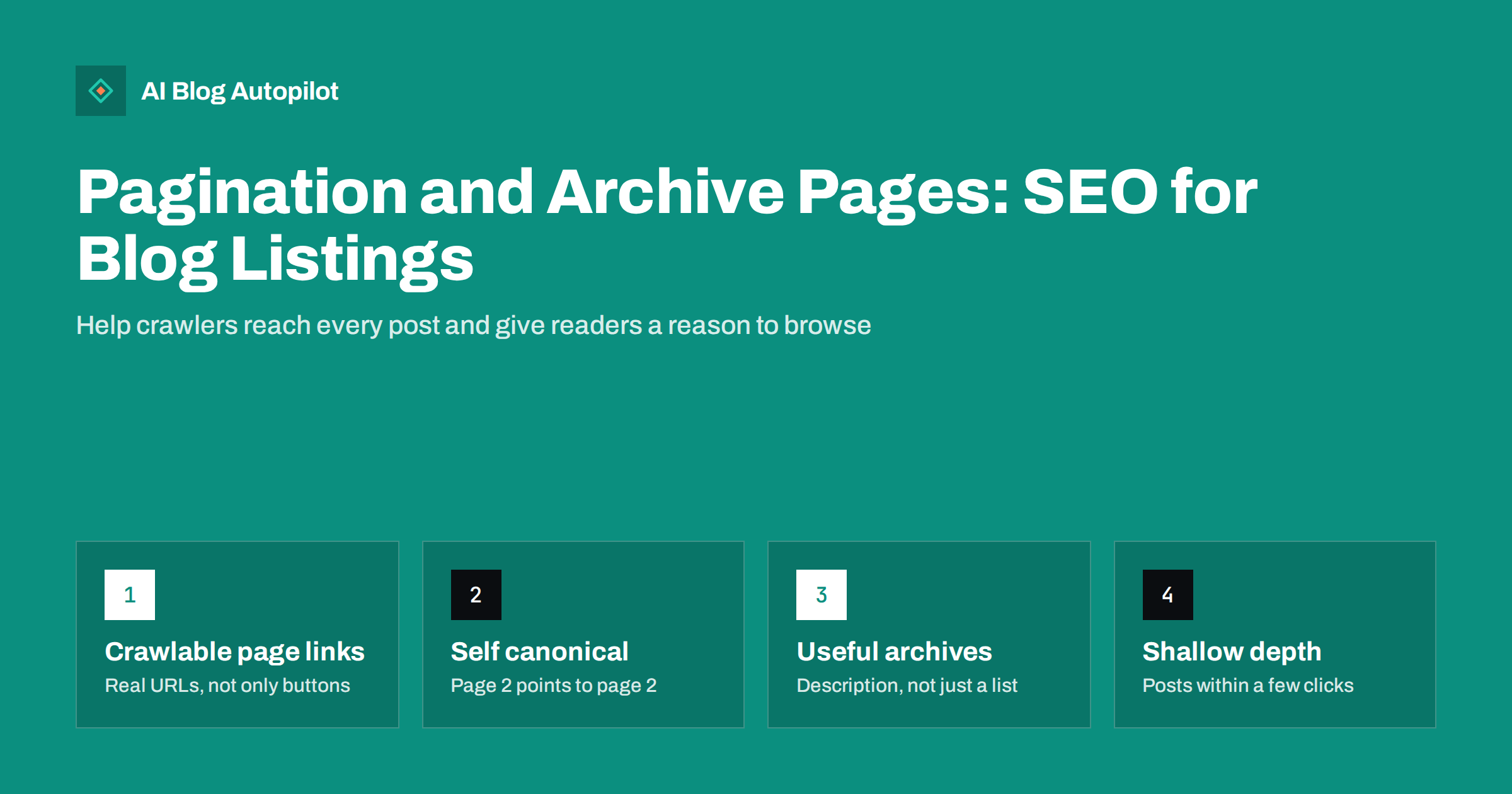
Short answer: blog archive pages, such as the main blog listing, categories and tags, are how crawlers and readers reach older posts, so they need crawlable pagination with real URLs like /page/2/. Each paginated page should normally be indexable or at least followable, carry a canonical tag pointing to itself rather than to page 1, and link to the pages around it. Google no longer uses rel=”next” and rel=”prev” as an indexing signal, so plain links do the work. Keep important posts within a few clicks of the homepage, add descriptions to key category pages, and make sure infinite scroll or “load more” buttons also have paginated URLs behind them.
Most blog owners think about individual posts and rarely about the pages that list them. Yet archive pages carry much of a blog’s internal linking. They decide how quickly crawlers find new posts, how deep older articles sit, and whether readers can browse a subject rather than leaving after one article.
Pagination, the splitting of long lists into page 1, page 2 and so on, is where most of the technical questions arise. This guide covers what matters for a typical blog.
What archive pages do on a blog
A blog usually has several kinds of listing pages:
- The main blog index, listing all posts from newest to oldest.
- Category archives, listing posts in each category.
- Tag archives, listing posts with each tag.
- Author and date archives, created automatically by many platforms.
Each of these, once it holds more posts than fit on one page, is split into paginated pages. On WordPress, these typically look like /category/seo/page/2/.
For crawlers, these pages are pathways. A new post appears first on page 1 of the blog index and its category, where crawlers find it quickly. As newer posts arrive, it moves to page 2, page 3 and beyond, getting further from the homepage with every step. Without good archives and internal links, older posts gradually become hard to reach.
How search engines handle pagination today
For years, the recommended approach was to mark paginated series with rel="next" and rel="prev" links. Google announced in 2019 that it no longer uses these as an indexing signal. They are harmless to keep, and some other search engines or browsers may use them, but they are not needed for Google.
Today Google treats paginated pages much like any other pages. Its guidance on pagination and incremental page loading recommends:
- Giving each page its own URL, such as
?page=2or/page/2/. - Linking pages to each other with ordinary crawlable links.
- Using a self-referencing canonical on each page, rather than pointing every page’s canonical at page 1.
- Making sure content loaded by “load more” or infinite scroll is also reachable through paginated URLs.
That guide is written with online shops in mind, but the same principles apply to blog archives.
Canonical tags on paginated pages
A common mistake, often from older SEO plugins or themes, is setting the canonical of every paginated page to page 1. It seems tidy, but it tells search engines that page 2 and beyond are copies of page 1. They are not: they list different posts.
The result can be that search engines stop crawling deeper pages, and posts that only appear on those pages become harder to discover.
The correct setup is simple: /blog/page/2/ has a canonical pointing to /blog/page/2/. Check a few paginated URLs on your site by viewing the page source and searching for “canonical”.
Should paginated pages be indexed?
This is a matter of choice rather than a strict rule, and approaches differ:
| Approach | Effect | When it suits |
|---|---|---|
| Index all paginated pages | Deeper pages may appear in search, usually rarely | The default on many sites; simple and safe |
| Noindex page 2 onwards, keep links followable | Only page 1 appears in search; crawlers still follow links | Sites that want cleaner indexing reports |
| Block paginated URLs in robots.txt | Crawlers cannot reach deeper pages | Not recommended for blog archives |
Either of the first two is reasonable. The important thing is not to cut crawlers off from deeper pages entirely, because that is how they reach many older posts. Be aware that pages kept on noindex for a long time may be crawled less often over time, which is another reason to make sure important posts are also linked from elsewhere.
Keeping posts within a few clicks
Click depth, the number of clicks needed to reach a page from the homepage, is a useful way to think about archives. Posts that sit on page 30 of a blog index might need thirty clicks to reach through pagination alone.
Ways to keep important posts shallow:
- Use categories properly. A handful of focused categories, each linked from the menu, means every post is within a few pages of a category’s first page.
- Link from pillar pages. A guide that links to all the posts in a topic cluster gives each of them a direct path.
- Add contextual links. Links from related posts are often the shortest route to older articles.
- Show more posts per page where it does not hurt page speed. Twelve or more posts per listing page shortens the chain compared with five.
- Use numbered pagination that links to several pages and to the last page, rather than only “next” and “previous”.
Infinite scroll and “load more”
Many modern themes replace numbered pages with infinite scroll or a “load more” button. These can be pleasant for readers, but crawlers generally do not scroll or click buttons.
If your blog uses either pattern, check that:
- Paginated URLs such as
/page/2/still exist and return the next set of posts. - The page contains ordinary links to those URLs, even if readers mainly use scrolling.
- When readers scroll, the URL in the address bar updates to reflect the page, so sharing and returning work as expected.
Test by disabling JavaScript in your browser or viewing the page source: if you cannot find a link to page 2, crawlers may not either.
Making archive pages worth visiting
Category pages can do more than list posts. A good category page can rank for the broad topic itself and help readers who arrive there.
- Add a short introduction on page 1: what the category covers, who it is for and where to start.
- Highlight key posts, such as a beginner’s guide or the most useful articles, before the chronological list.
- Keep the description on page 1 only, so paginated pages do not repeat the same text.
- Use clear titles for paginated pages, such as “SEO articles, page 2”, so they are not identical to page 1.
A category page that answers “where do I start with this topic?” is genuinely useful to a newcomer, and it gives search engines a clear hub for the whole subject. Updating it when you publish a major new guide takes a minute and keeps it current.
For tag archives, the same applies to the few tags that matter. Tags with one or two posts rarely deserve an indexable page; consider merging them or setting them to noindex.
Common archive and pagination mistakes
- Canonical to page 1 on every paginated page.
- Paginated URLs blocked in robots.txt or set to nofollow.
- Infinite scroll without URLs, leaving older posts reachable only by scrolling.
- Hundreds of thin tag pages, each with one post and no description.
- Date and author archives duplicating the main index on single-author blogs; many sites disable or noindex them.
- Only “next” and “previous” links, creating very long chains to reach older pages.
A ten-minute check catches most of these. Open page 2 of your blog index and of your largest category, view the source and confirm the canonical points to that page and that there is no noindex or nofollow you did not intend. Click through to the last page and count how many clicks it took. Then run a crawler with JavaScript rendering switched off and compare the number of posts it finds with the number in your sitemap. If the crawler finds noticeably fewer, some posts are reachable only through the sitemap or scrolling, and your archives or internal links need attention.
How AI Blog Autopilot fits in
AI Blog Autopilot publishes new articles to your WordPress blog on a schedule, with tags, FAQ and SEO meta, and shares each one to your social networks. A blog that grows steadily fills its archives quickly, so the pagination, canonical and category settings in this guide become more important with every month of publishing. They are set once in your theme and SEO plugin. You can see how the publishing works on the AI Blog Autopilot home page.
Related reading
- Categories or Tags: How to Organise a Blog
- Canonical Tags Explained Without the Jargon
- Breadcrumbs and Navigation for a Growing Blog
- Orphan Pages: Finding Blog Posts Nothing Links To
The bottom line
Archive pages are the roads crawlers and readers use to reach your older posts. Give every paginated page its own crawlable URL and a self-referencing canonical, keep deeper pages followable, back infinite scroll with real page URLs, and shorten click depth with focused categories and contextual links. Then give your main category pages a short introduction so they help readers as well as crawlers.
FAQ
Does Google still use rel next and prev?
No. Google announced in 2019 that it no longer uses rel=”next” and rel=”prev” as an indexing signal. Keeping them does no harm, but ordinary crawlable links between paginated pages are what matter.
Should paginated pages have a canonical to page 1?
No. Each paginated page lists different posts, so its canonical should point to itself. Pointing every page’s canonical at page 1 tells search engines the deeper pages are duplicates and can make older posts harder to discover.
Should I noindex blog pagination?
It is optional. Leaving paginated pages indexable is simple and safe, while noindexing page 2 onwards keeps indexing reports tidier. In either case, keep the links followable and do not block paginated URLs in robots.txt.
Is infinite scroll bad for SEO?
Not if it is backed by paginated URLs. Crawlers generally do not scroll, so the page must also contain ordinary links to URLs such as /page/2/ that load the next set of posts. Without them, older posts may only be reachable by scrolling.
How many posts should a blog archive page show?
There is no fixed rule, but showing a dozen or more posts per page shortens the chain of pages crawlers and readers must follow. Balance the number against page speed, especially if each listing includes large images.
Should date archives be indexed on a blog?
Usually not. On most blogs, date archives repeat the same posts as the main index and categories without adding anything for readers. Many sites disable them or set them to noindex, while keeping categories and important tags indexable.