ENEnglish
 LTLietuviškai
 DEDeutsch
 FRFrançais
 RUРусский
 ESEspañol
 PLPolski
 ITItaliano
 UKУкраїнська
 CSČeština
 PTPortuguês
 JA日本語
 LVLatviešu valoda
 ETEesti
 HUMagyar
 IDBahasa Indonesia
 TRTürkçe
 HIहिन्दी
 ELΕλληνικά
 ARالعربية
 THไทย
 VITiếng Việt
 RORomână
 MSBahasa Melayu
 BNবাংলা
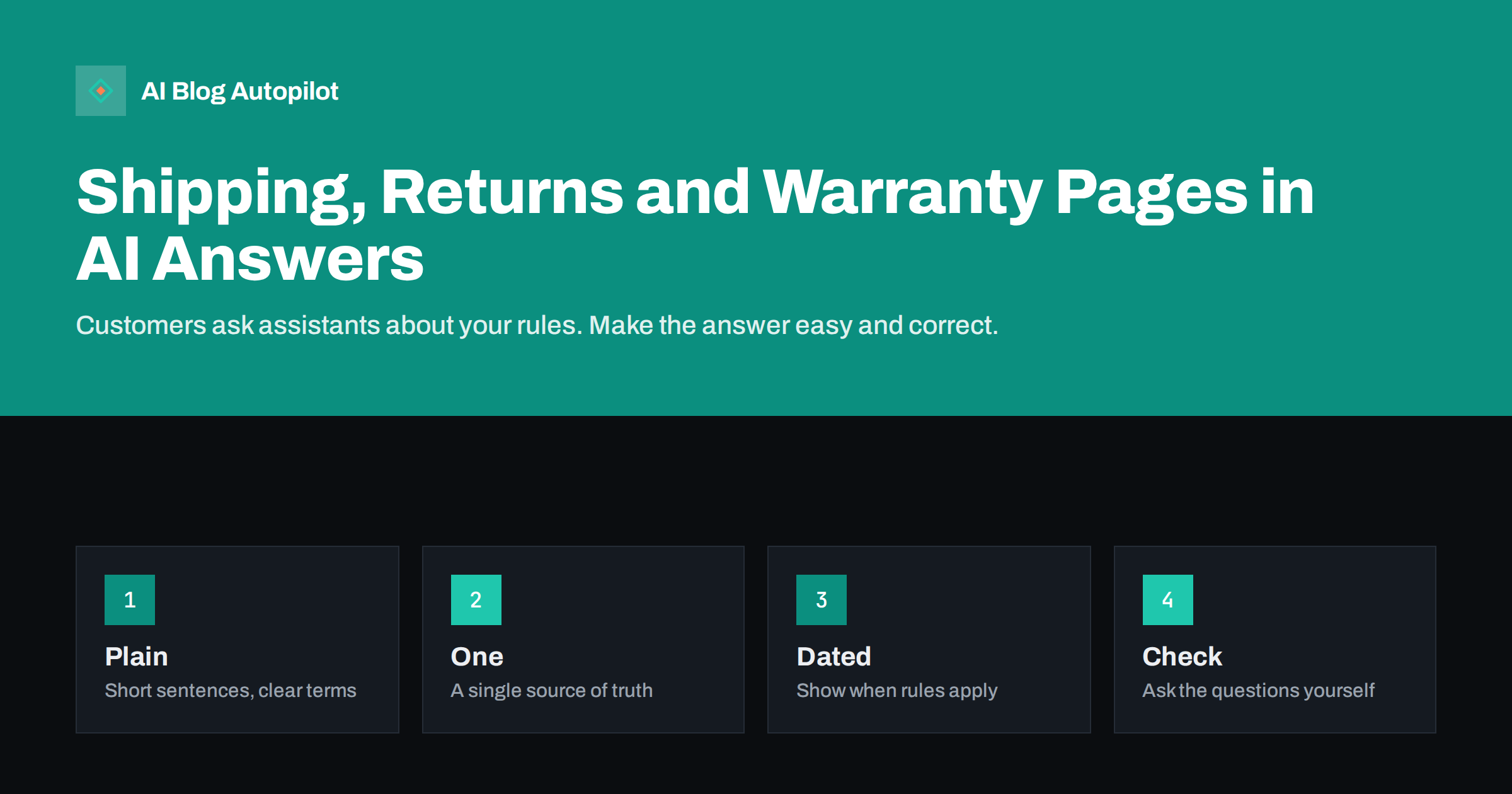
Short answer: shoppers increasingly ask AI assistants questions such as how long delivery takes, whether returns are free or how long a warranty lasts. To make sure that the answer is right, write your policy pages in plain language, keep one clear version of each rule, show the date and the exceptions, and check what assistants say. Pages that are clear and consistent are quoted correctly more often.
Policy pages are not glamorous, and many businesses treat them as a legal chore. Yet they answer some of the most common questions that customers have just before they buy. If an assistant guesses or uses an old copy, the customer may expect something you do not offer, and you pay for it in support time and disputes. This article shows how to make these pages work for readers and for the tools that summarise them.
Why policy pages matter for AI answers
Questions about delivery, returns and warranties are specific and factual. People want a number of days, a cost, a condition or a yes or no. Assistants try to give a short answer, and they take it from pages that appear to state the rules clearly. If your own page is vague or hidden, they may rely on a review site, a forum post or a competitor’s page that happens to be clearer.
Mistakes cost money. If an assistant says that returns are free when they are not, or gives a wrong time limit, some customers will arrive with expectations that you must then handle. Making the correct answer easy to find is a form of customer service. Our article on when AI answers get your business wrong covers what to do when it happens anyway.
These pages also build trust. Clear, fair terms tell buyers that you stand behind your products. That helps conversion for human visitors as much as it helps machines.
Ask someone outside your business to read the page and explain it back to you. If they cannot say how long a return window lasts or who pays for shipping after one reading, the page needs work. Fresh eyes find unclear sentences much faster than the people who wrote them.
Write in plain language
Start each policy with a short summary in two or three sentences. Say what customers can expect in simple terms, such as the main time limit, who pays for what and where to start. Then give the detail below. This mirrors the way that answer-first writing helps readers, as explained in answer-first writing.
Use short sentences and everyday words. Avoid long paragraphs of legal wording that hide the main rule in the middle. If you need formal text for legal reasons, keep it in a separate section and put the plain explanation first. Do not give up accuracy for simplicity: the plain version must say the same as the formal one.
Put numbers and units in the text. “Within 30 days of delivery” is clearer than “within the stated period”. Be exact about what the period counts from, such as the date of the order, the date of delivery or the date of purchase.
Do not forget internal tools. Chat scripts, support templates and staff guides often contain a copy of the rules. If they differ from the web page, customers receive mixed messages, so include them in the same update routine.
One source of truth
The most common cause of wrong answers is conflict. The shipping time appears in the product page, in the footer, in an old blog post and in a downloadable document, and they do not all match. When sources disagree, assistants may pick any of them, and customers cannot tell which one to trust.
Choose one page as the master for each policy and link to it from everywhere else. On other pages, state the rule in one short sentence and point to the master page, or repeat only what you are sure will stay in sync. Our article on conflicting facts across pages describes how to find mismatches.
Make a list of every place where each rule appears and note who must update them when the rule changes. Include emails, order confirmations, help pages and social posts. A change in policy should lead to a checked update of all of them.
Make delivery estimates honest. If delays are common in busy seasons, say so on the page and give a realistic range instead of the best case. An accurate range quoted by an assistant is much better than an optimistic number that causes complaints.
Dates, versions and exceptions
Show when the page was last updated and when the current rules took effect. If you have changed the policy, say what changed, especially if the change affects orders already placed. A date helps people and tools decide whether the information is current, which is a problem discussed in product facts for AI answers.
State exceptions openly. Many rules differ for sale items, custom orders, large goods, digital products, certain countries or particular carriers. If you list them as part of the rule, assistants can include them in the answer. If you hide them in small print, the answer will often leave them out, and the customer will be surprised.
Give each region its own section if rules differ. A single page that mixes rules for several countries without clear headings invites errors. Use headings with the country or region, and keep the order and wording consistent between sections.
Structure the page for quoting
Use clear headings that match the questions customers ask: how long does delivery take, how much does shipping cost, how do I return an item, who pays for return shipping, how long does a refund take, what does the warranty cover and how do I make a claim. Under each heading, give the answer in the first sentence and the detail afterwards.
Lists and steps work well for processes such as starting a return. A short numbered list that says what to do, where to go and what to send is easy to read and easy to summarise. A simple table can help with shipping options if it has few columns and plain labels.
A short question and answer section at the end can collect the remaining details. The guidance in FAQ page versus FAQ sections explains how to decide where such questions belong. Keep the page on a normal, readable web address, not inside a pop-up or an image, so that it can be found.
Link policy pages from the right places
Customers and crawlers both need to find these pages. Link them from the footer, from product pages, from the cart and checkout, and from your help centre. Use clear link text that says what the page is, such as “Returns and refunds” and not just “Policy”. Add them to your sitemap and make sure that they are not blocked.
Think about trust signals as well. A visible contact page, company details and real contact options near the policies make the whole set more credible, as discussed in contact and trust pages. If you sell online, the points in ecommerce blog strategy help connect policy content with your wider plan.
Write blog posts that answer the long questions around these topics, such as how to choose a size to avoid returns or how to look after a product to keep the warranty valid. Link them to the policy pages, which keeps the official rule in one place.
Keep a small log of the questions, the answers and the dates. Over time it shows whether your changes help, and it gives you proof of what an assistant said if a customer ever disputes what they were told. Screenshots are enough for this purpose.
Check what assistants say
Once the pages are live, ask assistants the questions that your customers ask. Try a few different phrasings, such as how long does delivery from your business take, what is the returns policy for your business and does it include a warranty. Compare each answer with your pages. Record mistakes and look for their cause: an old page, a mismatch, a missing exception or an unclear sentence.
Fix the source, not just the symptom. If an answer is wrong because of a third-party page, you may be able to ask the owner to correct it, or you can strengthen your own page so that it becomes the better source. See checking visibility in AI answers for a simple routine.
Repeat the check after each policy change and at least every few months. Answers drift as sources change, and a regular look catches problems before customers do.
Take legal advice where needed
Consumer rules differ between countries and between types of product, and some terms are required by law. This article is about clarity, not about what your policy must contain. If you are unsure whether your terms meet the rules that apply to you, get advice from a qualified professional, and then write the plain-language version to match the approved text.
Avoid promising more than you can deliver. A policy that is generous but not followed damages trust far more than a strict one that is kept. Write what you will really do, and make it easy for staff to follow.
Keep the approved text safe, with dates and versions, so that you can show what applied to a given order. Good records protect you and your customers.
How AI Blog Autopilot helps
AI Blog Autopilot writes full SEO articles for your WordPress blog from the topics, keywords, audience and tone you set, with FAQ sections, tags and SEO meta included, and it shares each one to your social networks. Use it for the helpful content around your policies, and use approval mode to read each article first and make sure that any rule it mentions matches your own policy page. See the pricing page for plans.
Related reading
The bottom line
Write policy pages in plain words, keep one source of truth, show dates and exceptions and check what assistants say. Clear pages protect customers and your support team.
KKK
Why do AI assistants get my returns policy wrong?
Often because several pages disagree, the rule is hidden in long text or an old copy is easier to find. Fix conflicts and state the rule plainly.
Should policy pages have a summary?
Yes. Two or three plain sentences at the top give readers and assistants the main rule before the detail.
Do I need separate pages for each country?
Not always, but rules that differ by region need clear headings or separate pages, so answers do not mix them up.
How often should I review policy pages?
Whenever a rule changes, and at least every few months. Ask assistants your customers’ questions at the same time.
Can I use a PDF for my policy?
Better to publish the rule as a normal web page and offer a PDF as an extra. Web pages are easier to find and quote.