ENEnglish
 LTLietuviškai
 DEDeutsch
 FRFrançais
 RUРусский
 ESEspañol
 PLPolski
 ITItaliano
 UKУкраїнська
 CSČeština
 PTPortuguês
 JA日本語
 LVLatviešu valoda
 ETEesti
 HUMagyar
 IDBahasa Indonesia
 TRTürkçe
 HIहिन्दी
 ELΕλληνικά
 ARالعربية
 THไทย
 VITiếng Việt
 RORomână
 MSBahasa Melayu
 BNবাংলা
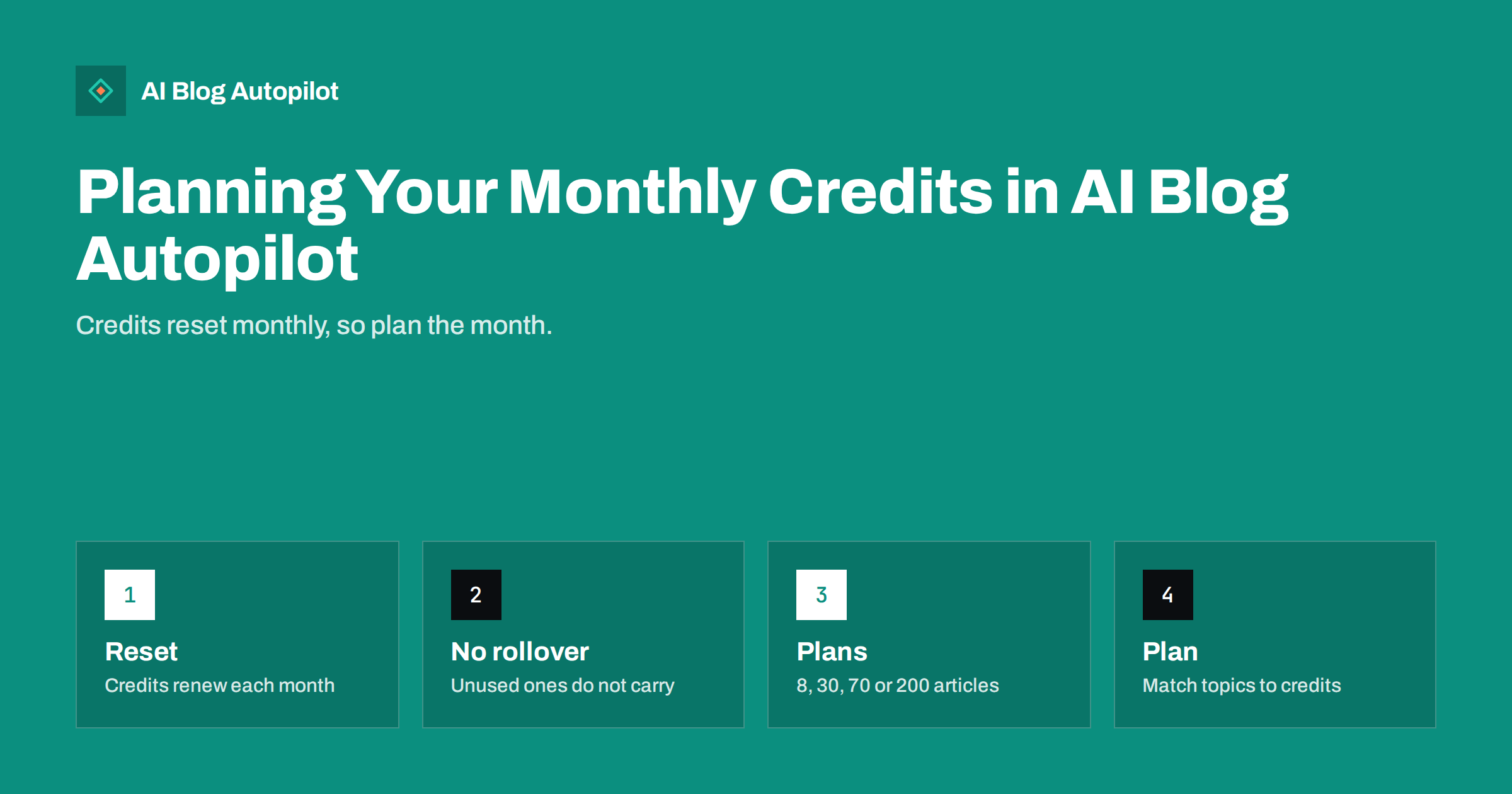
Short answer: AI Blog Autopilot credits are monthly: they reset each month and do not roll over, and one credit gives one full article. Starter includes 8 articles a month, Growth 30, Pro 70 and Agency 200, while the Social plan includes 60 social posts. Plan your topics at the start of the month so every credit is used on something useful.
A credit system is easy to understand and easy to waste. If you know that unused credits disappear, it makes sense to plan what you will do with them. If you treat them as a vague allowance, you may reach the end of the month with articles you could have had.
This guide explains what the product says about credits, how to choose a rhythm that fits your goals, how to plan the month on the content map and how to review the numbers. All prices and limits come from the product’s pricing page at the time of writing, so check it for current details.
What the product says about credits
The pricing page states that credits reset every month and do not roll over. The home page adds that one credit gives one full article, planned around a real search query, with FAQ, tags and SEO meta. Articles can be up to 3,000 words, and the first three articles are free, with no card needed.
The plans listed are Social at 15 euros a month, with 60 social posts and no website needed; Starter at 19 euros, with 8 articles; Growth at 49 euros, with 30 articles; Pro at 99 euros, with 70 articles; and Agency at 249 euros, with 200 articles. Yearly billing is shown at 20 percent lower, and VAT is added at checkout. You can cancel at any time.
These are the facts to plan with. Details about what happens at the edge of a limit, such as running out early in the month, are best confirmed in your account or by asking the team, because this article cannot promise anything the product pages do not state. The guide to piloting an AI blog tool shows how to test a tool before you commit.
Turn credits into a weekly rhythm
Dividing a monthly number by the weeks gives a rhythm you can picture. Eight articles is about two a week. Thirty is about one a day. Seventy is two to three a day, and two hundred is around six or seven a day. These are simple sums, not promises about when articles will go out, since your own settings decide the schedule.
Ask which rhythm matches your needs. A small local business may find two articles a week plenty, since each article is long and thorough. A shop with many product areas, or a company in several languages, may need more. Think about how much you can review: more articles mean more to read, even if the writing is automatic.
Consider your competition and your starting point. A new blog usually benefits from a steady rhythm over many months more than a sudden burst. The guide to how often to publish blog posts explains the trade-offs.
Plan the month before it starts
Because credits are monthly, the natural moment to plan is the start of the month. Look at your calendar: promotions, events, seasonal peaks, holidays and product launches. Decide which topics need articles ahead of those dates, and raise their weights so that the planner schedules them in time.
The product plans the month from the topics you set, using weight, keywords, audience and tone. Review those settings briefly, making sure they reflect the month ahead. Remove anything out of date and add new topics that matter now. The guide to prioritising blog topics helps you decide what deserves the most weight.
Open the content map and look at the calendar. Check that the articles are spread across the month, that no important week is empty and that the mix of topics matches your priorities. Small adjustments now are easier than fixing gaps later.
Avoid wasting credits
Waste usually comes from two causes: unused credits and unhelpful articles. For the first, review your plan after two or three months. If you routinely finish with credits unused, consider a smaller plan, or add topics to use the capacity well. If you often wish for more, consider a larger one.
For the second, spend effort on topic quality. A vague topic produces a general article that no one needs. A specific topic tied to a real customer question produces a page that works. The quality gate holds back weak articles for you to check, but better settings prevent weak articles from being written at all.
Do not chase the maximum number of articles for its own sake. The product is about long-form articles at a steady pace, not mass-produced pages. Choose the number you can support with good topics, true facts and a quick review. The article on scaling from 4 to 30 posts a month discusses how to grow safely.
Spread the work across the month, not across the first week. Because articles are published at the hours you choose and shared to networks at their own timing, a steady spread gives your audience a constant flow, and gives you time to review each one. Bunched articles produce a burst followed by silence, which readers and search engines notice.
Leave a margin for events you cannot predict. News in your industry, a sudden change in your offer or a viral question from customers may deserve an extra article. If you plan every credit in advance, you have no room to react. Keep a small part of the month open, and fill it when something worth covering appears.
Think about languages and websites
Plans also differ by languages and websites. Starter includes 1 website and 1 language, Growth 2 websites and 3 languages, and Pro 5 websites with all 25 languages. Agency lists 20 websites. When you plan credits, remember that articles for several sites or languages draw from the same monthly allowance.
That means a decision about spreading. If you run two websites on Growth, you may give each about fifteen articles, or favour the one with the stronger business case. If you publish in three languages, consider whether each language needs the same number of articles or whether one should lead.
Write the split down at the start of the month. A simple table of site, language and planned articles keeps everyone aligned. For multilingual publishing, see which languages to publish in.
Be ready to change plans as your needs change. Seasonal businesses may want more articles before their busy period, and a business that has built a large library may want fewer. Because credits reset monthly and you can cancel any time, according to the pricing page, the decision is not permanent. Review it at least every quarter, and write down the reason for each change so you can see later what worked.
Keep an eye on the quality of what you publish with each credit. A plan is only worth its price if the articles are read, shared and acted on. If review shows that many articles are held back or need heavy edits, the problem is rarely the number of credits; it is usually the brief. Improve the topic settings before you buy more.
Review the numbers each month
At the end of each month, count what was published and compare it with the plan. Use the content map to see the articles and the networks they reached. Note which topics produced the best readers’ response, enquiries or search impressions, and which fell flat.
Use that review to adjust the next month. Move weight toward topics that work, retire those that do not, and think about whether the rhythm still suits you. Keep a one-page record of each month: credits available, articles written, held articles, and any changes made. After a quarter, you will see patterns.
The monthly blog review agenda gives a ready list of questions. Combine it with data from Search Console and your analytics, as explained in how to measure blog ROI.
If you are a freelancer or small agency, think about how credits relate to clients. Dividing a plan between several clients is a business decision, and the Agency plan lists 20 websites, 200 articles, team and client approval, and API and white-label reports. Keep a simple ledger of credits per client, review it monthly and agree expectations in writing so that no one is surprised.
Finally, remember that credits are a means, not a goal. What counts is whether the articles help customers and bring enquiries. A smaller number of excellent, well-chosen articles will serve a business better than a large number of average ones. Use the numbers to plan, then judge the results by what your readers do.
Using the Social plan and social-only mode
The Social plan works differently: it covers 60 social posts a month, needs no website, and includes one brand, 5 social networks and one language. The credits there are posts, not articles, so planning means thinking about which networks, what mix of content and how often you want to appear.
Use the same discipline. Look at the month ahead, choose the themes you want to cover and check that the posts match your calendar. A mix of tips, how-tos, product posts, questions and seasonal moments, which the product describes for social-only mode, keeps a feed varied. The guide to blog versus social media only compares the approaches.
The product says you can add a blog later and your plan moves with you. Treat social-only mode as a starting point if you are not ready for a website yet.
How AI Blog Autopilot helps
You can test the credit system at no cost: the first three articles are free and need no card. Start at AI Blog Autopilot, set up your topics and look at the pricing page when you are ready to choose a plan.
Related reading
The bottom line
Credits reset monthly and do not roll over, so plan topics at the start of the month, match the rhythm to what you can review and check the numbers at the end.
KKK
Kas kasutamata krediidid kanduvad üle?
No. According to the pricing page, credits are monthly and reset with each month.
How many articles does each plan include?
Starter includes 8 articles a month, Growth 30, Pro 70 and Agency 200. The Social plan includes 60 social posts.
What does one credit buy?
One credit gives one full article, planned around a real search query, with FAQ, tags and SEO meta.
Can I try it before choosing a plan?
Yes. The first three articles are free and need no card.
How do I avoid wasting credits?
Plan topics at the start of the month, use specific topics tied to real questions and review usage monthly.