ENEnglish
 LTLietuviškai
 DEDeutsch
 FRFrançais
 RUРусский
 ESEspañol
 PLPolski
 ITItaliano
 UKУкраїнська
 CSČeština
 PTPortuguês
 JA日本語
JA日本語 LVLatviešu valoda
 ETEesti
 HUMagyar
 IDBahasa Indonesia
 TRTürkçe
 HIहिन्दी
 ELΕλληνικά
 ARالعربية
 THไทย
THไทย VITiếng Việt
 RORomână
 MSBahasa Melayu
 BNবাংলা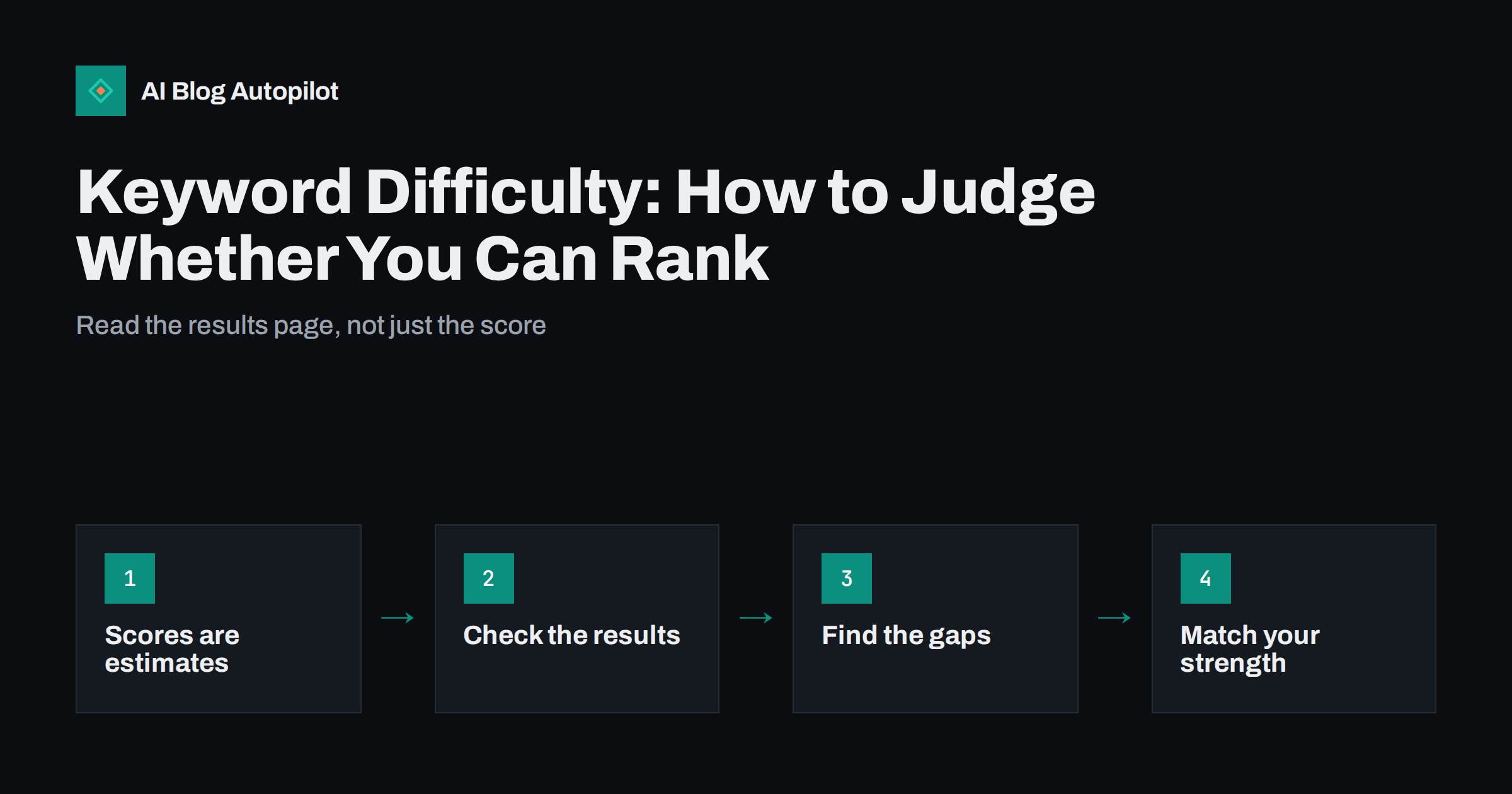
Short answer: keyword difficulty is an estimate, made by SEO tools, of how hard it would be to reach the first page of results for a search query, usually based mainly on the links pointing to the pages that already rank. It is useful for sorting a long list of ideas, but each tool calculates it differently and none knows your site’s real strength. The reliable test is to look at the actual results page: if it shows forums, thin articles, old posts or pages that miss the searcher’s intent, a smaller blog has a realistic chance. If it is full of strong, specific pages from well-known sites, pick a narrower query first.
Almost every keyword tool shows a difficulty score next to each query, often coloured from green to red. It is tempting to treat that number as a verdict: green means write it, red means forget it.
The number is more useful than nothing, but far less precise than it looks. This guide explains what difficulty scores measure, where they mislead, and a simple manual method for judging whether your blog can compete for a query.
What keyword difficulty measures
Each tool has its own formula, and most do not publish the details. Broadly, difficulty scores are built from signals such as:
- Links to the ranking pages. How many different websites link to the pages currently on the first page. This is the main input for many tools.
- The authority of the ranking domains. The tool’s own estimate of how strong each ranking site is overall.
- Sometimes content or SERP features. Some tools add factors such as the presence of ads, videos, AI summaries or other features on the results page.
The output is usually a score from 0 to 100. It is an estimate made by a third party from its own crawl of the web, which is always incomplete and never identical to what search engines see.
Why tools disagree
Run the same query through three tools and you will often get three different scores, sometimes wildly different. That is expected, for several reasons:
- Different link databases. Each tool crawls the web separately and finds a different set of links.
- Different formulas. One tool may weigh the strongest ranking page heavily, another the average of all ten.
- Different result snapshots. Results change by location, device and date. A tool may have checked the results weeks ago in another country.
- What is left out. No tool fully measures content quality, how well a page matches intent or how much search engines trust a site on a topic.
Treat difficulty as a way to sort a list, not as a measurement. Comparing scores within one tool is reasonably meaningful; comparing a score in one tool with a score in another is not.
What difficulty scores miss
The biggest gaps are exactly the factors that decide whether a focused blog can compete:
- Intent match. A page with many links can still rank poorly if it answers a slightly different question. A precise, better-matched page can overtake it.
- Topical focus. A site that covers a subject in depth often competes above its apparent weight on queries within that subject.
- Freshness. For topics that change, an up-to-date article can beat an older, more linked one that has gone stale.
- Content quality. Scores do not read the pages. A result full of thin, outdated or generic articles looks just as “difficult” as one full of excellent pages if the link numbers are similar.
- Your own site. A score of 40 means something very different for a new blog and for an established site with years of links.
How to judge difficulty from the results page
The most reliable check takes five minutes and needs no tool. Search the query in a private window, look at the first page, and answer these questions:
- What kinds of sites rank? Major brands, government sites and large publishers are hard to displace. Small blogs, niche sites and forums suggest room for a focused article.
- Do the pages match the intent exactly? If someone searches “how to write alt text for charts” and the results are general alt text guides, a specific article can fill that gap.
- How good are the ranking pages? Open the top five. Are they thorough, accurate and current, or thin, generic and dated?
- Are there forum threads or Q&A pages? Discussion pages ranking highly often mean no one has written a clear, dedicated answer yet.
- What else is on the page? Ads, shopping results, videos, local packs and AI summaries push organic results down. A query can be easy to rank for and still send few clicks.
- Would your article genuinely be the best result? Be honest. If you cannot say what yours would do better, the query is hard for you regardless of its score.
A simple scoring sheet
For a list of candidate topics, a quick manual rating keeps decisions consistent. Rate each query on three questions:
| Question | Easier | Harder |
|---|---|---|
| Who ranks? | Small sites, forums, mixed quality | Big brands and specialist leaders |
| How well do they answer? | Partly, generally or out of date | Precisely, thoroughly and current |
| How close is it to your expertise? | Core subject you write about often | Edge of your topic or new to you |
A query that scores “easier” on two or three of these is usually worth writing, whatever the tool says. One that scores “harder” on all three is a candidate for later, once your site covers the surrounding topics.
Matching difficulty to your blog’s strength
A realistic strategy starts where your site can win and widens from there.
- New blogs do best with specific, longer queries: detailed questions, comparisons within a niche, how-to guides for a particular situation. These often have lower volume but clearer intent and weaker competition.
- Growing blogs with a few dozen solid posts on a subject can start targeting broader queries within that subject, supported by internal links from the detailed posts.
- Established blogs can compete for head terms in their core topics, but even then, specific supporting content keeps feeding the broader pages.
Track your results as you go. When articles on specific queries start reaching the first page, that is evidence the site has earned some trust in the subject, and a good moment to attempt the next, slightly broader query in the same area.
This is the logic of topic clusters: many narrower articles build the depth that makes a broad article credible.
Difficulty and search volume together
Difficulty alone is only half a decision. A query that is easy but that nobody searches is not worth much, and one with high volume but impossible competition is not worth attempting yet.
Keep in mind that volume estimates are also approximate, and that a single article often ranks for many related queries, not just the one you targeted. A specific article on a low-volume query may collect traffic from dozens of variations that no tool lists.
Consider a bakery supplies shop. “Baking tips” is enormous and dominated by famous recipe sites. “How to store sourdough starter while on holiday” is small, but the people searching it are exactly the shop’s customers, the current results may be forum threads, and one clear article could answer it better than anything on the page. Several such articles, linked together, build the depth that later makes broader baking topics realistic.
The useful question is: which queries can we realistically rank for, that matter to our readers and our business? Answer that, and the exact scores become much less important.
Common mistakes
- Trusting a single number. Writing off a topic because it shows red in one tool, without looking at the results.
- Chasing only green scores. Very low difficulty sometimes means the query has little commercial value or unclear intent.
- Ignoring intent. Targeting a query where the results are product pages with a blog post, or the other way round.
- Going broad too early. A new blog aiming at the biggest terms in its field before it has any supporting content.
- Never revisiting. A query that was too hard a year ago may be realistic now that your site has grown.
How AI Blog Autopilot fits in
AI Blog Autopilot plans each article around a real search query, starting from the topics, keywords and audience you set, and writes long-form articles with FAQ, tags and SEO meta. On the Pro and Agency plans it can also import topic ideas from Search Console, which shows queries where your site already appears. Choosing realistic topics for your blog’s current strength is still the most important input you give it. You can compare what each plan includes on the pricing page.
Related reading
- Long-Tail Keywords: Why a New Blog Should Start There
- Keyword Research for an Automated Blog: Picking Topics Worth Writing
- Competitor Content Analysis Without Copying Anyone
- Search Intent: The Four Types and What Each Needs
The bottom line
Keyword difficulty scores are rough estimates built mostly from link data, and every tool calculates them differently. Use them to sort ideas, then look at the real results page: who ranks, how well they answer, and whether you can genuinely do better. Start with specific queries your blog can win, build depth around them, and move to broader terms as your site grows.
KKK
What is a good keyword difficulty score for a new blog?
There is no universal threshold, because each tool calculates difficulty differently. As a rough guide, new blogs do best with the lower range of a given tool’s scale, but the results page matters more than the number. If the top results are weak or off-intent, a higher score may still be achievable.
Why do SEO tools show different keyword difficulty scores?
Each tool uses its own link database, its own formula and its own snapshot of the results. None sees exactly what search engines see. Compare scores within one tool rather than across tools.
How can I check keyword difficulty for free?
Search the query in a private browser window and study the first page. Look at what kinds of sites rank, how well their pages answer the query and whether forums or thin articles appear. This manual check is often more reliable than any score.
Is low keyword difficulty always good?
Not always. Very low difficulty can mean few people search the query, the intent is unclear or it has little value for your business. Weigh difficulty against relevance, intent and realistic traffic.
Should a new blog avoid high-difficulty keywords completely?
Not forever, but it should start with specific, lower-competition queries in its core topic. As the blog builds depth and earns links, broader and harder queries become realistic, supported by the detailed articles already published.
Does keyword difficulty include AI summaries on the results page?
Some tools note the presence of AI summaries and other features on the results page, but most difficulty scores are still based mainly on links. Check the results page yourself to see how much space features take above the organic results.