ENEnglish
 LTLietuviškai
 DEDeutsch
 FRFrançais
 RUРусский
 ESEspañol
 PLPolski
 ITItaliano
 UKУкраїнська
 CSČeština
 PTPortuguês
 JA日本語
JA日本語 LVLatviešu valoda
 ETEesti
 HUMagyar
 IDBahasa Indonesia
 TRTürkçe
 HIहिन्दी
 ELΕλληνικά
 ARالعربية
 THไทย
THไทย VITiếng Việt
 RORomână
 MSBahasa Melayu
 BNবাংলা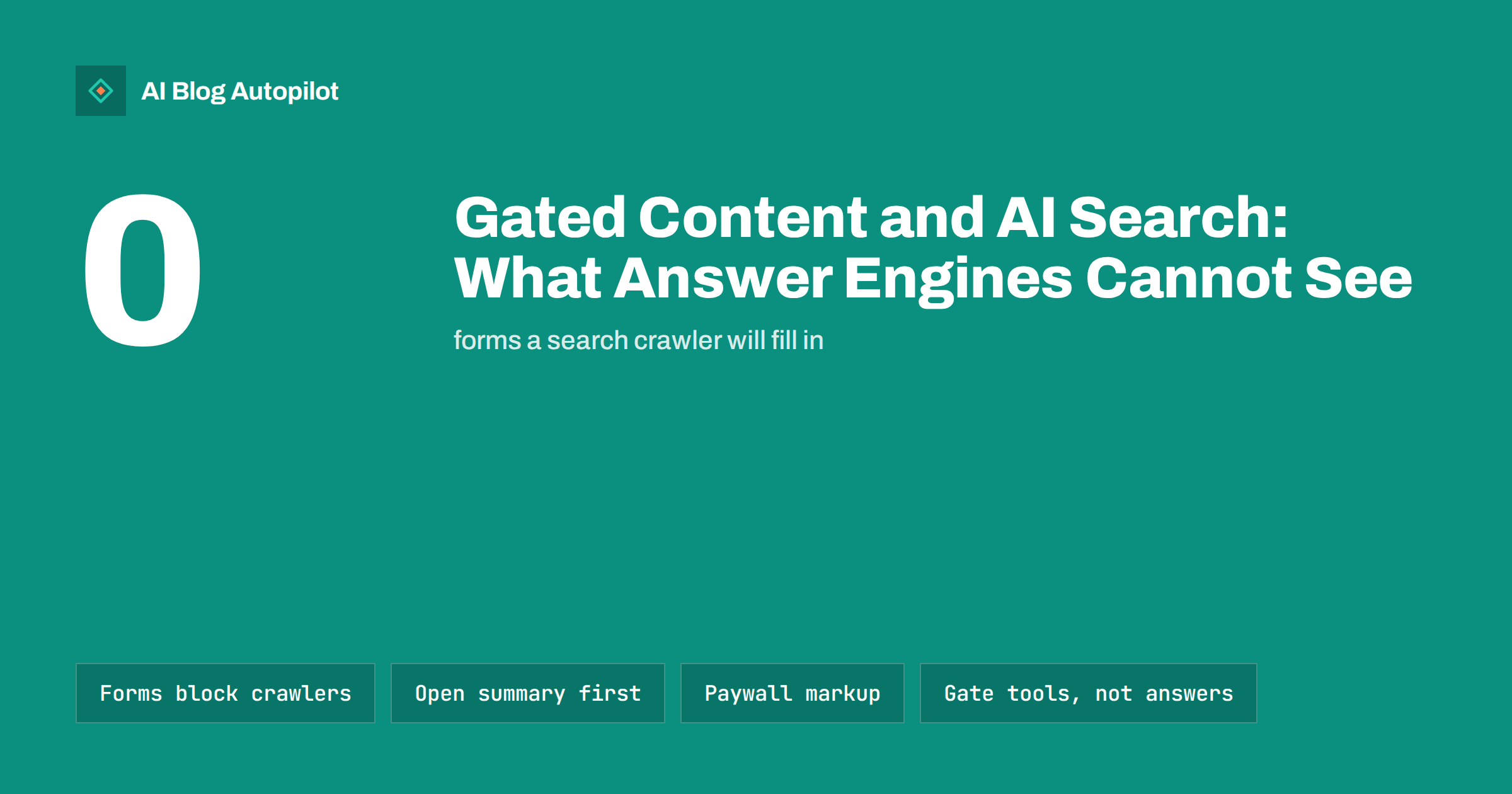
Short answer: search engine crawlers and AI assistants cannot fill in forms, log in or pay, so content behind an email gate, a login or a hard paywall is generally not indexed and cannot be cited in AI answers. Only the open part of the page counts. If you gate content, keep a substantial, useful public version that answers the main question, gate the extras such as templates or tools, and for paid articles use the structured data that search engines provide for paywalled content.
Gating content is a long-standing marketing habit. A business writes a detailed guide, puts it behind a form and collects email addresses from everyone who wants to read it. As more people find information through AI answers, the trade-off behind that habit has become sharper. An AI assistant cannot hand over its email address to read your guide, so it will cite someone else’s open article instead. This article explains what exactly is invisible, how to decide what to gate and how to structure the open part so it still works for search and AI.
What crawlers and AI systems can and cannot access
Search engine crawlers, and the crawlers and search integrations that AI assistants rely on, behave like an anonymous visitor who never clicks, types or pays. They generally see:
- Text that is in the page’s HTML, or rendered by JavaScript without user interaction.
- Links they can follow to other public pages.
- Publicly available files such as PDFs that are linked directly.
They generally do not see:
- Content shown only after submitting a form, such as an email gate before a download.
- Anything behind a login, including member areas and customer portals.
- Paid content behind a hard paywall, unless the publisher deliberately lets crawlers see it and marks it up correctly.
- Content loaded only after a click, such as “reveal full answer” buttons that fetch text from the server.
If a page’s valuable part sits in the second list, that part does not exist as far as search results and AI answers are concerned. The same applies to AI features in Google Search, which Google says need a page to be indexed and eligible for a snippet.
Why this matters more with AI answers
With classic search results, a gated landing page could still rank using its public description, and a reader would click through to the form. AI answers change that path in two ways.
First, AI systems summarise information from the sources they can read. If your guide is gated and a competitor’s article on the same topic is open, the answer is built from the competitor’s article, and any citation link points there. Your landing page may be found, but it offers little to quote beyond a few marketing sentences.
Second, people who get their answer from an AI summary click through less often for simple questions. The readers who do click are usually looking for depth or a specific resource. A public page that already proved its usefulness in the answer is better placed to win those clicks than a form with a promise.
Deciding what to gate
Gating is not wrong; it is a trade-off between reach and lead capture. A practical rule is to gate things that are more useful as a file or a tool than as reading, and keep the knowledge open.
| Usually better open | Reasonable to gate |
|---|---|
| Explanations, definitions and how-to guides | Editable templates and spreadsheets |
| Answers to common customer questions | Calculators that need company data |
| Comparisons and buying advice | Full research reports with raw data |
| Checklists summarised as text | Courses, webinars and recorded training |
The open article answers the question and demonstrates your expertise. The gated asset helps the reader act on it. This split also produces better leads: someone who downloads a template after reading your guide already knows what you offer.
Structuring the open part so it can be cited
If a page offers a gated asset, the public text still has to stand on its own. A few habits make it useful to readers, search engines and AI systems:
- Start with a real answer. Two to four sentences that answer the main question directly, as you would in any answer-first article.
- Publish the key findings openly. If you ran a survey, put the main results and your method on the page. Keep the full dataset for the download.
- Explain the steps, gate the file. Describe how to do the task in text, then offer the template that makes it faster.
- Use clear headings and an FAQ. Sections that make sense on their own are easier to quote accurately.
- Avoid teaser-only pages. A landing page that says “Discover the seven secrets” without revealing any of them gives nothing to cite and often frustrates readers.
The guide to templates, checklists and other reasons to subscribe covers how to design the gated asset itself.
Middle ground: optional and soft gates
Between fully open and fully gated there are several options that keep most of the reach while still collecting contacts:
- Optional sign-up. The full article is public, and a clearly placed box offers the same guide as a formatted PDF, a template or email updates. Readers who want to keep the material sign up; everyone else can still read.
- Content upgrades. Each article offers a small, specific extra that matches it exactly, such as a checklist version of the steps. These convert well because they are directly relevant.
- Partial gating of assets. A report’s summary, charts and method are public, while the detailed tables are in the download.
- Newsletter instead of gates. Some blogs drop gates entirely and ask readers to subscribe for new articles. The value exchange is ongoing rather than one file.
All of these keep the answer visible to search engines and AI systems, which is the part that brings new readers in the first place.
Paywalls and member content
Publishers with paid subscriptions face the same issue at a larger scale. Search engines offer a way to let their crawlers read paywalled articles while regular visitors see the paywall, as long as the page is marked up so that this is not treated as cloaking. Google documents this in its guide to subscription and paywalled content markup, which uses properties such as isAccessibleForFree and a CSS selector for the paid section.
Two points are often misunderstood:
- The markup does not make paid content free to readers. It tells search engines which part is behind the paywall, so that showing it to crawlers is not seen as deception.
- How much of the paid content a search feature may show or use is governed by your snippet settings. If you want to limit that, controls such as
max-snippetordata-nosnippetapply.
For small business blogs, full paywalls are rare. Member areas for customers are more common, and those are simply private: they should not be indexed, and nothing inside them will appear in search or AI answers.
Common mistakes with gated content
- Gating the best explanation on the site. The article that could have been the most cited page becomes invisible.
- Public PDFs by accident. Download links that point to a public file are often indexed directly, which means the gate only stops polite visitors. If the file must stay private, protect it properly.
- Thin landing pages. A form with a paragraph of marketing text is unlikely to rank, and it gives AI answers nothing to use.
- Hidden text tricks. Showing full content to crawlers and a gate to users without proper paywall markup can be treated as cloaking, which breaks search engine spam policies.
- Measuring only form fills. If gating reduced search visibility, the loss shows up as fewer impressions and fewer readers, not in the form report.
Testing the balance on your own site
If you are not sure whether gating is helping, test it on a small scale. Take one gated guide with a modest number of downloads, publish most of its content as an open article with the template or report still offered as a download, and compare over a few months:
- Impressions and clicks for the topic in Search Console.
- Referrals from AI assistants in your analytics.
- Downloads of the remaining gated asset.
- Enquiries that mention or follow the article.
Many businesses find that the open version brings more readers and a similar or better number of genuinely interested leads, but results vary by audience. Let your own data decide.
How AI Blog Autopilot fits in
AI Blog Autopilot publishes open articles to your WordPress blog: long-form posts with a direct answer, clear sections, an FAQ and SEO meta, all readable by search engines and AI systems. It does not create gated downloads or paywalls. Many teams use it to cover the explanatory topics openly, while keeping their own templates and tools as the gated offer. See how Autopilot works on the home page.
Related reading
- How to Get Your Blog Cited by ChatGPT, Perplexity and Google AI Overviews
- How to Put Something Original in an Article You Automated
- Getting More Enquiries From the Readers You Already Have
The bottom line
Search engines and AI assistants can only use what they can read. Keep the knowledge open with a direct answer and the key findings, gate the tools and files that help readers act, and use proper markup for any paid content. That way your expertise can be found and cited, and the gate still collects the readers who want more.
KKK
Can AI assistants read content behind an email form?
Generally no. Crawlers and AI systems do not fill in forms, so text shown only after sign-up is not indexed or used in answers. Only the public part of the page is available to them.
Does gating content hurt SEO?
It removes the gated text from search, so the page competes only with its public content. If that public part is thin, the page is unlikely to rank or be cited. A substantial open summary reduces the loss.
What should I gate on a business blog?
Gate assets that are more useful as files or tools, such as editable templates, calculators, full datasets and training. Keep explanations, how-to guides and answers to common questions open.
Is showing full content to Google but not to users allowed?
Only for genuine paywalled or subscription content marked up with the appropriate structured data. Doing it without that markup can be treated as cloaking, which breaks search engine spam policies.
Are gated PDFs indexed by search engines?
If the download link points to a publicly accessible file, search engines may find and index it directly, bypassing the form. Files that must stay private need real access protection.
How can I tell whether gating is worth it?
Compare one guide in open and gated form over a few months. Look at impressions, AI referrals, downloads and enquiries together, not only at form submissions.