ENEnglish
 LTLietuviškai
 DEDeutsch
 FRFrançais
 RUРусский
 ESEspañol
 PLPolski
 ITItaliano
 UKУкраїнська
 CSČeština
 PTPortuguês
 JA日本語
 LVLatviešu valoda
 ETEesti
 HUMagyar
 IDBahasa Indonesia
 TRTürkçe
 HIहिन्दी
 ELΕλληνικά
 ARالعربية
 THไทย
 VITiếng Việt
 RORomână
 MSBahasa Melayu
 BNবাংলা
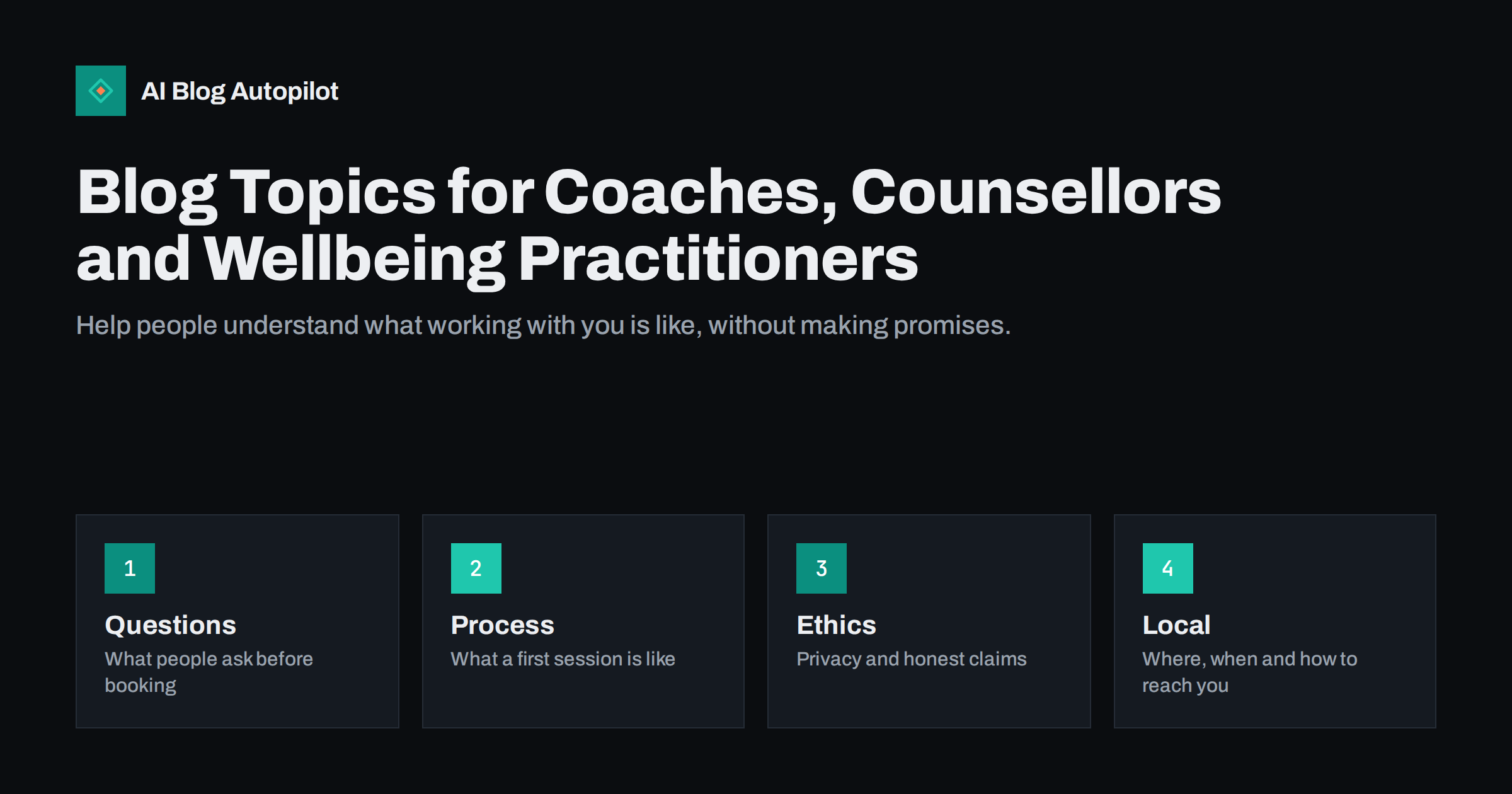
Short answer: coaches, counsellors and wellbeing practitioners do best with a blog that answers the questions people ask before they book: what the work involves, how a first session goes, how long it takes, what it costs and how privacy is protected. Add practical guides within your professional scope, local information and honest explanations of limits. Never promise results, share client stories without clear consent or give advice outside your training.
People who look for a coach or counsellor are often nervous. They search quietly, compare several names and want to feel that someone is safe, qualified and a good fit before they send a message. A blog is a gentle way to show who you are. It lets readers meet your way of thinking before they meet you, and it gives search engines clear signals about what you do and where.
The trade also carries special duties. Your words may be read by someone in a hard moment, and professional bodies and local rules limit what you can claim. The ideas below are written with that in mind, and they are general information, not professional or legal advice. Check your own regulator’s guidance before you publish.
Questions people ask before booking
The richest topics come from the messages that you already receive. Make a list of the first questions that new clients ask: How do I know if I need this? What is the difference between coaching and counselling? How many sessions will it take? Can we meet online? What if I do not know what to say? Each question can become a short article with a calm, honest answer.
Write the way that you would speak in a first call. Use plain words, avoid jargon and explain any term the first time. Describe the options and let the reader decide. A post called “Coaching or counselling: how to tell which one you need” can help someone choose, even if the answer is that they should see a different kind of professional. That honesty builds trust.
Collect more ideas from the sources in customer questions into topics, including the search suggestions that appear when you type your service and your city. Keep a note of the words that clients use, which often differ from professional terms.
Explaining how the work happens
Uncertainty about the process is a major reason that people delay. Describe what a first session is like, what to bring, how long it lasts, how you handle notes, how often people meet and how an ending is agreed. A simple walk-through, written in the first person, reduces anxiety more than any slogan.
Explain the practical side too: fees and cancellation rules, how to pay, where you work, what online sessions need and how to reach you between sessions, if at all. Be clear about what you do not do, such as emergency support. A short page on this belongs in the main menu, and a blog post can go into more detail. See contact and trust pages for what to place on those pages.
If you work in a particular method, describe it in everyday language and say what it is based on. Do not claim that it is the best approach. A reader should come away knowing what they can expect and what they cannot.
Practical guides within your scope
Readers value small, usable tools: a worksheet for planning a week, questions to ask before a career change, ways to prepare for a difficult conversation, a simple routine for ending the day. These posts show your thinking and give help at once, which is how a blog earns return visits.
Stay within your training. A coach can write about goals, habits and decisions. A counsellor can write about how therapy works and general ways of coping with common stress. Neither should give instructions for a medical condition, diagnose readers or suggest that a post replaces professional help. Add a clear note on when to seek urgent help in your area, and read YMYL topics on a blog and writing an editorial policy page.
Use sources for any factual claim, link to reputable public bodies and avoid dramatic statistics. When in doubt, describe the idea as general information, and invite the reader to talk to a qualified person.
Stories, examples and consent
Stories make posts human, but client confidentiality comes first. Do not share any real client’s story unless you have clear, written permission that covers the exact text and the place it will appear, and remember that people may still be recognised from small details. A safer choice is a composite example that is labelled as such, or a story from your own life that you are comfortable sharing.
Testimonials need special care in these fields. Some professional bodies restrict them, and a review that promises a result can be a problem even if the client wrote it. Check your rules before you place any, and read evidence for marketing claims for general practice.
Your own voice is a strength. A post about why you do this work, what you learned during training and what you changed your mind about shows character. See storytelling in business blog posts for ways to tell a story with a point.
Think about accessibility and tone for readers who may be anxious or tired. Short paragraphs, clear headings and a calm layout help. Offer more than one way to get in touch, such as a form, an email address and a phone number, and say how quickly you usually reply. If you offer a free introductory call, describe what it is and what it is not, so that nobody expects therapy on the phone. These small details lower the barrier to a first message more than any clever marketing line.
Local and online visibility
Many people look for someone nearby or someone who works online in their language. Make the basics easy to find: your area, your languages, the formats you offer and your opening times, repeated in the same words on your site, your business profile and your listings. The advice in local business blog strategy applies here.
Write posts that connect with the local world: how to find a quiet space for an online session, what to do after a busy season in the town, community talks or workshops that you offer and links to local organisations that you work with. Keep personal details private and avoid anything that could identify a client.
If you have several locations or work in several cities, keep each location page distinct, as covered in location pages for several branches. A single page with a list of towns rarely helps anyone.
Write about the limits of your service as well. Say which situations are better served by another professional, for example a doctor or an emergency service, and give a simple way to find them. A post called “When coaching is not the right tool” may feel risky, but readers and referring professionals respect it, and it shows that you put the person first. It also protects you, because it records your approach in public.
Honest claims and ethics
Do not promise cures, guaranteed outcomes or fixed timelines. Use words like “can help”, “many people find” and “in my experience”, and describe limits openly. Mention your qualifications, memberships and supervision arrangements accurately, and keep them up to date. If you are early in your career, say so. Honesty is often more reassuring than a long list of certificates.
Explain how you protect privacy: where notes are kept, who can see them, what happens if you must share information and how online sessions are secured. Plain, accurate descriptions help readers feel safe and also support the signals of trust described in E-E-A-T for automated blogs.
Be careful with comments and social posts. Do not invite readers to share personal details in public. Turn comments off or moderate them closely, and reply to sensitive messages privately. Our guide to whether a business blog should allow comments covers the trade-offs.
Consider a short series for new readers, for example a five-part guide to preparing for your first session. Each part answers one practical question, and together they work as a start page that you can link from your contact page and your profiles. Series build a path through the site, which suits nervous readers who like to take small steps, and they give search engines a clear cluster of related pages, as described in content clusters and pillar pages.
A simple twelve-month plan
You do not need a large calendar. Aim for two posts a month at a pace that you can keep. A balanced year might include four posts on common questions, three on how the work happens, two on practical guides, one on ethics and privacy, one local post and one personal post. Link each to the page where a reader can contact you.
Plan around the year of your readers. Interest often rises after holidays, at the start of the school year and in January, and falls in the middle of summer. See seasonal content planning for ways to prepare early.
Review what people read and which posts lead to enquiries every quarter, and write more of what helps. Update older posts when your fees, methods or rules change, as in how to refresh old blog posts.
How AI Blog Autopilot helps
AI Blog Autopilot writes full SEO articles for your WordPress blog from the topics, keywords, audience and tone you set, with FAQ sections, tags and SEO meta included, and it shares each one to your social networks. In a sensitive field, approval mode lets you read each article first, so that you can check every statement against your professional rules before it goes live. See the pricing page for plans.
Related reading
The bottom line
Answer the questions clients ask, explain how the work happens, keep to your scope, protect privacy and consent, avoid promises and write at a pace you can keep.
KKK
How often should a coach or counsellor blog?
Two posts a month is a good pace for most solo practitioners. Consistency matters more than volume.
Can I share client stories?
Only with clear written permission, and even then details may identify a person. Composite examples labelled as such are safer.
Should I use testimonials?
Check your professional body’s rules first. Some restrict them, and results-based claims can be a problem.
Can a blog post replace a first call?
No. Posts help people understand your approach, but they are general information and not personal advice.
Should comments be on?
Often it is wiser to turn them off or moderate closely, since readers may share personal details in public.