ENEnglish
 LTLietuviškai
 DEDeutsch
 FRFrançais
 RUРусский
 ESEspañol
 PLPolski
 ITItaliano
 UKУкраїнська
 CSČeština
 PTPortuguês
 JA日本語
JA日本語 LVLatviešu valoda
 ETEesti
 HUMagyar
 IDBahasa Indonesia
 TRTürkçe
 HIहिन्दी
 ELΕλληνικά
 ARالعربية
 THไทย
THไทย VITiếng Việt
 RORomână
 MSBahasa Melayu
 BNবাংলা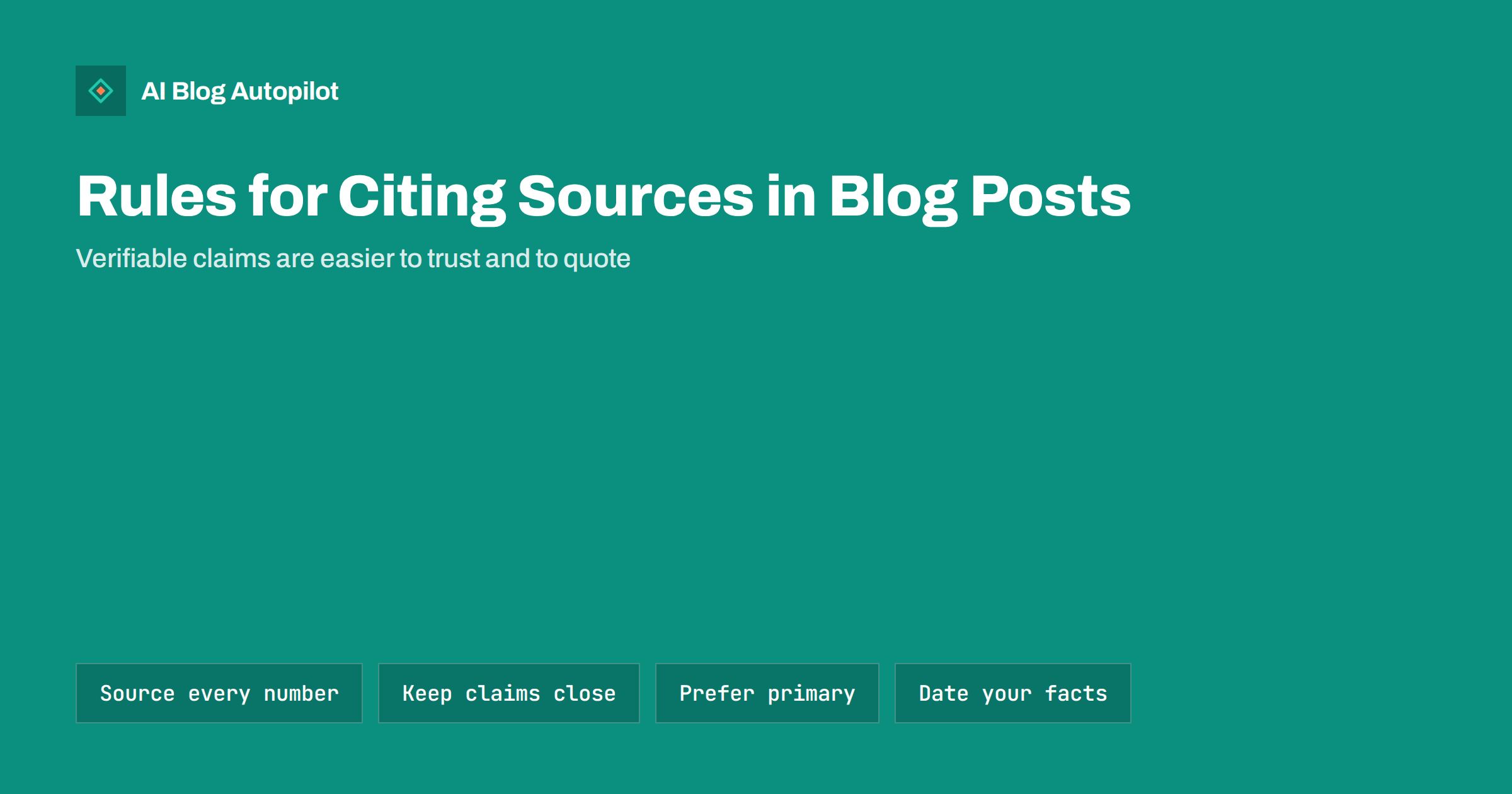
Short answer: citing sources makes the claims in a blog post verifiable, and verifiable claims are easier for readers, search engines and AI answer engines to trust and reuse. No one outside the search companies knows exactly how AI answers weigh citations, but pages that state facts clearly, attribute them to primary sources and keep them up to date are safer to quote than pages full of unattributed numbers. Cite the original source, place the citation right next to the claim, and remove anything you cannot back up.
AI answer engines summarise information from web pages and often show links to the pages they drew on. Blog owners understandably want to be one of those links. Much of the advice on how to achieve that is speculation, but one principle holds up under any reasonable reading of how these systems work: content that is accurate, specific and easy to verify is more useful to a system that is trying to give a correct answer.
Citing sources well is one of the most practical ways to make your content accurate, specific and verifiable. This article explains why, and how to do it without turning your posts into academic papers.
Why sourcing matters more when answers are generated
When a person reads your article, they can judge its credibility from many cues: your experience, the design, the tone, other people’s recommendations. An automated system summarising many pages has fewer cues and a strong incentive to avoid repeating mistakes.
That creates a few practical consequences:
- Unattributed numbers are risky to repeat. A statistic with no source might be invented, outdated or misread. A system trying to be accurate has reason to prefer a figure that can be traced.
- Consistency across sources builds confidence. If your claim matches what an official source says, and you link to that source, the claim is easy to corroborate.
- Clear attribution helps readers who click through. People who arrive from an AI answer are often checking a detail. If they find the detail clearly sourced on your page, they are more likely to trust the rest of it.
None of this guarantees a citation in an AI answer. Nothing does. But it removes one reason for your page to be passed over, and it improves the page for human readers regardless.
What counts as a good source
Not all links are equal. As a rough order of preference:
- Primary sources. Official documentation, standards, legislation, the original research paper, the organisation that collected the data. For web topics, that means places like official search engine documentation, web standards bodies and browser documentation.
- Reputable secondary sources. Established publications and recognised experts who explain or analyse primary sources, ideally linking to them.
- Your own first-hand evidence. Your tests, screenshots, customer questions or project experience, described honestly and specifically. This is a source too, and often the most valuable one on a small blog.
Avoid citing a page that itself cites nothing. Statistics roundup pages are a common trap: a number gets copied from site to site until nobody remembers where it started, and sometimes it was never true in the form quoted. Follow the chain back to the original, or leave the number out.
How to cite sources in a blog post
Blog citations do not need footnotes or formal reference lists. What they need is clarity.
- Put the source next to the claim. Link the specific phrase or sentence that contains the fact, not a generic word three paragraphs later. “According to the official documentation on robots.txt, …” with the documentation linked is clearer than a list of links at the end.
- Name the source in the text. Readers who do not click, and systems that extract text, still see where the claim comes from.
- Link to the most specific page. A deep link to the relevant documentation section beats a link to a home page.
- Say when the fact applied. “As of this writing” or the year of a study helps readers judge whether a figure is still current.
- Distinguish fact from opinion. Your recommendations are welcome, but label them as recommendations. “We suggest” and “in our experience” are honest signals.
Keep the number of external links sensible. A post that links out every sentence becomes hard to read. Link where a reader might reasonably ask “says who?”
Sourcing and answer-first writing work together
AI answer engines tend to lift short, self-contained statements. A good pattern combines a clear answer with its basis in the same passage:
- A one- or two-sentence direct answer to the question in the heading.
- The source or reasoning behind it, named in the text.
- Any important condition or exception.
For example: “A 301 redirect signals a permanent move, which is why it is the usual choice when you change a post’s URL. Google’s documentation on redirects describes permanent redirects as a strong signal that the target should be shown in results.” The answer stands on its own, and the basis is right beside it.
This structure is also what a hurried human reader wants. You are not writing for machines at the expense of people; you are writing clearly for both.
Your own data and experience as a source
Small blogs cannot out-cite large publications on general facts. Where they can stand out is first-hand information: what you observed, tested or learned from your own work.
To make first-hand material useful as a source:
- Be specific about the context. “On our own blog of about 200 posts” is more useful than “in our experience”.
- Describe the method briefly. What did you compare, over what period, and how did you measure it?
- Do not overgeneralise. A result from one site is an observation, not a rule. Say so.
- Show the evidence. A screenshot, a table or a clear description of what happened is worth more than an adjective.
Honest, clearly scoped first-hand material is exactly the kind of content that is hard to find elsewhere, which is what makes it worth linking to and quoting.
How much sourcing different posts need
Not every article needs the same density of citations. Match the effort to the kind of claims the post makes.
- How-to guides. Mostly your own steps and experience. Cite official documentation where a step depends on a platform’s rules or settings, because those change and readers need to check the current version.
- Explainers and definitions. Link the standard or official definition once, near the top, and then explain it in your own words. Readers get both the authoritative wording and a clearer explanation.
- Comparisons. Every claim about a product, price or feature should come from that product’s own pages, dated, because these facts go out of date quickly.
- Opinion and strategy pieces. Fewer links, but be explicit about which parts are opinion and which are facts, and source the facts.
- Legal, financial or health-adjacent topics. Cite primary sources for every factual statement and recommend professional advice where it applies. The cost of being wrong is higher.
A useful test is to read the post as a sceptical reader and mark every sentence where you would ask “how do you know?”. Those are the sentences that need a source or a rewrite.
Common sourcing mistakes
- Invented or rounded-up statistics. “Studies show” with no study. If you cannot name the study, do not mention it.
- Citing outdated documentation. Search and platform documentation changes. Check that the page you link still says what you claim.
- Linking to competitors’ summaries instead of the original. It weakens your credibility and sends readers away for no reason.
- Broken citation links. A source that returns an error looks careless. Check external links when you refresh a post.
- Quoting people without permission or context. If you quote someone, make sure the quote is accurate and attributable.
- Using sources to decorate rather than support. A link should back up a specific statement, not sit at the end of a paragraph as a general signal of seriousness.
A quick sourcing checklist before you publish
- Every number has a named, linked source or is clearly your own measurement.
- Each source is the original, or the best available, not a copy of a copy.
- Time-sensitive facts carry a date or “as of” note.
- Opinions and recommendations are labelled as such.
- External links work and point to the specific relevant page.
- Anything you could not verify has been removed or softened to “often” or “typically”.
Structured data such as FAQ markup can help machines understand the shape of your content, but it does not replace verifiable claims. The schema.org FAQPage type describes questions and answers; it does not make the answers true.
How AI Blog Autopilot handles facts
AI Blog Autopilot’s writer is instructed never to make up statistics, quotes or sources, and every article passes an automatic quality check on length, structure, keyword and meta before it goes live. Articles include an FAQ section, which pairs well with answer-first writing. If you want to add your own data or first-hand examples, you can switch on approval and review articles before publishing. See how Autopilot writes and publishes for details.
Related reading
- How to Get Your Blog Cited by AI Search
- How to Fact-Check Content Before You Publish
- How to Put Something Original in an Article You Automated
- Statistics Round-Up Posts: Doing Them Honestly
The bottom line
Citing sources will not force any AI system to quote you, but it makes your claims verifiable, and verifiable claims are safer to repeat and more useful to readers. Link to primary sources next to the claims they support, date time-sensitive facts, label opinions, and cut anything you cannot back up. The same habits that make a post trustworthy for people make it a better candidate for AI answers.
KKK
Do citations help a blog post appear in AI answers?
There is no public, guaranteed rule. However, AI answer engines aim to give accurate answers, and claims that are clearly attributed to reliable sources are easier to verify and safer to repeat. Good sourcing removes a reason to skip your page and improves it for readers either way.
Should I link to external sources if it sends visitors away?
Yes, where a reader might ask where a claim comes from. A few relevant links to primary sources make a post more credible. Opening external links is the reader’s choice, and most will return if your article is useful.
What is the best kind of source to cite?
The original: official documentation, standards, the organisation that collected the data or the original research. Reputable secondary sources are acceptable when they link to the original. Avoid pages that repeat a figure without saying where it came from.
Can my own experience count as a source?
Yes, if you describe it honestly and specifically: the context, the method and the limits of what you observed. Clearly scoped first-hand material is often the most distinctive part of a small blog’s content.
How often should I check the sources in old posts?
Whenever you refresh a post, and at least once a year for articles that rely on documentation or figures that change. Check that links work and that each source still says what you claim.