ENEnglish
 LTLietuviškai
 DEDeutsch
 FRFrançais
 RUРусский
 ESEspañol
 PLPolski
 ITItaliano
 UKУкраїнська
 CSČeština
 PTPortuguês
 JA日本語
JA日本語 LVLatviešu valoda
 ETEesti
 HUMagyar
 IDBahasa Indonesia
 TRTürkçe
 HIहिन्दी
 ELΕλληνικά
 ARالعربية
 THไทย
THไทย VITiếng Việt
 RORomână
 MSBahasa Melayu
 BNবাংলা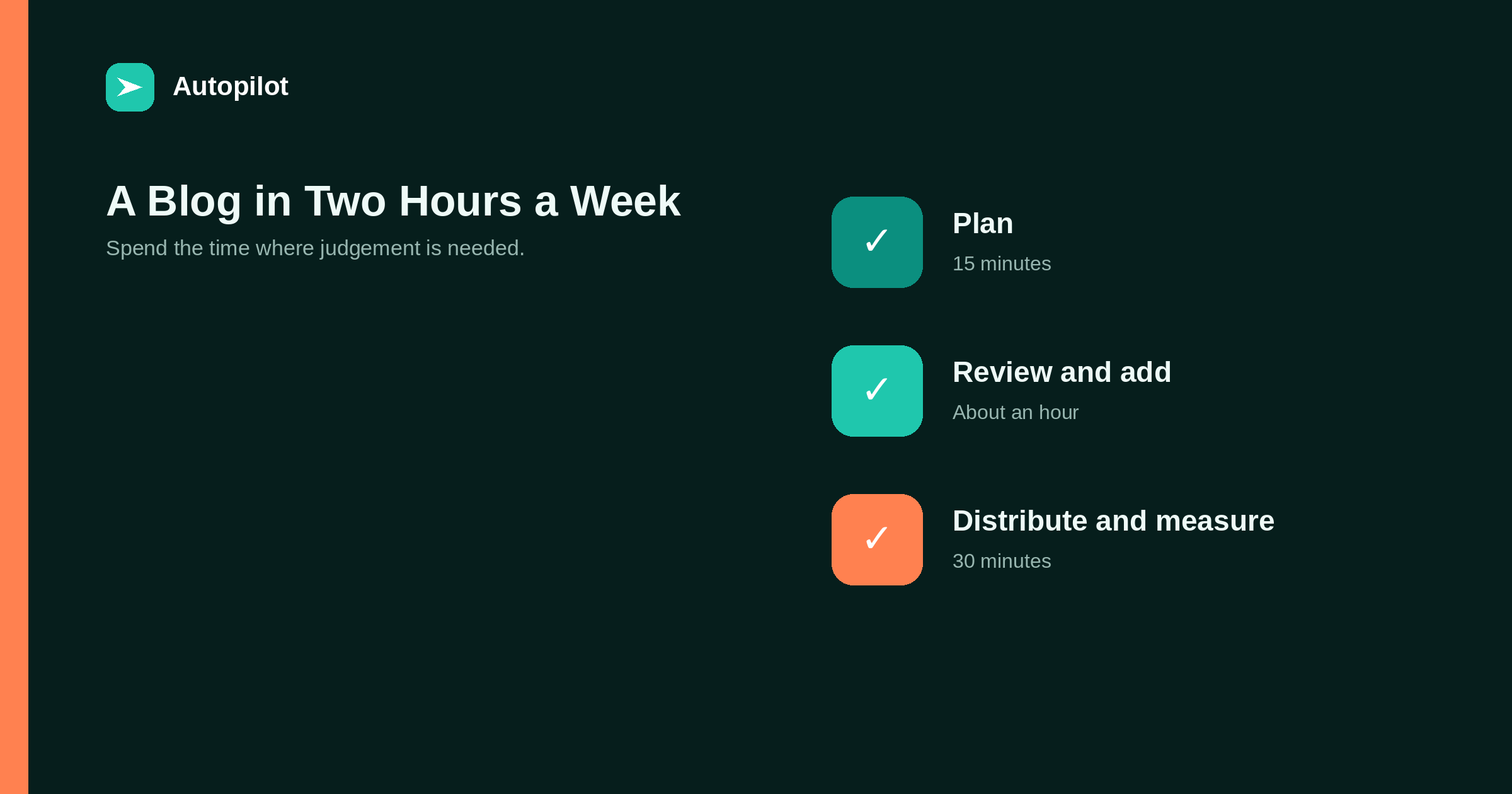
Short answer: two hours a week can run a useful business blog if the mechanical work is automated and the time goes to what needs judgement: about fifteen minutes planning and approving topics, about an hour reviewing articles and adding your own experience, and about thirty minutes on distribution, replies and a quick look at results. At that level of time, one to three articles a week is realistic, depending on how much review each needs. Set this up after an initial period of closer attention, once instructions are refined.
Most small businesses do not have a content team. They have an owner or manager with a few hours to spare, if that. The usual result is a blog that starts with enthusiasm and stops after two months.
A blog can be run steadily on about two hours a week, if the routine is designed around that limit.
Where the time should go
With drafting, images, publishing and sharing automated, the remaining work is judgement.
| Task | Time | Why a person |
|---|---|---|
| Plan and approve topics | About 15 minutes | Only you know what matters to customers |
| Review articles | About 40 minutes | Accuracy and fit |
| Add your own experience | About 20 minutes | What makes articles yours |
| Distribution and replies | About 20 minutes | Relationships, not broadcasting |
| Check results | About 10 minutes | Decide what to change |
These are rough allocations, not measurements; your own will vary.
Automate the rest
Drafting, featured images, formatting, publishing, social sharing and search engine notification should not consume any of the two hours — what content automation actually means covers what can be automated.
Plan once a month, approve weekly
Spend one longer session a month choosing topics from real questions, and a few minutes each week confirming the next week’s articles — planning a month of articles.
Review efficiently
A consistent checklist makes review faster: claims, answer near the top, structure, one addition from experience — editing a draft. Clear standing instructions reduce what review has to fix.
Once a category consistently needs little change, lighter review for it frees time — draft, approve or full auto.
Add something only you know
The most valuable minutes are those spent adding your own examples, numbers or opinions. Keep a running note of observations during the week, so adding them to articles takes minutes rather than thought — adding something original.
A realistic pace
At two hours a week, one to three articles a week is realistic, depending on subject and how much review each needs. Consistency matters more than volume — how often to publish.
Measure lightly
Ten minutes a week is enough to glance at published pages and any enquiries. A slightly longer monthly review of Search Console and outcomes guides the next month’s plan — measuring whether a blog is working.
Start with more, then settle
The first month or two need more time, while instructions are refined and every article is reviewed closely — the first 90 days. The two-hour routine is for afterwards.
A sample week
Monday, fifteen minutes: confirm this week’s two topics and glance at last week’s published articles on a phone. Tuesday and Thursday, thirty minutes each: review a queued article, check claims, add an example from the week’s notes, and approve. Friday, thirty minutes: reply to comments and messages about articles, share the best article of the week personally, check any enquiries, and note observations for next week.
Once a month, replace one of those sessions with a longer planning review. That rhythm fits into gaps in most working weeks.
When time runs short
Some weeks the two hours will not happen. Decide in advance what gives: usually publish one article instead of two, rather than publishing without review. A queue of articles reviewed a week ahead provides a buffer for busy weeks.
If weeks without time become the norm, reduce the pace permanently rather than letting review lapse. A smaller blog maintained properly is more valuable than a larger one nobody checks.
Sharing the load
Two hours need not all come from one person. A colleague might review articles in their subject, another might add examples from customer conversations, while the owner approves topics. Sharing the load spreads expertise across articles and makes the blog more resilient when someone is away.
Tools that save time
Beyond automated publishing, small tools help: a shared note for observations, a saved checklist for review, a standing monthly calendar slot for planning. The aim is to remove decisions from the weekly routine so the two hours go to judgement.
Signs the routine is working
After a few months, the routine should feel lighter: reviews quicker as instructions improve, a steady queue of topics from real questions, a handful of articles your team sends to customers, and impressions rising in Search Console. If instead review keeps taking longer, the instructions need attention before anything else.
Keep a note of how long each week actually takes. It shows whether the routine is sustainable and where time is going.
When to invest more
If the blog is producing enquiries and there are clearly more good questions than two hours can cover, that is the moment to add time or help — another reviewer, a freelancer for flagship pieces, or more articles with lighter review in safe categories. Scaling from 4 to 30 posts a month covers growing carefully.
Keeping it enjoyable
A routine that feels like a chore tends to stop. Reserve some of the time for the part you find most rewarding — often adding your own experience or replying to readers — and let automation carry the parts you do not. A blog that the owner enjoys contributing to lasts longer than one run purely from obligation.
What two hours cannot do
Two hours a week will not produce a large volume of heavily researched articles or original studies. It can produce a steady stream of accurate, useful articles with genuine experience added. Results are not guaranteed at any level of time; consistency gives them the best chance.
Related reading
If this was useful, these cover the questions that usually come next.
- The first 90 days — the setup period before this routine
- Draft, approve or full auto — review levels that make it possible
- How often to publish — a pace that fits two hours
The bottom line
Automate drafting, images, publishing and sharing, and spend two hours a week on planning, review, adding your own experience, distribution and a quick look at results. Plan monthly, review with a checklist, keep a running note of observations, publish one to three articles a week, and allow more time in the first months.
KKK
Can a business blog be run in two hours a week?
Yes, if mechanical work is automated and the time goes to planning, review, additions and distribution.
How many articles can I publish in two hours a week?
Typically one to three a week, depending on subject and review needs.
What should the two hours be spent on?
Approving topics, reviewing articles, adding your own experience, distribution and a quick look at results.
What can be automated?
Drafting, featured images, formatting, publishing, social sharing and search engine notification.
Does the first month take longer?
Yes, while instructions are refined and every article is reviewed closely.
Will two hours a week guarantee results?
No. It supports a steady, accurate blog, which gives results the best chance.