ENEnglish
 LTLietuviškai
 DEDeutsch
 FRFrançais
 RUРусский
 ESEspañol
 PLPolski
 ITItaliano
 UKУкраїнська
 CSČeština
 PTPortuguês
 JA日本語
 LVLatviešu valoda
 ETEesti
 HUMagyar
 IDBahasa Indonesia
 TRTürkçe
 HIहिन्दी
 ELΕλληνικά
 ARالعربية
 THไทย
 VITiếng Việt
 RORomână
 MSBahasa Melayu
 BNবাংলা
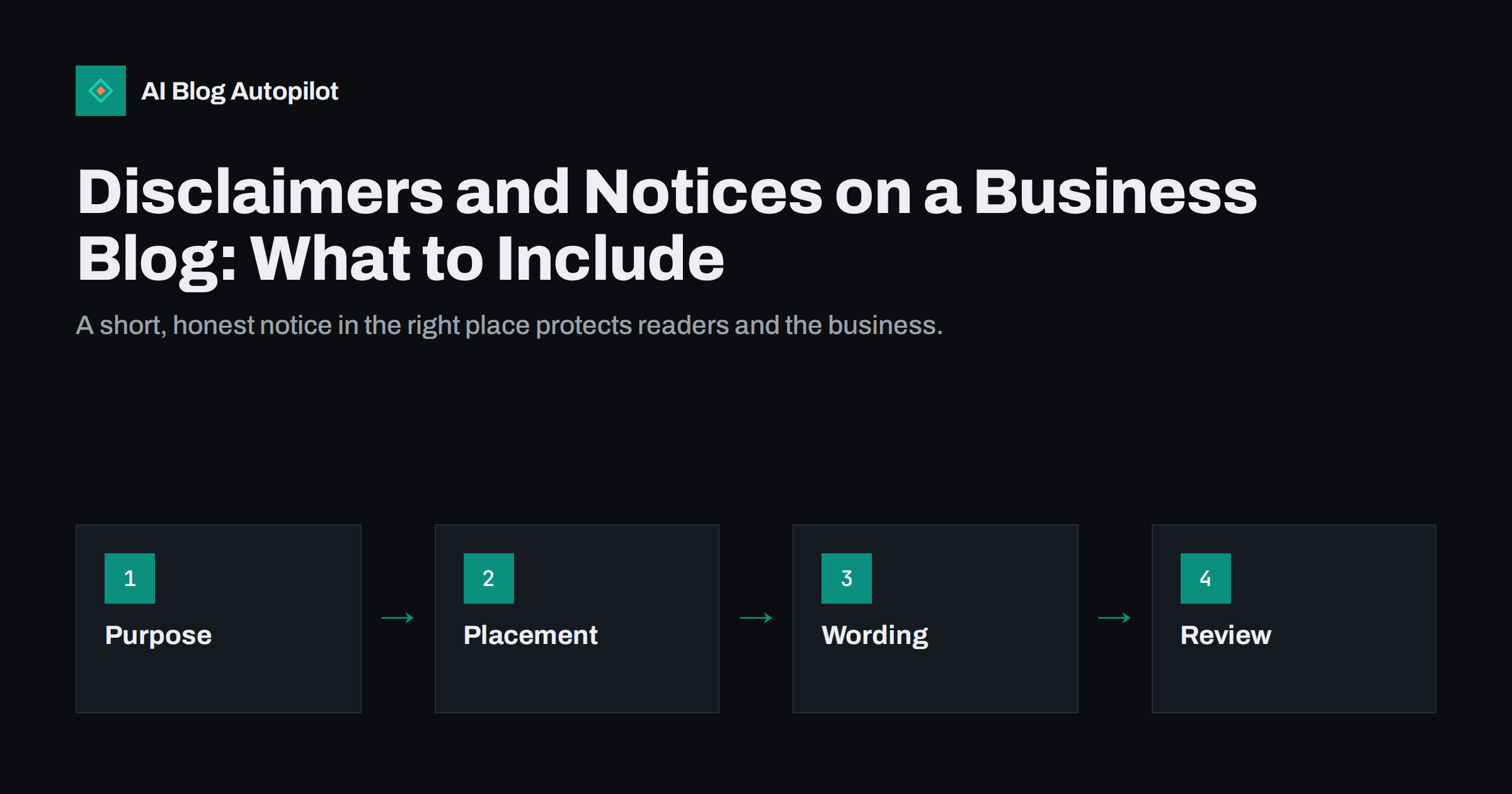
Short answer: a business blog usually needs a few short notices: that the content is general information and not individual advice, that some links are affiliate or sponsored, how AI is used where it matters, how corrections are handled and how readers can contact you. Write them in plain words, place them where readers will see them and ask a qualified adviser to check anything that touches regulated advice. This is general information, not legal advice.
Disclaimers have a poor reputation, and many are rightly ignored: a wall of capital letters in the footer that nobody reads. Used well, a notice does something useful. It tells readers what they can rely on, what you have been paid for and how to reach you, and it shows search engines and AI assistants that the site is transparent. The aim is not to avoid every risk with legal fog but to be clear about the things that matter.
Say what the content is and is not
A general information notice states that the articles are written for general guidance and do not replace advice from a qualified professional who knows the reader’s situation. It matters most in fields such as health, money, law, safety and property, where a reader may act on what they read. Put it where people will see it, for example at the top or end of an article in such a field, not only in a distant footer.
Keep it short and specific: “This article is general information about taxes and is not personal advice. Rules differ by country and change over time; check with a qualified adviser before you act.” Name the limits that apply, such as the country or the date. Our guide to YMYL topics on a business blog explains how to write sensitive subjects responsibly.
A notice does not excuse careless content. If an article could cause harm when followed, the right response is to improve the article, add a reliable source and, where needed, say that readers should seek help. A disclaimer is a complement to accuracy, not a substitute for it.
Remember that disclosure applies to gifts and free products as well as money. If a company sent a sample and you write about it, say so, even when you were free to say what you liked. Readers are more forgiving of an openly declared relationship than of one they discover later, and the discovery usually costs far more than the disclosure would have.
Disclose affiliate links and sponsored content
If you earn a commission from a link, or were paid or given something in exchange for a mention, readers have a right to know, and in many countries the law requires it. Put a clear statement near the first affiliate link, in words such as “we may earn a commission if you buy through this link”, and mark the links with the appropriate attributes, as described in nofollow, sponsored and UGC links.
Make the notice visible and plain. A phrase buried in a footer or in a different part of the page does not meet the standard in most places. Label sponsored posts as such at the top, and do not disguise advertising as independent opinion. Our guide to affiliate links on a blog covers the practical side.
Rules differ between countries and between platforms, so check what applies where you and your readers are. Keep a record of paid relationships so that you can answer questions, and update the notice when a relationship ends.
Keep the description of your process accurate as it changes. If you begin to use AI for outlines but not for final text, or the other way round, update the page. A vague statement that is true is better than a precise statement that stopped being true last spring. Review it whenever you change tools or workflow.
Be open about the use of AI
Readers and regulators increasingly expect honesty about AI. Decide what you will say, and keep it truthful: for instance, that articles are drafted with AI assistance and reviewed by a named person before publication, or that images are illustrations and not photographs. Place the notice where it is relevant, such as the author box, the editorial policy page or a note under an illustration.
Do not claim human authorship where it is not true, and do not create invented authors. Our guide on disclosure of AI use explains what to disclose and how, and the editorial policy page is a good home for a longer description of your process.
If the law in your country or the rules of a platform require labels for synthetic images, audio or video, follow them. A short, consistent label costs nothing and avoids the awkwardness of being asked later.
Give readers a way to report an error: an email address or a short form linked from the article footer. Reply to reports promptly, thank the sender and fix the page when they are right. Many of the best corrections come from readers who know the subject better than the author, and a visible route for them makes the blog more accurate.
Explain how you handle corrections and updates
A short notice that says how you correct mistakes, and where changes are recorded, builds trust. For example: “If we find a factual error we correct it and note the change at the end of the article.” Then do it. Our guide to how to handle corrections on a blog shows a simple routine.
Show the dates of publication and update plainly, and say what changed when the update is substantial. Readers and search engines both use these dates to judge how current a page is, as explained in publish and updated dates. Do not change the date without changing the content.
For topics that change quickly, such as prices, laws and product features, add a line that says when the information was last checked and what it refers to. A date is more honest than the word “current”.
Do not forget the smaller details: an unsubscribe link in every email, a clear note next to each sign-up box about what readers will receive, and a plain statement of how to ask for their data to be deleted. These everyday notices do more to build trust than a long policy, because readers meet them at the moment they make a decision.
Cover privacy, cookies and comments
If your site collects personal data, uses analytics or cookies, or allows comments or forms, readers need a privacy notice, and in many places a consent mechanism. Link to the privacy page from the footer and from forms. State what you collect, why, how long you keep it, who receives it and how to exercise their rights. Our guides to GDPR and blog analytics and cookie banners and SEO explain the basics.
If you allow comments, say how they are moderated and what you will remove. A short comment policy sets expectations and gives you a basis for removing abuse. For forms, explain in one line what happens to the message and how long it is kept.
Because privacy law depends on where you operate and where readers live, ask a qualified adviser to review the texts. Copying another site’s policy rarely works, because it will not describe your own practice.
Test the placement with a person who does not know the site. Ask them to find the affiliate note, the privacy policy and the contact details, and watch how long it takes. If they struggle, move the notices or change the wording. Small usability checks like this show quickly whether a notice is doing its job or merely existing.
Place notices where readers will see them
A notice only works if it is seen. Put the general information line near the top or the end of the relevant article, the affiliate note near the first link, the AI note in the author box or beneath an illustration, and the privacy and contact links in the footer. Add one “About and policies” page that gathers everything with links, and mention it in the footer and the author bio.
Use plain, readable text, not tiny grey letters. Ensure that notices are accessible, with sufficient contrast, and not hidden inside images. Mobile readers should see them as easily as desktop readers do.
Avoid overusing notices. If every page has five paragraphs of warnings, readers stop reading them. Keep to the ones that apply, and make each as short as you can without losing the point.
Keep notices honest and up to date
Once a year, read your notices as a reader would. Are they accurate, do they match what you do, are the links working and are the legal references still valid? Update them when your practices change, such as when you add an affiliate programme, begin to use new analytics or change how you use AI. Record the date of each revision.
Ask the team to tell you when they change anything that affects a notice. A small checklist in the editorial process, “does this article need a note?”, is often all it takes. Keep the checklist short and put it with the pre-publication steps described in the pre-publication checklist.
How AI Blog Autopilot helps
AI Blog Autopilot writes full SEO articles for your WordPress blog from the topics, keywords, audience and tone you set, with FAQ sections, tags and SEO meta included, and it shares each one to your social networks. Approval mode lets you read each article first, so that you can add the notices that apply to a topic before it goes live. See the pricing page for plans.
Related reading
- Disclosure of AI Use: What to Say and Where
- Writing an Editorial Policy Page
- Affiliate Links on a Blog: Disclosure, Attributes and Trust
The bottom line
Use a few short, honest notices: general information, paid links, AI use, corrections and privacy. Place each where readers see it, write in plain words, ask an adviser to check regulated areas and review them every year.
KKK
Does every blog need a disclaimer?
Not a long one, but most need a few short notices: general information where relevant, paid links, privacy and contact details.
Where should I put an affiliate disclosure?
Near the first affiliate link in the article, in plain words, as well as on a page that describes your policies.
Should I tell readers that I use AI?
Be truthful about how you use it, especially for authorship and images, and follow any rules that apply to labelling.
Can I copy another site’s privacy policy?
No. It must describe your own practice and the laws that apply to you, so ask a qualified adviser to review it.
Does a disclaimer protect me from liability?
Not by itself. It supports clear communication, but accurate content and advice from a qualified professional matter more.