ENEnglish
 LTLietuviškai
 DEDeutsch
 FRFrançais
 RUРусский
 ESEspañol
 PLPolski
 ITItaliano
 UKУкраїнська
 CSČeština
 PTPortuguês
 JA日本語
 LVLatviešu valoda
 ETEesti
 HUMagyar
 IDBahasa Indonesia
 TRTürkçe
 HIहिन्दी
 ELΕλληνικά
 ARالعربية
 THไทย
 VITiếng Việt
 RORomână
 MSBahasa Melayu
 BNবাংলা
Short answer: a software or app company can use AI Blog Autopilot to publish how-to guides, use-case articles, honest comparisons and stories around releases, shared on the networks where developers and buyers gather. Keep feature lists, prices, limits and code samples under human review, link to your documentation instead of repeating it and use approval so that a product person reads each article first.
Software teams often have a blog that starts well and then falls silent as the roadmap takes over. The people who know the product best are the ones with the least time to write, and release notes are no substitute for articles that help someone who has never heard of you. Yet search is how many buyers and users find software: they type the problem they have, not your product’s name.
This guide explains how a software or app company can use the product responsibly. The plan and product facts come from the pricing and home pages. Everything about your own product, and the technical content, depends on you, so treat the advice as a framework to adapt.
What a software blog is for
A software blog has several audiences. Prospective buyers want to know whether the product solves their problem and how it compares with others. New users want to get started. Existing users want to learn more and fix problems. Search engines and AI assistants want clear, accurate material to quote. A good blog serves all of them with different articles.
The best articles start with the user’s problem, not with your feature. A person searching for how to export data from one format to another needs steps, and if your product is part of the answer, it appears naturally. That is the logic of content that helps first and sells second. The article on a blog for a mobile app and the one on an IT support company list related topic ideas.
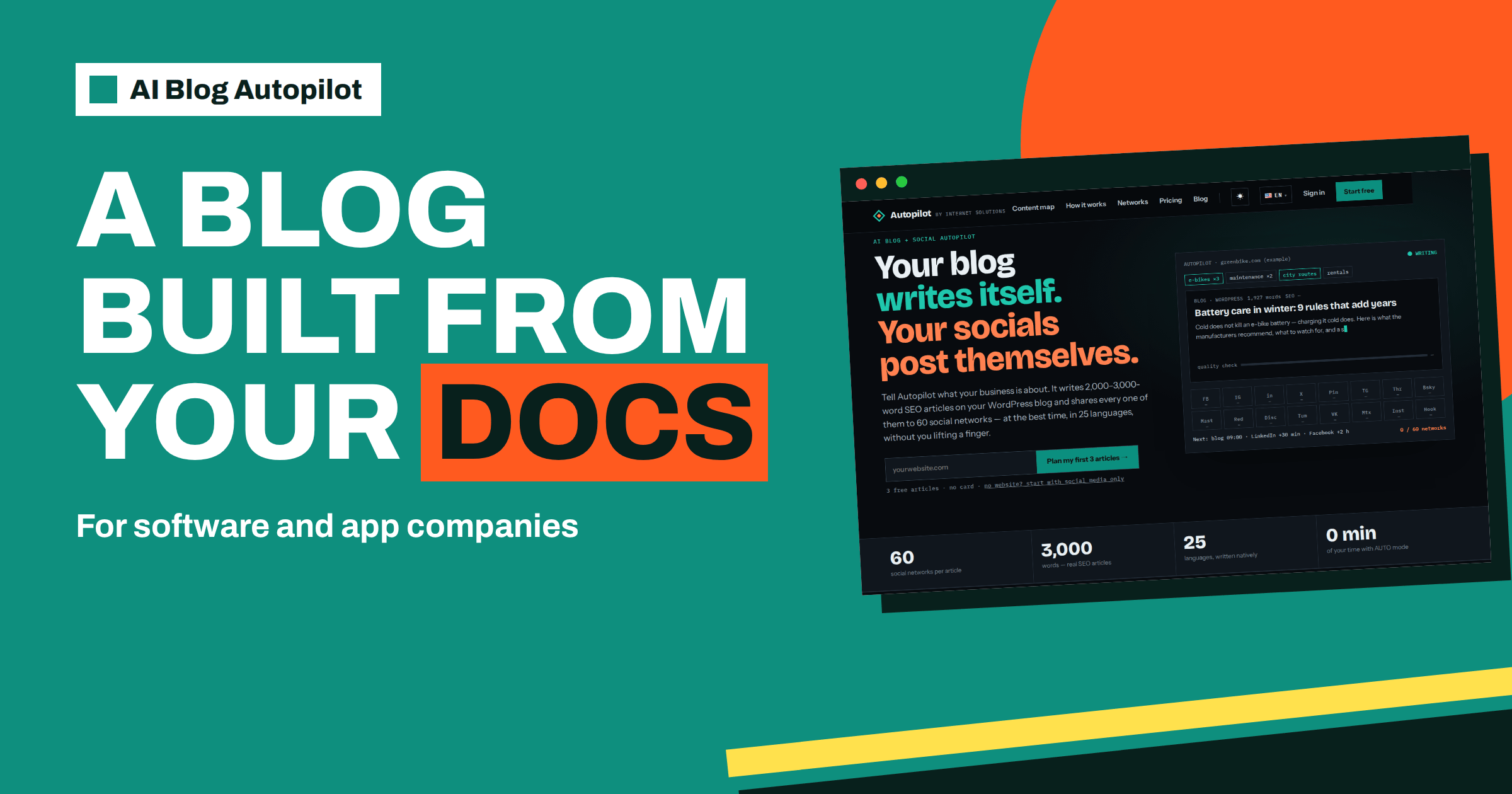
The home page describes what the product writes: 2,000 to 3,000 word articles planned around real search queries, with an FAQ, tags and SEO meta, published on WordPress and shared to the networks. For a software company, that is a way to cover many user questions without pulling engineers off the roadmap.
Topic families for software
Group your topics into families and weight them. How-to articles explain tasks step by step, in the user’s words. Use-case articles show how a type of company or person can use the product for a specific job. Comparison articles explain the differences between approaches, such as building versus buying or one method versus another, with fairness and without attacking named competitors.
Troubleshooting articles answer the questions that support receives most often, which are also questions that people search for. Glossary articles explain terms in plain language and bring in beginners. Story articles describe how a release came about, what changed and why, written for users and not for engineers.
Use the product’s settings to steer the mix: weight, keywords, audience and tone. For a technical audience, say so, and ask for a direct, precise tone without marketing language. For buyers, describe the business problem and the decision they face. The article on setting up topics in AI Blog Autopilot goes through each setting.
Keep volatile facts out of the text
Software changes constantly. Features appear, prices shift, limits move and screens are redesigned. An article that describes a feature in detail may be wrong within months. Decide what the blog says about the product’s specifics, and what it leaves to the documentation and pricing pages.
A good rule is that articles explain concepts and methods, and link to the docs for current details, such as exact settings, limits and prices. Put in the brief that articles must not state prices, limits or plan contents. This prevents the contradictions that confuse both readers and AI answers. The article on product and pricing facts for AI answers explains why consistency matters.
The home page says the writer is instructed never to make up statistics, quotes or sources, but a writer without access to your product cannot know what it does today. Supply an accurate description of the product, a list of what it does not do and a list of terms to use. Have a product person confirm any statement about functionality.
Technical accuracy and code
If articles contain commands, code or configuration, the risk of error is higher, because a small mistake can break a reader’s setup. Either avoid code in automated articles or have an engineer test every sample before publication. A broken example damages trust more than a missing one.
Be careful about security advice and anything that touches credentials, permissions or data handling. A statement that is correct for one environment can be dangerous in another. If a topic is sensitive, include a note in the brief that articles must describe general principles and link to the official documentation, and consider handling the topic yourself.
Technical readers detect vagueness quickly. Prefer concrete, verifiable statements. If an article is too general to be useful, tighten the topic in the brief, for example by naming the exact task and the environment.
Approval by a product person
For a software company, approval is usually the right mode. The home page says AUTO is the default and approval is optional. Switch approval on, and have someone who knows the product read each article before it goes out. This person checks claims about features, accuracy of steps and consistency with documentation.
Agree a checklist. Is every statement about the product correct today? Are there promises about roadmap or dates? Are steps accurate and in the right order? Does the article link to the docs for the details? Does it compare fairly? Does it use the terms your product uses? Keep notes of corrections, and turn repeated ones into rules in the brief.
After several weeks of reliable output on safe topics, you might consider AUTO for those topics while keeping approval for anything technical. The article on the quality gate explains what the automatic check covers, and the article on editorial review compares the modes.
Choosing a plan and a schedule
A small software company with one website might start on Starter, which lists 8 articles a month for 19 euros, or Growth, which lists 30 articles, 2 websites and 3 languages for 49 euros. If the product has a marketing site and a separate help site, two websites may be useful. If it serves several markets, languages matter, and Pro lists all 25.
Volume should follow review capacity. A product person with an hour a week can review perhaps four to eight articles. Do not buy more credits than that person can check, since credits are monthly and do not roll over and unreviewed articles carry risk.
Tie the schedule to the product calendar. Plan articles around releases, events and seasons for your users. If a major feature launches in six weeks, prepare how-to content that will be ready when it does, and brief the product person in advance so that they can approve quickly.
Networks for developers and buyers
Choose networks where your audiences are. Professional networks suit buyers and managers. Developer communities and open discussion platforms suit technical readers, though many of them dislike promotional posts, so be careful to offer value. The networks page lists many types: social networks, messaging channels, team chats, publishing platforms and read-later tools. It names DEV (Forem) among the publishing platforms, which suits some technical audiences.
The page says the product writes a separate text for each network, including a short hook for X and Bluesky and a professional post for LinkedIn. Read the first posts for tone and accuracy. A summary that over-simplifies a technical point can mislead.
If you run a community on a chat platform for your users, team chats and messaging channels in the list may let you share new articles there. Ask the community whether they want it, and keep the volume modest. The article on sharing blog posts on Reddit without getting banned explains the culture of one such community.
Measuring a software blog
Judge the blog by outcomes that matter to the business: sign-ups, trial starts, demo requests and activation, not only visits. Use analytics to see which articles lead to those actions, and which topics attract the right readers. Look at support too: do articles reduce repeated questions?
Review the topics monthly. Give more weight to families that bring qualified readers, and less to those that do not. Use support tickets, sales calls and community questions as sources of new topics. This keeps the blog tied to real needs and prevents it from drifting into generic content.
It also pays to involve support and sales. Support knows the questions users ask most, and sales knows the objections buyers raise. A monthly fifteen-minute conversation with each, with a short list of questions to cover, gives the blog a steady stream of topics that matter. Share the published articles with both teams, so that they can use them in replies and calls, and ask them which ones helped. Articles that are used by colleagues in real conversations are usually the ones that also work for readers.
Keep an eye on the language of your own product in articles. Names of features, plans and screens should match what users see, and when you rename something, update the brief on the same day. A mismatch between an article and the product confuses new users, who cannot find the button the article mentions, and it weakens trust in the rest of your content.
How AI Blog Autopilot helps
The product handles writing, publishing and posting for a steady blog, while your team keeps control of facts, code and claims through approval. Try three free articles on AI Blog Autopilot, no card needed, and compare plans on the pricing page.
Related reading
- A Blog for a Mobile App: Updates, Help and Search Traffic
- Product and Pricing Facts: Making Them Easy for AI Answers
- Editorial Review: Draft, Approve or Full Auto?
The bottom line
Use the product for how-to guides, use cases and fair comparisons, keep features, prices and code under a product person’s review, link to the documentation and measure sign-ups, not only visits.
KKK
Should a software company use approval?
Usually yes. AUTO is the default but approval is optional, and a product person can check claims and steps before publication.
Should articles mention prices and limits?
It is safer not to. Link to the pricing and documentation pages for current details.
Can articles include code?
Only if an engineer tests every sample. Otherwise describe principles and link to the official documentation.
Which plan suits a small software company?
Starter lists 8 articles and 1 website, and Growth lists 30 articles, 2 websites and 3 languages. Choose by review capacity.
How should I measure results?
By sign-ups, trial starts and activation, as well as visits and support questions.