ENEnglish
 LTLietuviškai
 DEDeutsch
 FRFrançais
 RUРусский
 ESEspañol
 PLPolski
 ITItaliano
 UKУкраїнська
 CSČeština
 PTPortuguês
 JA日本語
JA日本語 LVLatviešu valoda
 ETEesti
 HUMagyar
 IDBahasa Indonesia
 TRTürkçe
 HIहिन्दी
 ELΕλληνικά
 ARالعربية
 THไทย
THไทย VITiếng Việt
 RORomână
 MSBahasa Melayu
 BNবাংলা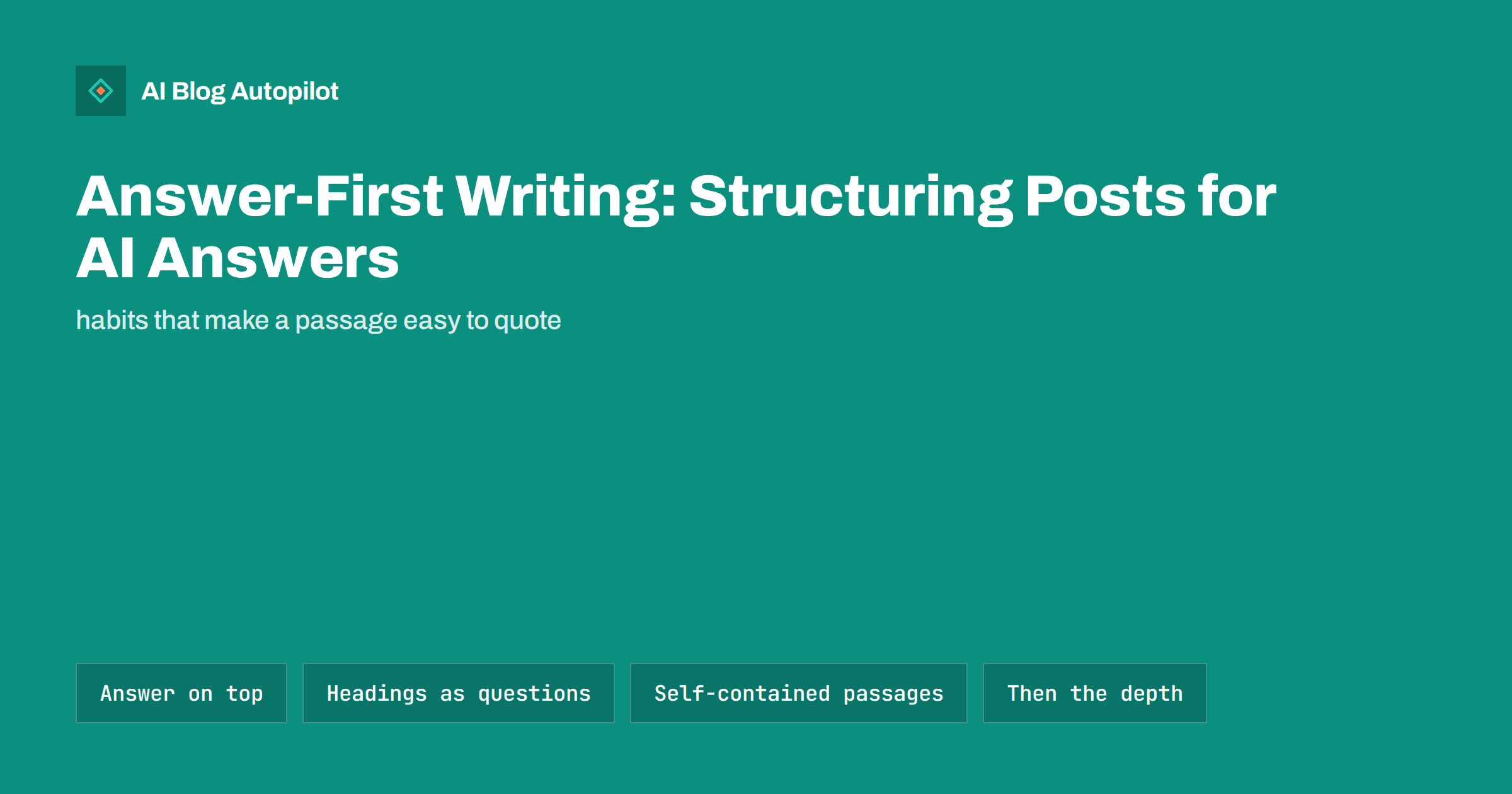
Short answer: answer-first writing means stating the direct answer to the reader’s question at the very start of an article, and again at the start of each section, before the explanation and detail. It helps busy readers, and it makes passages easy for search features and AI answer engines to extract and quote accurately. It does not mean writing short or shallow articles: the depth still follows the answer. Done well, it is simply good explanatory writing with the conclusion moved to the front.
For years, many blog posts opened with a scene-setting paragraph, a bit of history and a promise that the answer was coming. Readers scrolled past it. Now AI answer engines and search overviews read pages looking for a clear passage that answers a specific question, and they skip the preamble too.
Answer-first writing is the response. It is not a trick for machines; it is the structure journalists and technical writers have used for decades. This guide explains how to apply it to blog articles without making them feel mechanical.
What answer-first writing is
The principle is simple: whatever question the page or section exists to answer, answer it immediately and plainly. Then explain, qualify and expand.
In practice this happens at two levels:
- The article level. The first paragraph gives a short, complete answer to the question in the title. A reader who stops there should leave with something correct and useful.
- The section level. Each
H2section opens with one or two sentences that answer the question its heading raises. The rest of the section supports that answer.
Journalists call a version of this the inverted pyramid: most important information first, supporting detail after. Technical writers call it bottom line up front. The names differ; the idea is the same.
Why AI answer engines favour it
AI-generated answers and search overviews typically assemble a response from passages on several pages. They need text that states something clearly, in a form that makes sense when lifted out of the surrounding article.
An answer buried in the fourth paragraph of a section, after a long lead-in, is harder to identify and harder to quote accurately. A section that opens with “A canonical tag tells search engines which URL is the preferred version of a page” gives an extractor exactly what it is looking for.
The same structure has long helped with featured snippets in classic search, and it helps human readers for the same reason: they arrive with a question and want to see quickly whether the page answers it. No format guarantees that a page will be cited or shown, but a clear, well-supported answer at the top of a section makes it a much easier candidate.
There is also a practical benefit for your own editing. When the answer has to come first, a vague article becomes obvious immediately: if you cannot write the opening paragraph, you have not yet decided what the article is saying. Fixing that before drafting the rest saves more time than any tool.
How to write the opening answer
The opening answer is the most important paragraph in the article. A few rules make it work:
- Answer the title’s question directly. If the title asks “How long should a blog post be?”, the first sentence should contain a length or a clear rule for choosing one, not a discussion of why length is debated.
- Keep it to two to four sentences. Long enough to be complete, short enough to be quoted whole.
- Include the key qualification. If the honest answer is “it depends”, say what it depends on in the same paragraph. “It depends on search intent: definitions need a few hundred words, in-depth guides often need a few thousand.”
- Use the words the reader used. If people search for “robots.txt”, do not open with “the crawler directives file”.
- Make it self-contained. Avoid “as mentioned above”, “this” without a noun and pronouns that point to earlier text.
A useful test: read the opening paragraph aloud as if it were the complete reply to someone who asked you the question in person. If it sounds evasive, incomplete or like a preamble, rewrite it.
Turning headings into answerable questions
Answer-first sections work best under headings that make the question explicit. Compare these pairs:
- “Background” versus “Why canonical tags exist”
- “Considerations” versus “When a redirect is better than a canonical”
- “Tips” versus “How to write alt text for a chart”
Descriptive headings do three jobs at once. They help readers scan, they tell search engines what each section covers, and they give answer engines a clear question to match against. You do not need to phrase every heading as a literal question; a descriptive statement works just as well, as long as it is specific.
Then apply the rule inside each section: the first sentence after the heading answers it. Supporting paragraphs, lists and examples follow.
Writing passages that survive being quoted
When a passage is extracted, it loses everything around it. Write the key sentences so they still make sense alone:
- Name the subject. “Robots.txt controls crawling, not indexing” works out of context. “It controls crawling, not indexing” does not.
- Keep numbers with their units and conditions. “Most posts need two to four internal links” is clearer than “two to four is usually right”.
- Put definitions in one sentence. “X is Y that does Z” is the most quotable form in the language.
- Avoid hedging stacks. “It may possibly sometimes help” says nothing. State the typical case and the exception separately.
- Be accurate. An answer engine quoting a wrong statement from your page does more harm than not being quoted at all.
Where answer-first writing goes wrong
The structure is easy to overdo. Watch for these mistakes:
- Thin articles. Some writers give the answer and stop. The article then has nothing that earns a click, a link or trust. The answer should open the article, not replace it.
- Robotic repetition. Starting every section with “The answer is” or restating the heading word for word reads badly. Vary the phrasing; keep the substance up front.
- Answering the wrong question. If the title promises “how to” and the opening defines the term, the reader is still waiting. Match the answer to the intent.
- False certainty. A crisp answer to a question that genuinely depends on circumstances misleads. State the rule and the main exception together.
- Burying the answer in formatting. A box, a tab or an accordion that hides the answer until clicked can make it harder for crawlers and readers to find. Keep the key paragraph in plain, visible text.
Supporting structures: FAQ, lists and tables
Several page elements reinforce an answer-first structure:
- An FAQ section at the end handles the follow-up questions readers commonly ask, each with a short, self-contained answer. Marking it up with FAQPage structured data describes those questions and answers in a machine-readable way; the vocabulary is documented at schema.org. Search engines decide for themselves whether to show any rich result.
- Numbered lists suit processes. Each step starts with a verb and makes sense on its own.
- Comparison tables suit “X vs Y” questions, where the answer is a set of differences rather than one sentence.
A short summary box near the top can also help on long guides, but only if it contains real answers rather than a list of what the article will cover. “In this article you will learn” is a table of contents, not an answer. “Use a 301 for permanent moves and a 302 only for temporary ones” is an answer.
None of these replace the opening answer. They extend it for readers who need more.
A quick before-and-after
Here is a typical opening written the old way:
“Internal linking is something every blogger has heard about, but few understand it fully. In this article, we will explore the history of internal links, why they matter, and some of the best practices you can adopt.”
And the same opening, answer first:
“Internal links are links from one page on your site to another. On a blog, each post typically needs a few contextual links to closely related posts, using descriptive anchor text, plus a link from at least one other page so it can be found. They help readers keep reading and help search engines understand which pages matter most.”
The second version is longer, but every sentence carries information. A reader who stops after it knows what to do.
How AI Blog Autopilot handles structure
AI Blog Autopilot writes long-form articles planned around a real search query, with an FAQ section, tags and SEO meta included. Its automatic quality check covers length, structure, keyword and meta before anything goes live, and the writer is instructed never to make up statistics, quotes or sources. If you want articles on your own blog that start with the answer and then go deep, you can see how the process works on the AI Blog Autopilot home page.
Related reading
- How to Get Your Blog Cited by AI Search
- Writing for Featured Snippets Without Chasing Them
- Writing Introductions That Don’t Waste the Reader’s Time
- How to Write FAQ Sections That Rank
The bottom line
Answer-first writing puts the conclusion where readers and answer engines look for it: at the top of the article and at the top of each section. Write a short, complete, self-contained answer, use headings that name the question, and then give the depth that makes the page worth trusting. It is not a format for machines; it is respect for the reader’s time.
KKK
What is answer-first writing?
Answer-first writing is a structure where the direct answer to the reader’s question comes at the start of the article and at the start of each section, followed by explanation and detail. It is similar to the inverted pyramid used in journalism.
Does answer-first writing get my blog cited in AI answers?
It makes citation more likely but guarantees nothing. AI answer engines look for clear, accurate passages that answer a question, and answer-first sections provide exactly that. Accuracy, depth and the page’s overall trustworthiness still matter.
How long should the opening answer be?
Usually two to four sentences. That is long enough to give a complete answer with its main qualification, and short enough to be quoted as a whole by a search feature or an AI answer.
Will answering immediately reduce time on page?
Some readers will leave once they have their answer, and that is fine. Readers who need more keep going because they can see the page is relevant. An article that hides its answer usually loses more readers than one that gives it up front.
Should every heading be a question?
No. Headings should be specific and descriptive, which can be a question or a statement. What matters is that each section clearly answers what its heading promises, starting in the first sentence.
Can I use answer-first writing on older posts?
Yes, and it is one of the cheapest improvements you can make. Rewrite the introduction so it answers the title directly, then check that each section opens with its main point. The rest of the article often needs little change.