ENEnglish
 LTLietuviškai
 DEDeutsch
 FRFrançais
 RUРусский
 ESEspañol
 PLPolski
 ITItaliano
 UKУкраїнська
 CSČeština
 PTPortuguês
 JA日本語
 LVLatviešu valoda
 ETEesti
 HUMagyar
 IDBahasa Indonesia
 TRTürkçe
 HIहिन्दी
 ELΕλληνικά
 ARالعربية
 THไทย
 VITiếng Việt
 RORomână
 MSBahasa Melayu
 BNবাংলা
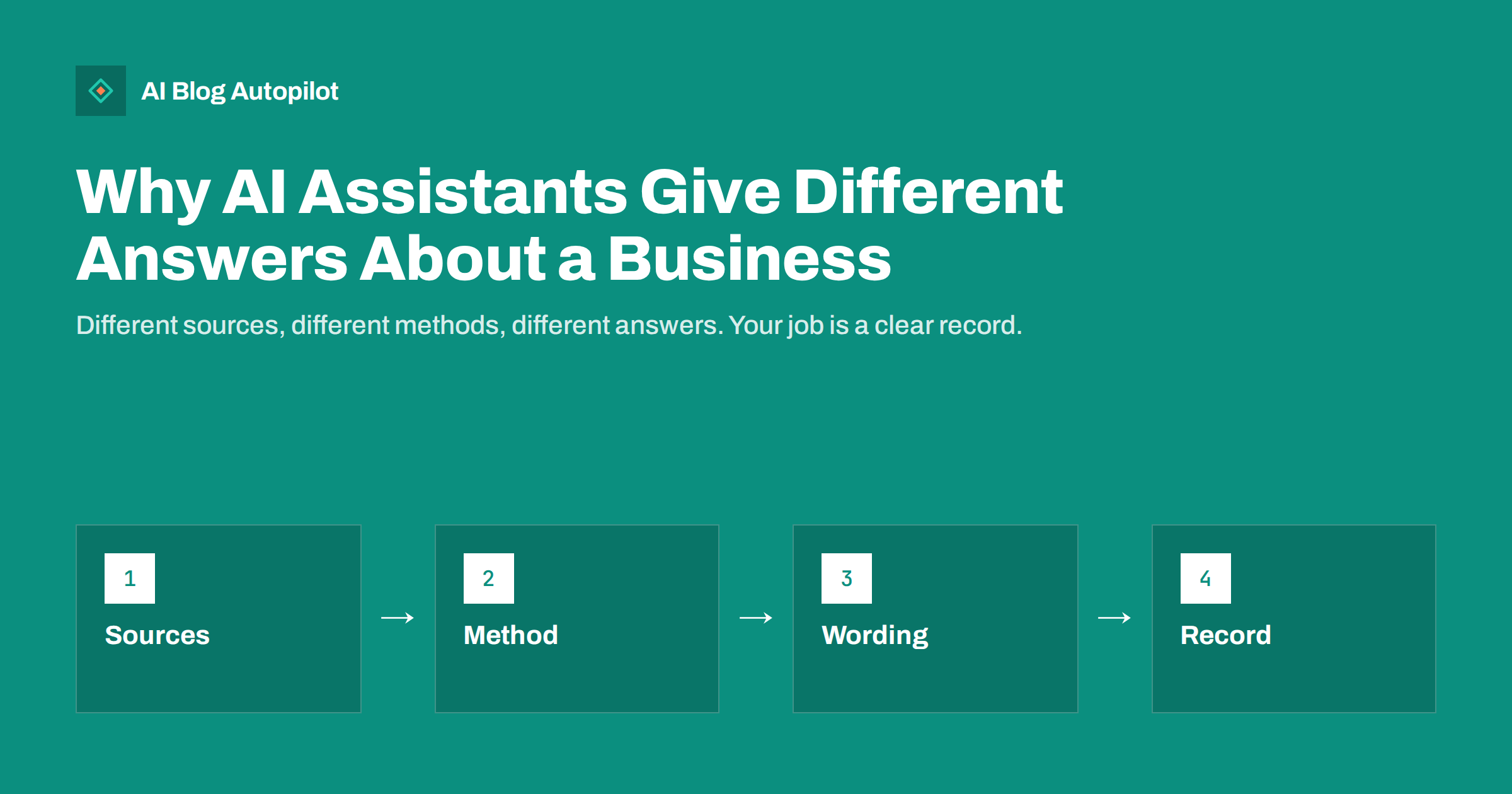
Short answer: AI assistants give different answers about the same business because they do not share one source of truth. They differ in what they learned during training, whether they search the web while answering, which pages and indexes they search, how they rank and summarise what they find, which language, location and settings apply and how the question is worded. Even the same assistant can answer differently from one request to the next. You cannot control any of those mechanics, but you can make your business easy to describe consistently by keeping facts accurate, identical across your pages and visible on pages that are easy to read and cite.
Many owners discover this by accident. One assistant describes the company correctly, another gets the services slightly wrong, a third does not seem to know the business exists and a fourth recommends a competitor for the same question. It is natural to assume that something is broken on your site. Often nothing is, and the differences simply reflect how these systems work. Understanding the causes helps you test properly, avoid chasing noise and put your effort where it can make a difference.
Five reasons the answers differ
- Different training knowledge. Each assistant was built from a different collection of text and has a different cut-off date. A business that launched recently, changed its name or moved may be missing, outdated or confused with another one in some assistants’ built-in knowledge. Our article on training data versus live search explains this distinction.
- Different use of live search. Some answers come from built-in knowledge alone; others combine it with a search of the web at the time of the question. When search is used, the answer depends on what the search finds, which depends on the search system, its index and how fresh it is.
- Different indexes and ranking. Assistants that search the web rely on different underlying indexes and their own ranking methods. A page that one system retrieves easily may not appear in another because it was not crawled, was blocked, loads slowly or is ranked lower.
- Different summarising behaviour. Having found sources, assistants choose which to quote, how to compress them and how cautious to be. Two systems reading the same three pages may emphasise different parts.
- Different context. Language, country, device, account settings and the earlier messages in a conversation all affect the answer. A question asked in another language may bring a different set of sources.
On top of these, assistants are not deterministic. Asking the same question twice can produce different wording, different examples and sometimes different facts. A single answer is therefore a sample, not a verdict.
The wording of the question changes the answer
“What does [business] do?” and “Is [business] any good?” and “Best [service] in [city]” are three different tasks. The first asks for a description, the second for an evaluation and the third for a ranked list from a wide field. Small differences in phrasing change which sources are used and how the answer is framed. If you are testing how assistants describe you, vary the question deliberately and record the exact wording each time. Use the language your customers use, not your internal terms. Our guide to checking whether AI assistants mention your blog describes a repeatable way to do this.
How to test fairly
An unscientific glance at two answers tells you very little. A simple, careful test tells you more.
- Write down ten to twenty real questions that customers might ask, in three groups: about you by name, about your category and about comparisons with alternatives.
- Ask each question in each assistant you care about, and repeat it two or three times on different days, noting the date and the exact wording.
- Record what matters: whether you are mentioned, whether the description is correct, which sources are cited and which competitors appear.
- Score accuracy separately from visibility. Being mentioned with wrong details is a different problem from not being mentioned.
- Look for patterns, not single results. If the same wrong fact appears in several places, find where it comes from.
- Repeat monthly and keep the log. Our article on a monthly AI visibility report suggests what to track.
Do not draw strong conclusions from one answer, one day or one tool. Do not pay for guarantees about results in a specific assistant either, because nobody outside those systems can promise them.
Where wrong or missing details come from
When an assistant says something wrong about your business, the origin is usually one of a small number of causes. The information may be outdated, such as an old address, old prices or discontinued services. It may be inconsistent: your home page, your directory listings and your social profiles say slightly different things, and the system picks one. It may come from a third-party page that you do not control, such as an old directory entry, a review site or an article by someone else. The name may be ambiguous and shared with other businesses, so that details get mixed. Or the information may simply not exist in a clear, readable form on any page, so the assistant fills the gap with something plausible. Our articles on ambiguous brand names and on what to do when AI answers get your business wrong deal with these cases in detail.
What you can do to make answers more consistent
You cannot make every assistant say the same thing, but you can remove the reasons for disagreement that are within your control.
- Keep one set of facts. Decide the correct name, description, address, services, prices policy and contact details, and use them identically everywhere. Our article on conflicting facts across pages explains how to audit this.
- State the basics plainly on your own site. A clear about page, a services page and a pricing or contact page, written in simple sentences, give any system something reliable to quote.
- Make pages crawlable and fast. If your pages are blocked, hidden behind scripts or very slow, search-based assistants may not retrieve them. Check your robots rules and rendering.
- Use structured data for the basics where it applies, such as organisation and contact details, and make sure it matches the visible text.
- Update third-party profiles. Directories, business listings and professional profiles are common sources. Correct them at the source.
- Build a record of independent mentions. Articles, reviews, partner pages and interviews that describe you consistently help systems corroborate the facts. Our article on brand mentions explains why.
- Publish dated, specific content about what you do and what is new, so the freshest information is on your own pages.
A worked example
Imagine a small bookkeeping firm that changed its name two years ago. In one assistant, a question about the firm returns a correct description. In another, the answer mentions the old name and a service the firm no longer offers. A third confuses it with a larger company of a similar name in another country. The firm tests ten questions over two weeks and finds that the wrong details always trace back to the same few places: an old directory listing, a press article from before the rename and a social profile that was never updated. It corrects the listing, asks the publisher to update the article, updates the profile and publishes a short, plain page stating the current name, services and location, with the previous name mentioned once for clarity.
Within a few weeks the wrong details appear less often, though not everywhere, since some assistants rely on older built-in knowledge. That is a typical result: improvement without perfection. The firm keeps the test log, repeats it monthly and adds a line to its checklist so that any future change of name, address or service is updated across all listings on the same day.
When to leave it alone
Some variation is normal and not worth fixing. An assistant that describes you in slightly different words from another is not making an error. An assistant that does not mention you in answers to broad category questions may reflect a crowded market rather than a problem with your site. And a model with older built-in knowledge may take time to catch up, whatever you publish. Concentrate on factual errors that could cost you customers, such as wrong services, wrong location or confusion with another company, and on missing basic information that you can easily provide. Treat everything else as something to monitor.
Be honest, too, about the limits of influence. Nobody can pay or optimise their way into guaranteed placement in AI answers. The reliable path is the unglamorous one: accurate, consistent, well-structured information on a site that search systems can read, supported by credible mentions elsewhere.
How AI Blog Autopilot helps
AI Blog Autopilot writes and publishes SEO articles on your WordPress blog from the topics, keywords, audience and tone you give it, with FAQ sections, tags and SEO meta, so there is a steady stream of clear, specific pages about what your business does and knows. It cannot control what any assistant says, and it does not promise placement. Use approval mode to check facts about your business in every article before publication, so that your own site never contradicts itself. Plans are on the pricing page.
Related reading
- Training Data or Live Search: How AI Assistants Know a Business
- Checking Whether AI Assistants Mention Your Blog
- When AI Answers Get Your Business Wrong: What to Do
- How AI Search Picks Which Pages to Cite as Sources
The bottom line
Different assistants differ because they use different knowledge, different searches and different ways of summarising, and even one assistant varies from one request to the next. Test with a written set of questions, repeated over time, and judge patterns rather than single answers. Then work on what you control: one consistent set of facts, plain pages that can be read and cited, correct third-party listings and credible mentions elsewhere. That does not guarantee identical answers, but it removes the avoidable reasons for them to go wrong.
FAQ
Why does the same AI assistant answer differently each time?
These systems generate text with some built-in variation, and their sources or settings can change. Treat each answer as a sample and look for patterns across repeated tests.
Can I make every AI assistant describe my business the same way?
No. You can reduce avoidable differences by keeping your facts accurate and consistent, but each system uses its own sources and methods.
Which assistant should I optimise for?
Rather than choosing one, focus on fundamentals that help all of them: clear facts, crawlable pages, consistent listings and credible mentions.
What if an assistant states something false about my company?
Find where the claim comes from, correct the source if it is yours or a listing you can edit, publish a clear factual page and use the assistant’s feedback option where available.
Is it worth paying someone to guarantee AI answers?
Be wary of guarantees. Nobody outside these systems controls what they say, so any promise of guaranteed placement should be treated with suspicion.