ENEnglish
 LTLietuviškai
 DEDeutsch
 FRFrançais
 RUРусский
 ESEspañol
 PLPolski
 ITItaliano
 UKУкраїнська
 CSČeština
 PTPortuguês
 JA日本語
 LVLatviešu valoda
 ETEesti
 HUMagyar
 IDBahasa Indonesia
 TRTürkçe
 HIहिन्दी
 ELΕλληνικά
 ARالعربية
 THไทย
 VITiếng Việt
 RORomână
 MSBahasa Melayu
 BNবাংলা
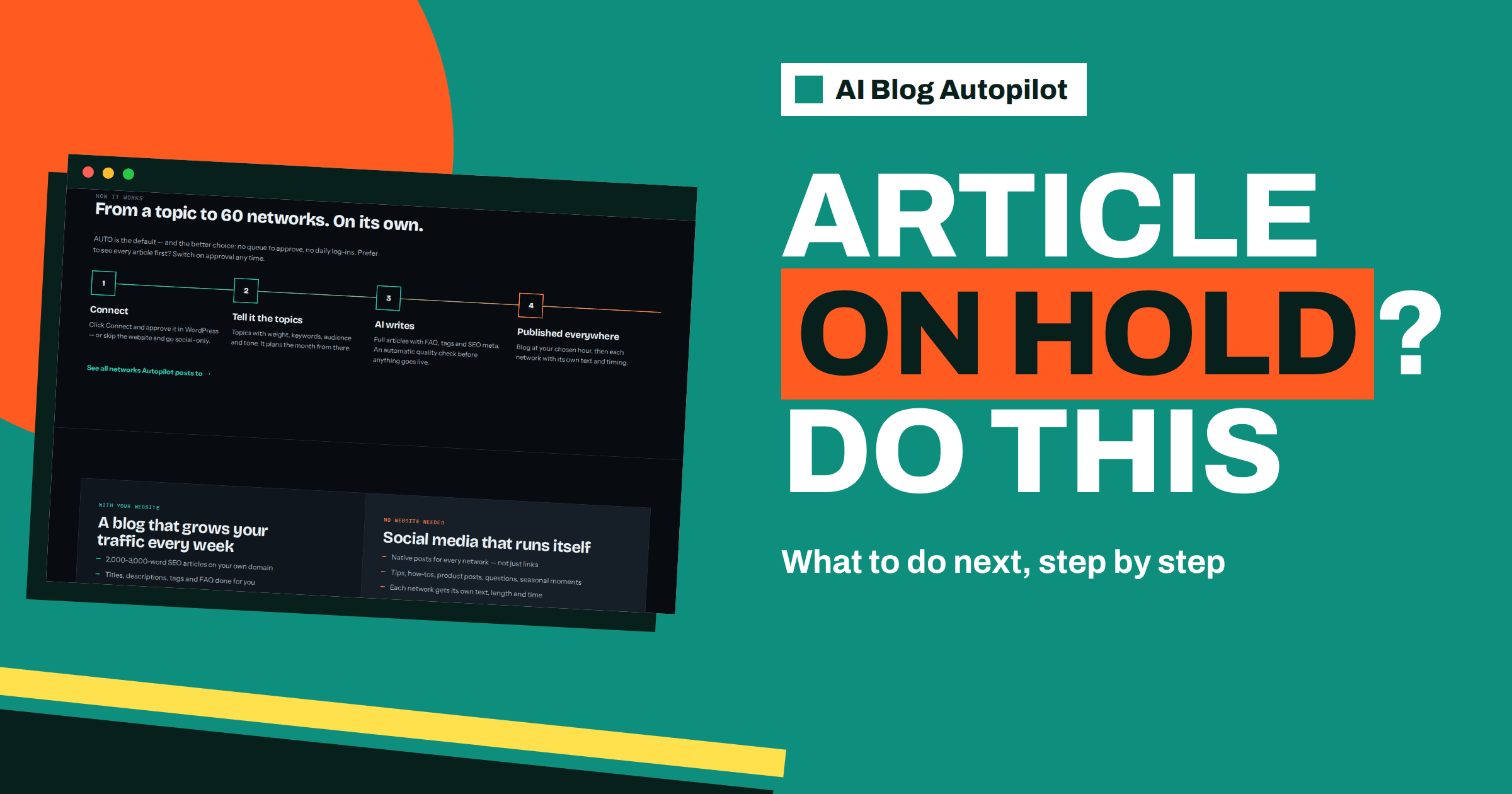
Short answer: the AI Blog Autopilot home page says that an automatic quality check looks at length, structure, keyword and meta, and that weak articles wait for you instead of going live. When one is held, read it, work out what is weak, decide whether to approve, improve through the brief or drop it, and then adjust the topic settings so the same weakness does not return.
A held article can feel like a failure, but it is the system working as designed. The product would rather pause an article than publish something weak, and it leaves the decision to you. That is a sensible trade: a short delay in exchange for not putting poor content on your blog under your name.
Still, a held article is a gap in your calendar and a question you need to answer. This guide explains how to find held articles, how to judge them, what choices you have and how to reduce the number over time. It uses only what the product’s home page says about the quality check. Check your account for the exact way held articles are shown.
What the quality check does
According to the home page, the product checks length, structure, keyword and meta automatically before anything goes live. The feature list calls it a quality gate and says weak articles wait for you instead of going live. It sits between writing and publishing.
Each of the four checks guards against a common weakness. Length ensures the article is substantial, since the home page says articles run from 2,000 to 3,000 words. Structure checks that headings and sections form a coherent shape. Keyword checks that the article is about the intended phrase. Meta checks that title and description are present and sensible.
The check is a safety net for form, not a guarantee of truth. An article can pass all four and still contain a wrong statement about your business, which is why your own review remains important. The article on the quality gate explains more about what it covers.
Finding held articles
Start with the content map. The home page describes a calendar for when and a network matrix for where, with each cell linking to the live post, and notes that if something failed, the page tells you why. An article that was planned but did not publish will show as missing or waiting on the calendar for its date. Look for gaps.
Check also on the day. If you have a habit of looking at the blog on publishing days, a missing article is easy to spot. A weekly scan of the content map, as suggested in other guides on this blog, catches the rest. If you use approval mode, remember that articles waiting for you to approve are a different case from articles held for quality, so check which situation applies.
Because the product posts to the networks after the blog goes live, a held article also means no social posts for it. If you see an empty column in the matrix, check whether the article behind it is waiting. The article on reading the content map explains the screen.
Read it before you decide
Open the held article and read it as you would any draft. Do not assume that it is bad: sometimes a held article is close to acceptable, and sometimes the weakness is minor. Read the title, the description, the headings and the opening. Skim the rest for anything that feels thin or off topic, then check the FAQ.
Ask what is weak. Is it too short or padded? Is the structure confused, with sections that overlap or are missing? Does it drift away from the intended subject? Is the title unclear or the description missing? Each of these points to a different cause and a different remedy.
Note your answer in a log. A simple line with the date, the article, what was weak and what you decided is enough. After a few entries, you will see patterns.
Your choices
You have three realistic choices. The first is to approve the article as it is, if on reading you find it good enough for your purposes. You know your audience, and the check is a general test, so you may judge it differently. Be honest, though: approving something you would not be proud of defeats the purpose of the gate.
The second is to improve the cause through the brief. If the article is held because the topic was too broad or the keywords unclear, narrow the topic, sharpen the keywords and describe the audience more precisely, so that the next article is stronger. The home page says topics have weight, keywords, audience and tone, and those are the levers.
The third is to drop the topic. Some topics do not suit the product, or your site, or your capacity to review. If a topic keeps producing weak articles, it may be the wrong topic. Remove it, or reduce its weight, and spend the credit on something better. The article on setting up topics in AI Blog Autopilot explains how.
Handling the calendar gap
A held article leaves a hole in your plan. Decide whether the hole matters. If the article was tied to a date, such as a seasonal subject or an event, you may need a replacement quickly. If it was an ordinary piece, a gap of a few days will not harm the blog.
Remember that credits are monthly and do not roll over, as the pricing page states. If an article is held and you decide to drop it, think about whether you still have time to use the credit this month. Add a replacement topic, or adjust the weights, so that the month’s articles are not wasted. The article on planning your monthly credits shows how to do this.
If your audience expects regular publishing, such as a weekly series, a short note on your blog or social profiles about a delay is better than silence. Most readers will not notice a missing article, but a loyal audience may.
Finding the cause in your brief
Held articles often point to weaknesses in the brief. A topic that is vague, such as general advice, gives the writer little to anchor on. A topic whose keywords are ambiguous may drift. A topic that asks for something impossible, such as detailed content on a subject where little can be said without specific facts, leads to thin pages.
Review the topic settings for the held article. Is the audience clear? Are the keywords specific and natural? Does the weight suit the subject? Is the tone described in plain terms? Adding specifics, such as the exact question to answer and the situation of the reader, usually improves the next attempt.
Look at your fact sheet as well. If the article is thin because the writer had nothing concrete to say about your business, adding real details to the brief gives it substance. The home page says the writer is instructed never to make up statistics, quotes or sources, so it will not fill gaps with invented material, which can leave an article thin where facts are missing.
When many articles are held
One held article in a month is normal. Several in a row suggest a systematic problem. Look for what they share. Are they all on the same topic? The same weight? The same language? A newly added subject? If so, the common factor is your starting point.
Consider whether you asked for too much. A very long list of topics with little weight each may produce scattered articles. Narrowing the number of topics can make each article stronger. Consider also whether the keywords in a new language are accurate, since natural phrases differ by language. The article on choosing which languages to publish in explains why local research matters.
If you cannot find a cause, contact support through the details on the product’s site, with specific examples: the topics, the dates and what you changed. A precise report is easier to help with than a general complaint.
Making holds rarer
Over time, a good brief means fewer holds. Write topics as you would brief a skilled colleague: a clear subject, a specific reader, real keywords, a stated tone and a note of what to avoid. Keep the fact sheet current. Review a sample of published articles monthly, and feed what you learn back into the settings.
Avoid changing too many things at once. If you alter weights, keywords and tone together, you will not know which change helped. Change one or two settings, watch the next few articles and then adjust again. A calm, iterative approach produces steadier results.
Do not aim for zero holds. A system that never holds anything may be set too loosely. A small number of holds shows that the gate is doing its job.
A short example makes the process concrete. A florist sees that the article on wedding flowers is held. Reading it, she finds that the topic was simply called flowers for events, so the draft wandered between weddings, funerals and corporate arrangements. She narrows the topic to wedding flowers for small ceremonies, names the typical reader as a couple planning a budget and adds the sentence that the shop does not offer destination weddings. The next article on the subject comes through without a hold, and she has also stopped a future article from promising a service she does not provide.
How AI Blog Autopilot helps
The product checks length, structure, keyword and meta before anything goes live and keeps weak articles for you, so poor content does not reach your blog without your say. See AI Blog Autopilot, try the three free articles and compare plans on the pricing page.
Related reading
- The Quality Gate in AI Blog Autopilot
- How to Read the AI Blog Autopilot Content Map
- Quality Control When You Publish at Volume
The bottom line
Treat a held article as a prompt: read it, decide whether to approve, improve the brief or drop the topic, replace the gap in your calendar and fix the cause so holds become rare.
FAQ
Why would an article be held?
The home page says weak articles wait for you instead of going live, after a check of length, structure, keyword and meta.
Where do I see a held article?
Look at the content map and your account for articles planned but not published, and check the reason shown.
Do I lose the credit if I drop a held article?
Credits are monthly and do not roll over, so use the credit this month by adding or adjusting topics.
Can I publish a held article anyway?
You decide whether to accept it. Read it first and approve only if you would be happy to publish it under your name.
How do I reduce held articles?
Write clearer topics with specific keywords, audience and tone, keep your fact sheet current and review a sample regularly.