ENEnglish
 LTLietuviškai
 DEDeutsch
 FRFrançais
 RUРусский
 ESEspañol
 PLPolski
 ITItaliano
 UKУкраїнська
 CSČeština
 PTPortuguês
 JA日本語
JA日本語 LVLatviešu valoda
 ETEesti
 HUMagyar
 IDBahasa Indonesia
 TRTürkçe
 HIहिन्दी
 ELΕλληνικά
 ARالعربية
 THไทย
THไทย VITiếng Việt
 RORomână
 MSBahasa Melayu
 BNবাংলা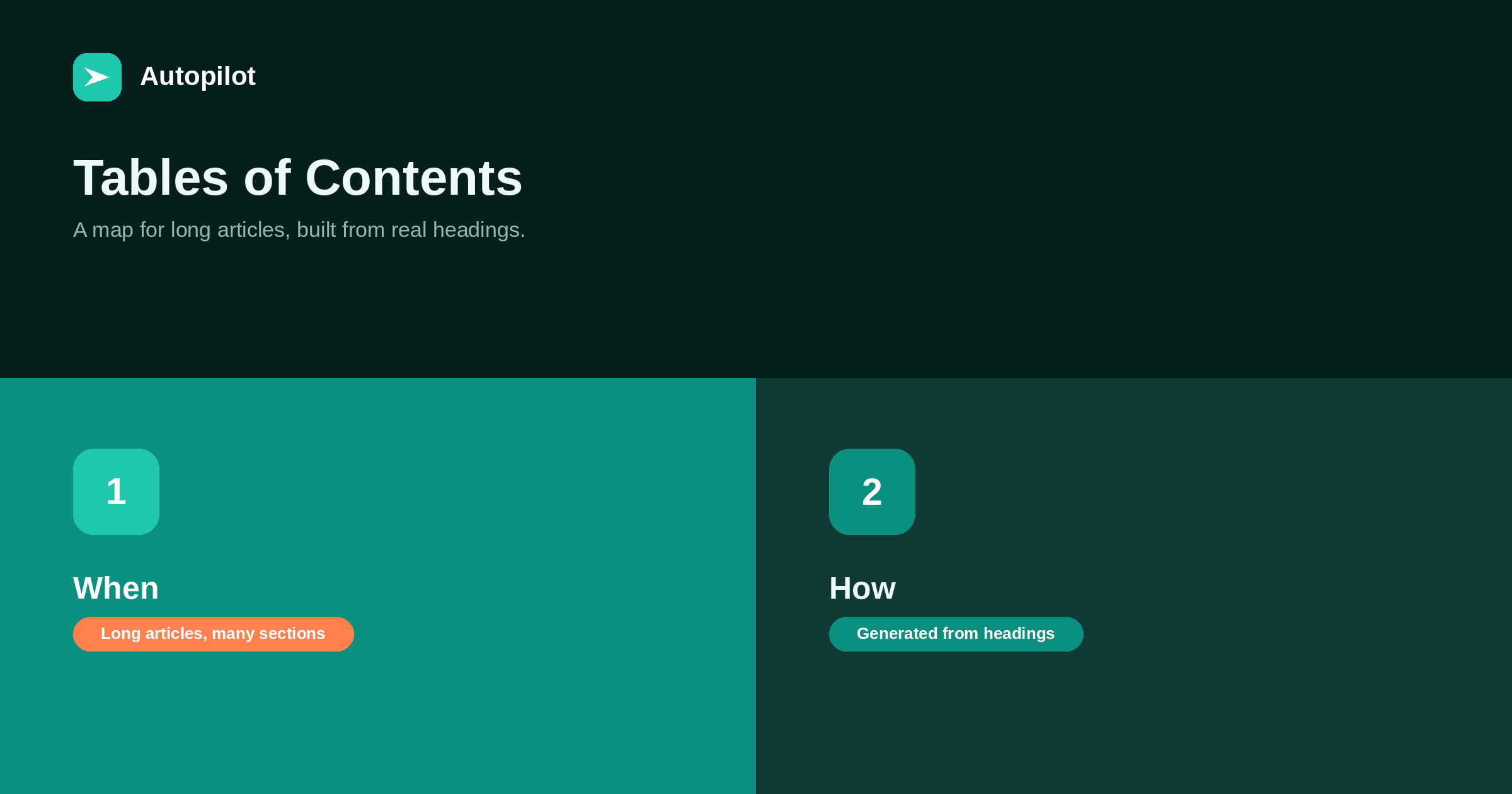
Short answer: add a table of contents to articles long enough that readers need help finding their section, typically those with six or more main headings. Generate it automatically from the article’s H2 headings, so it always matches, with each entry linking to its section. Place it after the short answer or introduction, not before, and keep it compact on phones. A table of contents only works if headings are descriptive; it cannot rescue vague headings or a poorly organised article.
Long articles serve readers with different questions. One wants the costs, another the setup steps, another only the FAQ. A table of contents lets each jump to their part.
It is a simple feature that helps readers of long articles, and it is only as good as the headings it is built from.
When to add one
Not every article needs a table of contents.
| Artículo | Table of contents? |
|---|---|
| Short, a few sections | No, it adds clutter |
| Six or more main sections | Usually helpful |
| Reference guides and pillars | Yes |
| Step-by-step how-to | Optional; the steps are the structure |
On a blog with consistently long articles, a table of contents on every article is reasonable. Otherwise add it where length justifies it.
Build it from headings
Generate the table of contents automatically from the article’s H2 headings, with each entry linking to its section through an anchor. Most themes and plugins can do this.
Automatic generation keeps it in sync when headings change. Hand-built tables of contents drift as articles are edited.
Headings make or break it
A table of contents is a list of headings. If headings are vague — Introduction, Overview, Final thoughts — the list tells readers nothing.
Descriptive headings produce a useful table of contents; the list reads like a summary of the article. how to structure an article covers writing them.
Where to place it
Place it after the short answer or introduction, not at the very top. Readers should get the answer first; the table of contents is for those who want more.
A table of contents above the introduction pushes the answer down, especially on phones — introductions that do not waste time covers why the first screen matters.
On phones
A long table of contents takes up a whole phone screen. Make it collapsible, or keep it compact, so readers can reach the article quickly. A sticky or floating table of contents can help on desktop but often gets in the way on phones.
Anchors and links
Each section needs a stable anchor so contents entries, and links from other articles, can point to it. Anchors based on heading text change when headings change; if other pages link to sections, consider stable anchors that do not depend on the exact wording.
Linking to specific sections from other articles is useful for long guides, pointing readers exactly where they need to go.
Search and tables of contents
Search engines sometimes show links to sections of a page in results when the page is clearly structured. Clear headings and working anchors make that possible; they do not guarantee it.
Accessibility
A table of contents helps screen reader and keyboard users move through long articles. Make it a proper list of links, keyboard accessible, and make sure focus moves to the section when a link is followed — accessibility.
An example
Consider a long guide to setting up a blog. A weak table of contents reads: Introduction, Background, Getting started, More details, Tips, Conclusion. It tells the reader nothing about where to find anything.
A strong one reads: Choosing a platform, Setting permalinks, Making the site indexable, Creating categories, Submitting a sitemap, Installing an SEO plugin, What can wait. A reader looking for sitemaps finds it instantly, and the list itself summarises the article’s advice.
The difference is entirely in the headings. The table of contents feature is the same in both.
Including subheadings
Including H3 subheadings in the table of contents makes it more detailed and much longer. For most articles, H2 headings alone are enough. For very long reference guides, a collapsible second level can help, showing subheadings only when a reader expands a section.
If the table of contents becomes longer than a screen, it is usually a sign the article covers too much and might be better split into several linked articles — clusters and pillar pages covers that approach.
Tables of contents and FAQs
Include the FAQ section as the final entry in the table of contents. Many readers look specifically for it, and a direct link saves them scrolling through the whole article.
Back to top
On very long articles, a small link back to the table of contents at the end of each section, or a button that returns to the top, helps readers move between sections without long scrolling on a phone. Keep it unobtrusive so it does not clutter the text.
On automated articles
Automated articles often follow a consistent structure, which makes automatic tables of contents work well: every article gets one generated from its headings, with no extra effort. The quality still depends on the headings, so review them with the same care as the rest of the article.
Measuring use
Some analytics setups can record clicks on table of contents links. If readers consistently jump to one section, that section may deserve its own article, or a more prominent place near the top. If nobody uses the table of contents, the article may be short enough not to need one.
Either finding is useful: it shows what readers came for, which is the most reliable guide to structuring the next article on the subject.
Keeping it light
Keep the table of contents visually light: a simple list of links, clearly separated from the article, without heavy boxes or colours competing with the text.
What it cannot fix
A table of contents cannot fix a disorganised article. If sections overlap, headings are vague or the order makes no sense, the table of contents will simply display the problem. Fix the structure first.
Related reading
If this was useful, these cover the questions that usually come next.
- How to structure an article — headings that make a good contents list
- Breadcrumbs and navigation — navigation between pages
- Reading on a phone — contents on small screens
The bottom line
Add a table of contents to articles with six or more main sections, generated automatically from descriptive H2 headings with linked anchors. Place it after the short answer, keep it compact or collapsible on phones, make it accessible, and fix the article’s structure first, since the table of contents only reflects it.
FAQ
When should an article have a table of contents?
When it has six or more main sections, or is a reference guide or pillar page.
Should the table of contents be generated automatically?
Yes, from the H2 headings, so it stays in sync when headings change.
Where should the table of contents go?
After the short answer or introduction, not above them.
Does a table of contents help SEO?
It can help search engines show section links in some results, but nothing guarantees it. Its main value is for readers.
How should it work on phones?
Compact or collapsible, so readers reach the article quickly.
Can a table of contents fix a messy article?
No. It displays the structure; fix the structure first.