ENEnglish
 LTLietuviškai
 DEDeutsch
 FRFrançais
 RUРусский
 ESEspañol
 PLPolski
 ITItaliano
 UKУкраїнська
 CSČeština
 PTPortuguês
 JA日本語
 LVLatviešu valoda
 ETEesti
 HUMagyar
 IDBahasa Indonesia
 TRTürkçe
 HIहिन्दी
 ELΕλληνικά
 ARالعربية
 THไทย
 VITiếng Việt
 RORomână
 MSBahasa Melayu
 BNবাংলা
Short answer: the pricing page of AI Blog Autopilot has a switch between monthly and yearly billing, with yearly shown at 20 percent lower. Choose monthly while you are still testing the product and your needs may change, and consider yearly once you have run it for a few months, know which plan fits and expect to keep publishing. Credits stay monthly either way.
Billing choice looks like a minor detail, but it affects cash flow, flexibility and the pressure you feel to use the product. A discount for paying yearly is attractive, yet it only makes sense if you are certain you will keep the service for the whole year. A discount on something you stop using after four months is no discount at all.
This guide explains what the pricing page says, how to compare the two options with simple arithmetic, which situations favour each and what you should check before committing. Prices and conditions come from the pricing page at the time of writing, so confirm the current figures there before you decide.
What the pricing page says
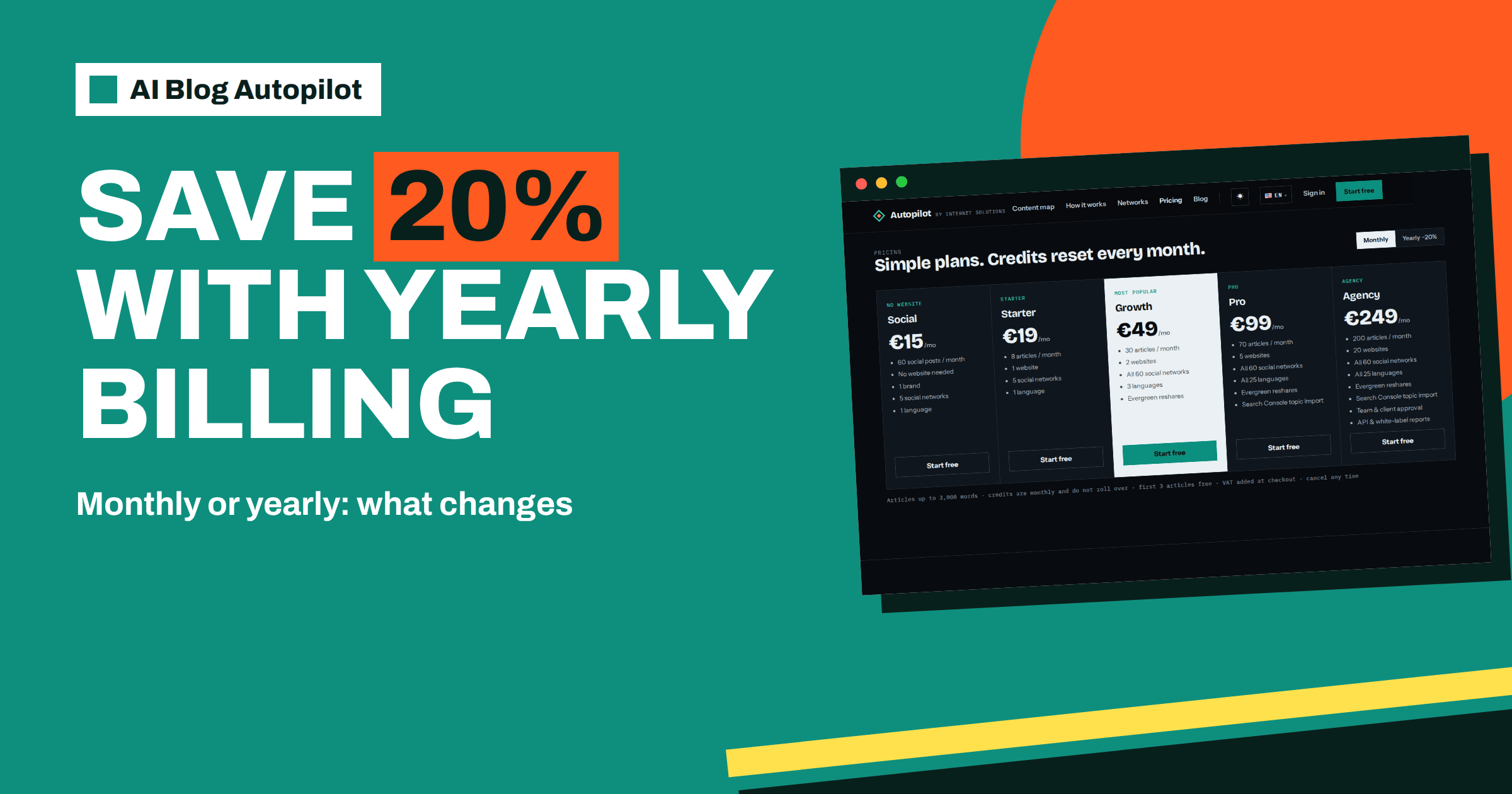
At the top of the plans, the pricing page shows a switch labelled Monthly and Yearly, with the yearly option marked as 20 percent lower. Below it are the plans: Social at 15 euros a month, Starter at 19, Growth at 49, Pro at 99 and Agency at 249 euros a month. The yearly option is described as 20 percent lower, and the page does not set out each yearly total in the text, so look at the figures it shows when you switch.
A line below the plans lists conditions that apply whichever way you pay: articles up to 3,000 words, credits that are monthly and do not roll over, the first 3 articles free, VAT added at checkout and cancellation at any time. These conditions are the same for both options, so the billing switch changes the price and the rhythm of payment, not what you get.
That last point is important. A yearly plan does not give you a year’s worth of credits in one go. According to the pricing page, credits reset every month. So you still have to use each month’s articles within the month. The article on planning your monthly credits explains how.
A little arithmetic
If yearly billing is 20 percent lower than monthly, then the yearly price is 80 percent of twelve times the monthly price. Take Starter at 19 euros a month as an illustration. Twelve months at the monthly rate would be 228 euros, and 80 percent of that is about 182 euros. The saving is roughly 46 euros. Check the figure that the pricing page shows when you choose yearly, because it is the one that counts.
Another way to see it is in months. A 20 percent saving on twelve months equals about two and a half months free. So if you would use the product for at least ten months anyway, yearly billing costs less. If you would stop before that, monthly billing is cheaper. The break-even point is about ten months.
Do the sum for your plan, and then ask the honest question: how confident am I that I will still be using this in ten months? If the answer is very, yearly deserves a look. If the answer is not sure, stay monthly. The saving is real but small compared with the cost of paying for something you do not use.
When monthly is the better choice
Choose monthly if you are new to the product. In the first months, you are learning how the briefs, the review and the content map work for your business, and you may find that a different plan suits you better. A monthly plan lets you move between plans without losing money.
Choose monthly if your business is seasonal or uncertain. A shop that is busy for four months of the year might want articles in those months and not others. A new venture that is not yet sure of its direction may need the freedom to stop. The pricing page says you can cancel at any time, which is a safety net that you should not give up lightly.
Choose monthly if you are testing the product with a trial of more than the first three free articles. A thirty-day pilot, as described in the article on how to pilot an AI blog tool, is easier to run on monthly billing.
When yearly is worth considering
Consider yearly if you have used the product for several months, you know that the plan size fits and your review routine is working. At that point you are paying for something you rely on, and a discount of 20 percent is a sensible reward for commitment.
Yearly also suits businesses that budget annually. If you plan marketing costs once a year, a single payment may be easier to manage than twelve small ones. If your accounting treats it as one expense, that can simplify records. Check how it appears on your invoices, and ask your accountant if you need to.
It suits long projects, such as a blog that you plan to build over two years. The article on the first 90 days of an automated blog sets expectations for the early period, and by the end of it you should know whether to commit longer.
What to check before paying yearly
Read the terms on the pricing page and at checkout. Confirm how cancellation works for a yearly plan, and what happens to the unused part of a period if you cancel. The pricing page says you can cancel at any time, but the practical effect, such as whether a refund applies, is something to verify in the terms and in your account before you pay.
Check the currency and VAT. The page says VAT is added at checkout, so the final amount depends on your location and status. A business with a VAT number may handle it differently from a consumer. Look at the total at the last step before you confirm.
Think about changing plans. If you pay yearly for Starter and later need Growth, ask how the change would work. If you are likely to change plan in the coming months, monthly is safer. The article on choosing an AI Blog Autopilot plan helps you decide which plan you really need.
Do not let a discount decide the plan
A discount can push people toward a bigger plan than they need. Twenty percent off a plan that you cannot use fully is more expensive than full price for a smaller plan that you use well. Decide the plan first, based on the number of articles you can review, the websites you run and the languages you need. Then choose the billing period.
Likewise, do not let a discount push you to commit before you have seen results. A blog takes months to show effects, and the first three free articles are a way to see the writing before you spend. After that, a few months on monthly billing show how the routine works. Only then does a yearly saving make sense.
Remember also that the real cost of the product is your attention. Review time, replies to comments and fact checks cost more than the subscription. A plan you cannot review is a bad bargain at any price.
Two short scenarios
A bakery with one website starts on Starter at monthly billing. After four months, it has a routine: eight articles a month, a quick weekly check and a steady trickle of enquiries from its guides. The owner expects to keep the blog for years, and switching to yearly saves a little over a fifth of the cost. That is a reasonable moment to commit, after the product has proved itself.
A consultant who is unsure whether a blog suits the business starts on the Social plan, also monthly. After three months, enquiries from the professional network are encouraging, and the consultant adds a website and moves to Starter. Had the consultant paid yearly for the first plan at the start, the move would have been more awkward. Monthly billing kept the options open exactly when the owner was learning.
Combining the choice with a review date
Whichever option you choose, put a review date in your calendar. For monthly billing, a quarterly check is enough: are you using the credits, is the plan right and are you seeing results? For yearly billing, review at six months and again a month before renewal, so that you can decide with time to spare.
At each review, look at the numbers. How many articles were published, how much time did you spend, which networks worked and what did the blog do for the business? Compare these with the cost. If the answer is positive, stay. If not, adjust the plan, the topics or the networks, or stop.
Keep the invoices in one place with the review notes. A short summary at the end of each period makes the next decision easier and gives your accountant what they need.
A final point on mindset: a subscription you keep only out of inertia is a leak, whatever the billing period. Set a calendar reminder before each renewal and ask one question: if I were deciding today, would I buy this plan? If the answer is yes, renew without worry. If it is no, change the plan or cancel, since the pricing page says you can cancel at any time.
How AI Blog Autopilot helps
The product gives you a switch between monthly and yearly billing, the same monthly credits either way and the freedom to cancel at any time. Start with the three free articles on AI Blog Autopilot, no card needed, and compare the plans and the yearly option on the pricing page.
Related reading
- Choosing an AI Blog Autopilot Plan
- Planning Your Monthly Credits in AI Blog Autopilot
- How to Pilot an AI Blog Tool
The bottom line
Stay monthly while you test, move to yearly only when you know the plan fits and expect to use it for about ten months or more, and never let the discount choose your plan size.
FAQ
How much lower is yearly billing?
The pricing page shows yearly billing at 20 percent lower than monthly. Check the exact figures when you switch on the page.
Do I get all the year’s credits at once on a yearly plan?
No. The pricing page says credits are monthly and do not roll over.
Can I cancel a yearly plan?
The pricing page says you can cancel at any time. Check the terms at checkout for what happens to the rest of the period.
Is VAT included in the prices?
No. The pricing page says VAT is added at checkout.
What is the monthly price of each plan?
Social is 15 euros, Starter 19, Growth 49, Pro 99 and Agency 249 euros a month on the pricing page.