ENEnglish
 LTLietuviškai
 DEDeutsch
 FRFrançais
 RUРусский
 ESEspañol
 PLPolski
 ITItaliano
 UKУкраїнська
 CSČeština
 PTPortuguês
 JA日本語
 LVLatviešu valoda
 ETEesti
 HUMagyar
 IDBahasa Indonesia
 TRTürkçe
 HIहिन्दी
 ELΕλληνικά
 ARالعربية
 THไทย
 VITiếng Việt
 RORomână
 MSBahasa Melayu
 BNবাংলা
Short answer: link equity is the value that one page passes to another through a link. A link from a trusted, relevant page, placed in the main text with descriptive wording, passes more than a link from a weak page in a footer. You cannot measure link equity exactly, but you can manage it: earn links from good sources, link to your important pages from your own strong pages, fix redirects and broken links, and avoid sending value to pages that do not matter.
Search engines use links to find pages and to judge which pages are worth showing. The term link equity, sometimes called link juice, describes the idea behind this. Search companies do not publish a score called link equity, so it is a working model rather than a number you can read. Even so, the model is useful, because it explains why some internal and external links help more than others.
This guide explains the idea in plain words, shows how value moves around a blog and gives you a short list of actions that improve the flow. It is written for business blogs that publish regularly, where small habits in linking add up over hundreds of articles.
What link equity means in practice
Think of a link as a recommendation. When a respected page links to another page, it signals that the target is worth visiting. Search systems read many such signals and use them, together with the content itself, to decide which pages should appear for a query.
The idea is a simplification, but it matches how sites behave. A page that many good pages link to tends to be easier to rank than a page nobody links to. A new article with no links, either from outside or from inside your own site, has to rely on its content alone and may take much longer to be found and trusted.
Link equity is not a magic fix. A page with strong links and poor content will not satisfy readers, and a page with excellent content and no links can still do well on a quiet topic. Links are one part of a larger picture, which the guide to how search engines crawl, index and rank a blog describes.
What makes one link worth more than another
Several features change how much a link is likely to help. None of them is a strict rule, but together they give a good guide for deciding where to put effort.
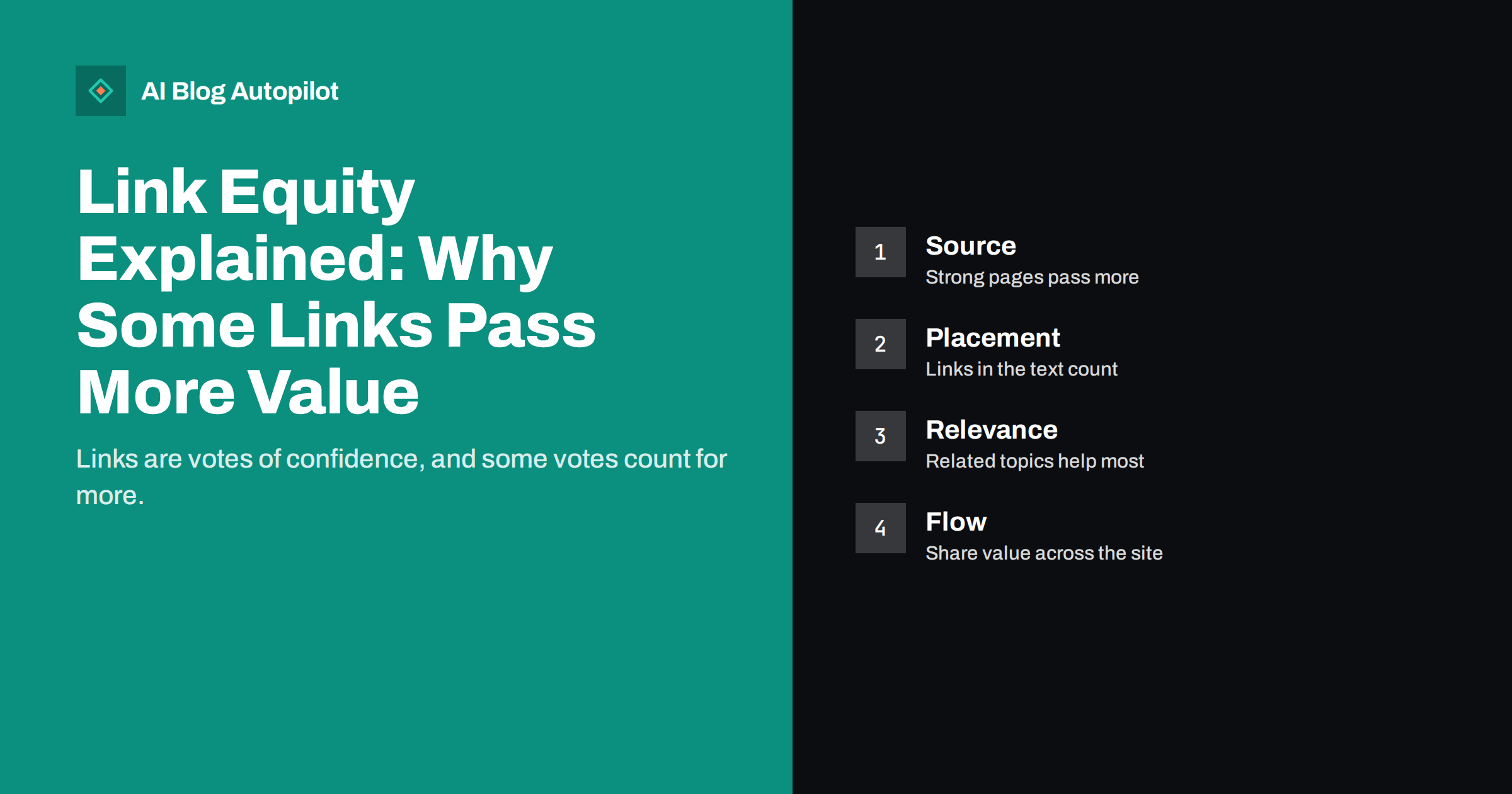
The strength of the source page is the first one. A link from a page that itself has many good links is generally worth more than a link from an isolated page. A mention from a well-known publication in your field counts for more than a link from a directory nobody reads.
Relevance is the second. A link from a page on a related topic makes sense to readers and to search systems. A link to your cleaning blog from a page about cars looks odd, and it is unlikely to help. Placement matters, too. A link inside the main text, surrounded by relevant words, carries more meaning than one in a footer, a sidebar or a long list of links.
The wording of the link, called anchor text, also gives context. Descriptive anchors tell readers and machines what the target page is about. The guide on anchor text for internal links shows how to write them. Finally, the number of links on the same page matters in a rough way: a page with five links shares its value among five targets, while a page with five hundred links shares it very thinly.
How value moves inside your own blog
Most of the links on your site come from you, which means you control a large share of the flow. Your home page and a few popular articles usually gather the most outside links. When they link to other pages, they pass a part of that strength on.
This is why pages that are many clicks away from the home page can struggle. If an article is only reachable through page seven of an archive, it receives little value and may be crawled rarely. The article on click depth and site architecture explains how to bring important pages closer to the top.
It is also why orphan pages are a problem. A page with no internal links gets no value from the rest of the site, and search engines may not find it at all. Use the checks in the guide to orphan pages on a blog to find and link them.
A good internal structure sends value where you need it. If you have a main guide on a topic, link to it from the related articles, and let the guide link back to the best of them. This is the idea behind content clusters and pillar pages: each page supports the others, and the group is stronger than the sum of its parts.
Links from other sites
Outside links are harder to control, but they are the most valuable signals for many blogs. They come from people who found your content useful enough to mention. The best way to earn them is to publish something that deserves a reference, such as original data, a clear explanation of a hard topic or a useful free tool.
Quality matters more than quantity. One link from a respected site in your field can be worth more than a hundred links from poor pages. Bought links and link exchanges arranged only for ranking are against the guidelines of the main search engines, and they can lead to penalties. The guide on earning backlinks honestly lists methods that work for a small site.
When a link is added, check where it points. If another site links to an old address that now redirects, some value may be lost or delayed. Update the old links when you can, or make sure a permanent redirect is in place, as explained in the article on 301 and 302 redirects.
How value is wasted
Value leaks away in several common ways. Broken internal links send readers and crawlers to error pages. Long chains of redirects add delay and may weaken the signal. Pages that were deleted without a redirect lose the links that pointed to them.
Another leak is linking to the wrong version of a page. If your site can be reached with and without the www prefix, or with several address variants, links may be split between versions. Pick one version and use it everywhere, so that every link supports the same address.
A third waste is spreading links across too many weak targets. If your articles link out to dozens of tag pages, archive pages and thin pages, the strong pages receive less. Think about which pages are your priorities, such as the main service page, the main guides and the pages that bring enquiries, and link to those first.
Finally, avoid links that pass value to sites you do not trust. When you link to a source because you want the reader to see it, there is no problem. When you link to a paid or user-submitted page that you do not control, use the right attribute, as described in the guide on nofollow, sponsored and UGC links.
A simple routine to improve the flow
You do not need special tools to manage link equity. A monthly routine of about an hour is enough for most blogs. Start by listing your ten most important pages: the ones that sell, explain or convert. Then check how many internal links each one receives from other articles.
For every important page with few links, find three related articles and add a natural link to it from each. Use descriptive anchors and place the link where it helps the reader, not at the very end of the page. Next, open your newest articles and check that they link to at least two older pages and receive a link from at least one older page, since new posts often start with none.
Then run a broken-link check and fix what it finds. Look at your most linked pages from outside sources, if your tools show them, and make sure those pages are up to date and link onward to your key pages. A strong page that is stale or links nowhere passes little value.
Keep a record of what you changed and when. After a month or two, look at the pages you supported and see whether impressions and positions moved. The effect is rarely sudden, but a steady habit pays off over a year.
What not to do
Avoid sculpting link flow with tricks. Older advice suggested adding nofollow to some internal links to control where value goes, and current guidance does not recommend this. Use plain internal links and decide which pages deserve them.
Do not stuff pages with links in the hope of lifting every page. Too many links in a short article make the text hard to read and dilute each link. A good rule is to add a link when it helps the reader take a useful next step, and to stop when it does not.
Do not chase scores. Third-party authority metrics try to estimate link strength, but they are not used by search engines in the same way. Use them as a rough guide to compare sites, not as a goal, as the article on domain authority scores explains.
How AI Blog Autopilot helps
AI Blog Autopilot writes articles with internal links to related pages on your site, plus FAQ sections, tags and SEO meta, and publishes them to your WordPress blog. That gives every new article a place in your link structure from the day it goes live. Review the links as part of your regular checks, and see the pricing page for plans and monthly credits.
Related reading
- Anchor Text for Internal Links: What to Write and Avoid
- Orphan Pages: Finding Blog Posts Nothing Links To
- Earning Backlinks Honestly: What Works for a Small Site
- Internal Linking on Autopilot: Building Link Structure as You Publish
The bottom line
Link equity is the value links pass between pages. Earn links from good sources, link to your key pages from your own strong ones and stop leaks from broken links and redirects.
FAQ
Is link equity an official Google term?
No. It is a model that SEO professionals use to describe how links pass value. Search engines do not publish such a score.
Do internal links pass link equity?
Yes, in the sense that internal links help crawlers find pages and signal which pages matter. You control them, so they are the easiest to improve.
Do nofollow links pass value?
They are treated as hints and may not pass value in the usual way. Use the right attribute for paid or user-submitted links.
How many links should one article have?
There is no fixed number. Add a link wherever it helps the reader, and avoid filling short articles with dozens of them.
How long do link changes take to matter?
Search engines must crawl and process the changes, so effects often take weeks. Review the results after a month or two.