ENEnglish
 LTLietuviškai
 DEDeutsch
 FRFrançais
 RUРусский
 ESEspañol
 PLPolski
 ITItaliano
 UKУкраїнська
 CSČeština
 PTPortuguês
 JA日本語
JA日本語 LVLatviešu valoda
 ETEesti
 HUMagyar
 IDBahasa Indonesia
 TRTürkçe
 HIहिन्दी
 ELΕλληνικά
 ARالعربية
 THไทย
THไทย VITiếng Việt
 RORomână
 MSBahasa Melayu
 BNবাংলা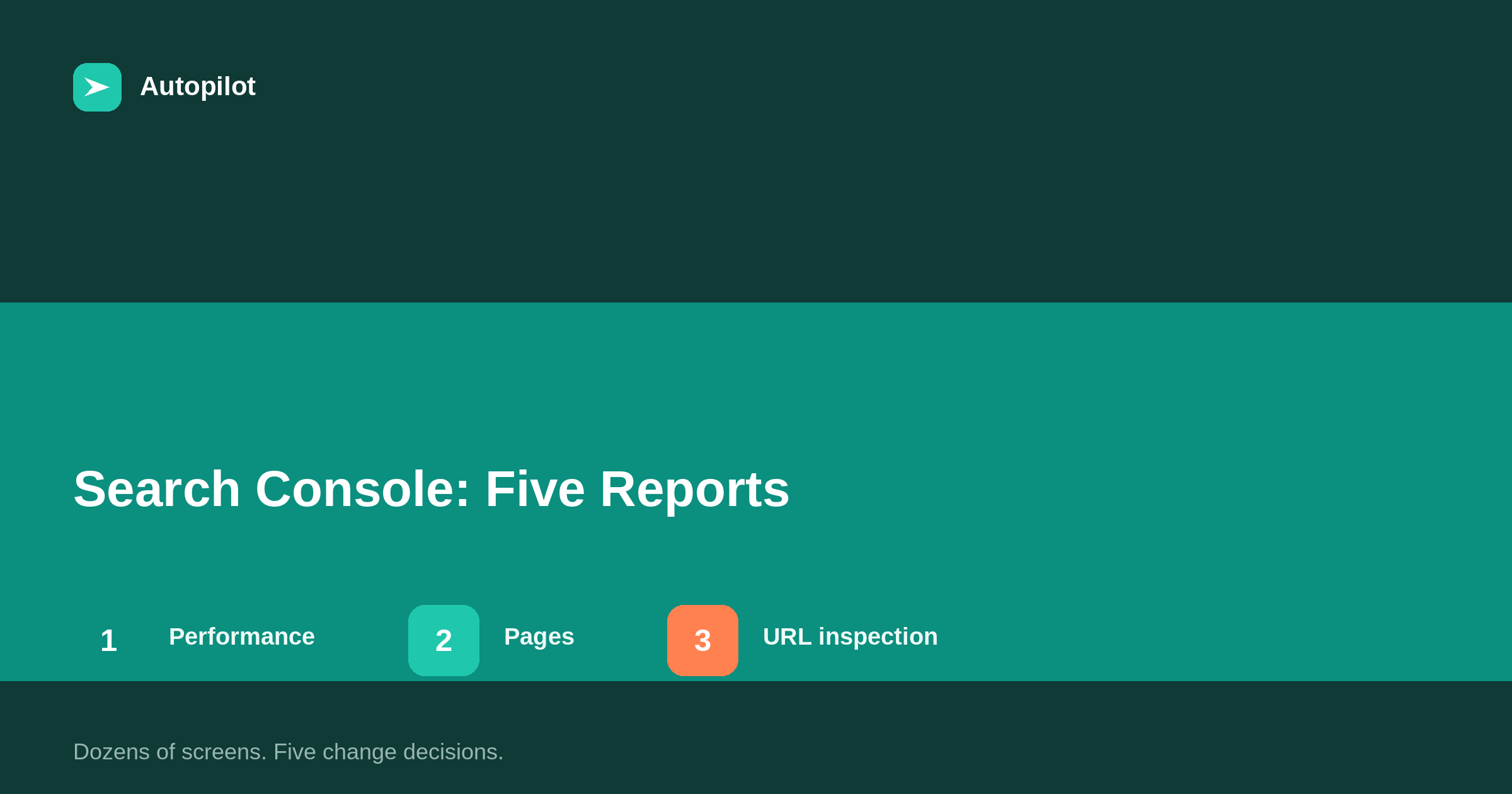
Short answer: five reports do almost all the useful work. Performance shows the queries you appear for, with clicks, impressions, click-through rate and position. Pages shows which URLs are indexed and the reason for any that are not. URL inspection checks a single page’s status, canonical and indexability. Sitemaps confirms discovery is working. Manual actions tells you whether there is a penalty, and is almost always empty. Check performance monthly, pages when something looks wrong, and the rest when you need them.
Search Console is free, authoritative and underused, mostly because it opens on a dashboard of charts that do not tell you what to do.
For a blog, five reports carry nearly all of the value. Knowing which question each one answers turns it from a place you glance at into a tool you use.
Performance: what people search and what they do
This is the report to know well. It shows queries and pages with four numbers each: clicks, impressions, click-through rate and average position.
Three patterns are worth looking for monthly.
- High impressions, low click-through rate at a reasonable position: the title and description are not earning the click. See titles and descriptions.
- Positions 8 to 20 on queries you care about: pages close to working, where an improvement is most likely to matter.
- Queries with no matching page: you appear because something mentions it in passing, which is a gap — the method in finding the gaps in your blog.
Always compare equal periods, and prefer three months to seven days. Weekly numbers on a small blog are mostly noise.
Reading position correctly
Average position is the most misread number in the tool.
It is an average across every query and every time the page appeared. A page at position 3 for one query and 45 for twenty others will show an average in the 40s, which says almost nothing about either.
Filter by a single query before reading position, and treat small movements as noise. A shift from 7.4 to 8.1 is not an event. A shift from 7 to 25 that holds for a month is.
Pages: indexed or not, and why
The pages report, sometimes called page indexing, lists URLs that are not indexed along with a reason. The reasons matter more than the counts.
| Status | What it usually means | Action |
|---|---|---|
| Excluded by noindex tag | Deliberate, or a mistake | Check it was deliberate |
| Alternate page with proper canonical | A duplicate pointing to the original | Usually fine |
| Page with redirect | The old URL of something moved | Usually fine |
| Crawled, currently not indexed | Fetched and judged not worth including | Improve or merge |
| Discovered, currently not indexed | Waiting in the queue | Mostly patience |
| Not found (404) | A deleted page still linked somewhere | Fix the links or redirect |
Many excluded URLs are excluded correctly: tag archives, feeds, redirects. A large count is not a problem by itself. The rows to act on are unexpected noindex, crawled-not-indexed on pages you care about, and 404s that still have internal links.
URL inspection: one page, everything about it
Paste any URL from your site into the search bar at the top and you get that page’s full status: whether it is indexed, when it was last crawled, which canonical Google chose, whether it is mobile usable, and whether anything blocks it.
It is the first tool to use when a specific page misbehaves, and it settles in a minute what could otherwise take an hour of guessing — it is step one in why posts do not rank.
It also has a request indexing button. Use it for important new or substantially changed pages. Using it for every post does not help, and repeated requests for the same page do nothing.
Sitemaps: is discovery working
Submit your sitemap once — on WordPress it is usually at /wp-sitemap.xml or the address your SEO plugin uses — and then check occasionally that it shows success and a sensible count of discovered URLs.
A sudden drop in discovered URLs usually means the sitemap broke, often after a plugin change. An error status means search engines cannot read it. Either is worth fixing quickly, because the sitemap is one of the main routes by which new articles are found — the subject of how long a new post takes to rank.
Manual actions, and the other screens
Manual actions shows whether a person at Google has applied a penalty to the site. For almost every blog it says no issues detected, and if it does, you have ruled out a common fear in five seconds.
Of the remaining screens, two are occasionally useful. Links shows which sites link to you and which of your pages are most linked internally, which helps spot orphans. Core Web Vitals flags pages with poor loading or layout-shift performance on real devices.
The rest can be ignored on a normal blog without losing anything.
A monthly routine
Twenty minutes a month covers it.
- Performance, last three months against the previous three: note any page that dropped sharply.
- Filter to positions 8 to 20: pick two pages to improve.
- Sort queries by impressions: note any that lack a real page.
- Pages report: check for unexpected noindex or new 404s.
- Sitemaps: confirm success.
Record what you found and what you decided. Over a year this produces a far better picture of what works on your site than any general advice, including this article. None of it guarantees a result; it makes sure your decisions are based on what is actually happening.
Related reading
If this was useful, these cover the questions that usually come next.
- Why posts do not rank — the diagnosis these reports support
- Finding the gaps in your blog — using the performance report for topics
- Titles and descriptions — fixing the pages this report flags
The bottom line
Performance for queries and clicks, pages for indexing status and reasons, URL inspection for a single page, sitemaps for discovery, manual actions to rule out a penalty. Twenty minutes a month, three months of data at a time, one query at a time when reading position, and a written note of what you decided.
FAQ
Which Search Console report is most useful for a blog?
Performance. It shows the queries you appear for with clicks, impressions, click-through rate and position, and it is where most decisions about which pages to improve come from.
Why is my average position so different from what I see in search?
Because it averages across every query and every appearance. Filter to one query before reading position; the page-level average mixes good and irrelevant queries together.
Is a large number of excluded pages a problem?
Usually not. Tag archives, feeds, redirects and canonical duplicates are excluded correctly. Act on unexpected noindex, crawled-not-indexed pages you care about, and 404s that still have internal links.
Should I request indexing for every new post?
No. Keep a sitemap submitted and link new posts internally; request indexing only for important new or substantially changed pages. Repeated requests for the same page do nothing.
How often should I check Search Console?
A twenty-minute review monthly is enough for most blogs, plus URL inspection whenever a specific page seems wrong. Weekly figures on a small site are mostly noise.
How do I know if my site has a penalty?
Open the manual actions report. If it says no issues detected, there is no manual penalty. Algorithmic changes are not reported there, but they are not penalties in that sense either.