ENEnglish
 LTLietuviškai
 DEDeutsch
 FRFrançais
 RUРусский
 ESEspañol
 PLPolski
 ITItaliano
 UKУкраїнська
 CSČeština
 PTPortuguês
 JA日本語
 LVLatviešu valoda
 ETEesti
 HUMagyar
 IDBahasa Indonesia
 TRTürkçe
 HIहिन्दी
 ELΕλληνικά
 ARالعربية
 THไทย
 VITiếng Việt
 RORomână
 MSBahasa Melayu
 BNবাংলা
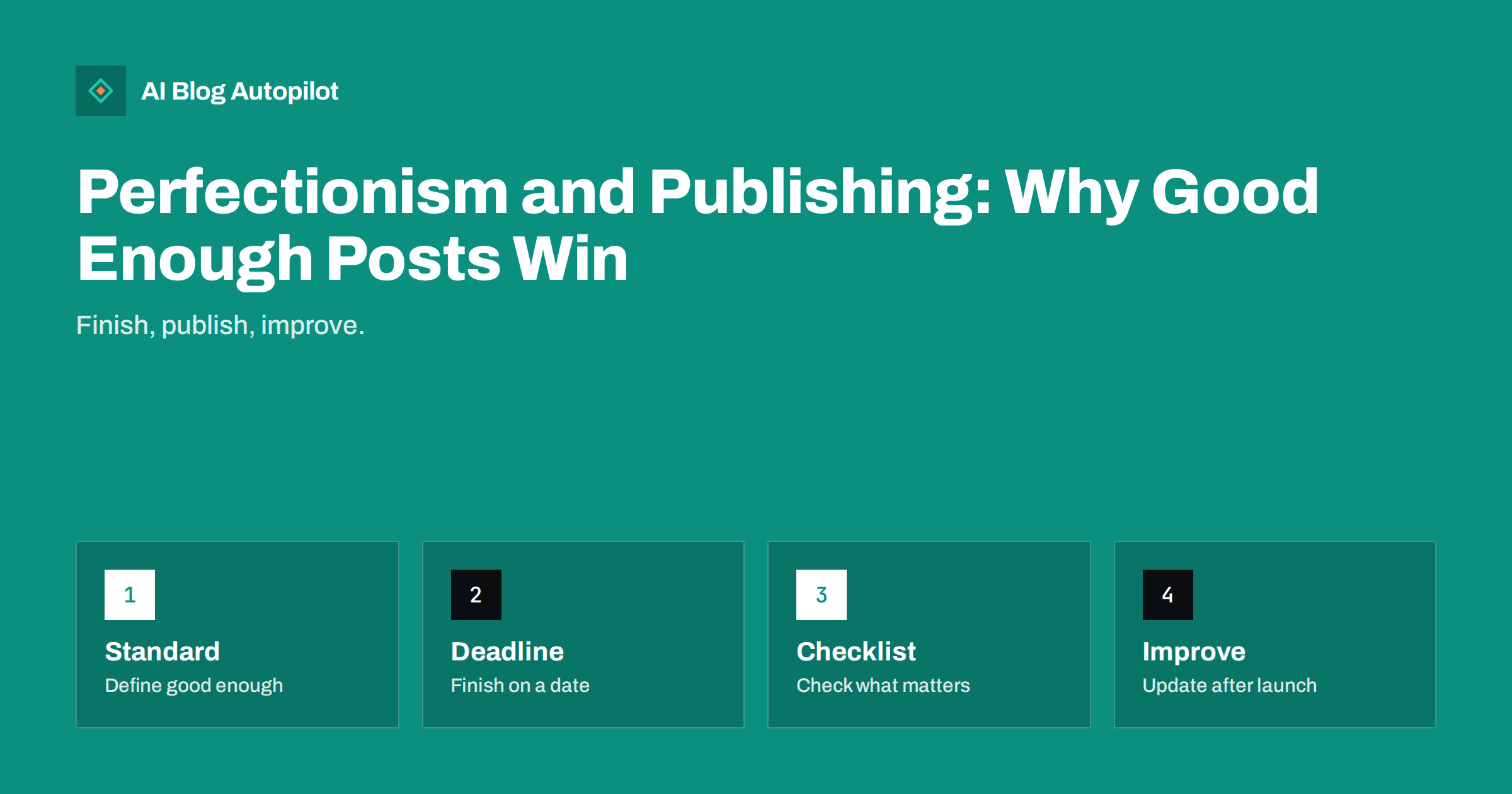
Short answer: perfectionism stops many business blogs before they begin. Write down what “good enough” means for your posts, use a short checklist for the things that truly matter, set a deadline, publish, and improve the post later using real feedback. A useful, accurate article that is live beats a flawless one that is never finished.
Almost everyone who writes for a business has had the experience: a draft sits for weeks while it is polished, doubted and rewritten. Meanwhile, the questions it would have answered go unanswered, and the blog stays quiet. The effort is real, but it brings no benefit until someone can read the result.
This guide explains why perfectionism hurts blogs, how to define a clear standard, how to build routines that make finishing normal and how to keep quality high without endless polishing. It is written for owners, marketers and small teams who write their own content.
The hidden cost of waiting
An unpublished post cannot rank, be shared, answer a customer or build trust. Every week of delay is a week in which a competitor may publish the answer you had in mind. Over a year, the lost output can be large: a dozen unfinished drafts is a dozen missed chances.
Perfectionism also drains energy. Rewriting an introduction for the tenth time rarely improves it, but it consumes the time and motivation that could produce the next article. Many blogs fade not because the owner lacks ideas, but because the process feels too heavy to repeat.
There is a quality cost, too. Readers value usefulness, clarity and accuracy, not elegance for its own sake. A post that answers a question plainly serves them better than one that is beautiful but late. The guide to restarting an abandoned blog shows how common this problem is.
Remember that your readers are not judging as harshly as you are. Most people read quickly, on a phone, looking for an answer. They notice whether the article helps, whether it is clear and whether it is honest. They rarely notice a slightly awkward sentence, and if they do, they forgive it when the content is useful.
Why we over-polish
People over-polish for understandable reasons. They fear mistakes in public, worry about what customers or competitors will think, or feel that the post must represent the whole business. They may also lack a clear picture of what finished looks like, so any flaw seems a reason to continue.
Some are uncertain about their expertise and hide it behind more edits. Others have been criticised in the past and want to avoid it. These feelings are normal, and they are best handled with a process, not with willpower.
Notice the pattern in your own habits. Do you keep changing the first paragraph? Do you wait for another person’s approval that never arrives? Do you keep adding sections? Naming the habit makes it easier to set a rule against it, such as “no more edits to the introduction after the first review”.
Define “good enough” in writing
A standard is the cure for endless revision. Write a short list of requirements every post must meet: it answers one clear question near the top, the facts are checked, the links work, it has a useful title and description, it reads well on a phone, and it has an honest conclusion. When all are met, the post is ready.
Keep the list short, ideally five to eight items. Long lists invite delay. Separate must-haves from nice-to-haves: a custom image or a quote from an expert may be welcome, but they should not block publishing if the article is otherwise sound.
Use a standard that fits the stakes. A casual update may need little review, while an article on health, law or money needs more care and a qualified reader. The guide to the pre-publication checklist gives a list you can adapt.
Share the definition with everyone who writes or reviews. When two people hold different ideas of finished, one will keep asking for changes and the other will feel they never get approval. A single written standard turns opinions into a simple question: does the post meet the list or not?
Set deadlines and time boxes
Work expands to fill the time available, so limit it. Choose a publication date for each article and work backwards: research, outline, draft, review, publish. Put these steps in your calendar, as you would a meeting. A date creates a commitment that a vague intention does not.
Use time boxes for tasks that tend to run on. Give yourself 30 minutes to write the introduction, an hour for the first draft of a section, 15 minutes to choose an image. When time is up, move on and return only if a review shows a real problem.
Plan a regular publishing rhythm that you can keep. It is better to publish twice a month on time than weekly for a month and then stop. The guide to how often to publish blog posts explains how to choose. A rhythm turns finishing into a habit.
Print the checklist or keep it pinned beside the editor. Tick each item as you go, and when the list is complete, the post is ready. The tick marks give a sense of closure that endless reading never provides, and they leave a record that helps another person review the article quickly.
Use a checklist for what really matters
Instead of reading the post again and again, read it once with a checklist. Check facts and figures against sources. Check names, dates, prices and links. Check that the title matches the content. Check that there are no sentences you would be embarrassed by. Then stop.
Include accessibility and structure in the list: headings in order, alt text, readable paragraphs. Include a legal and ethical check where it applies, such as consent for photographs or permission to quote. The guide to fact-checking content before you publish covers the most important part.
Ask for one review, from one person, with a clear task: find errors that would mislead readers. Do not ask for opinions on style, which can start a spiral of changes. A single focused review is worth more than five vague ones.
Separate drafting from editing
Many people edit while they write, which slows both. Try writing a rough draft quickly, without stopping to fix phrasing, then edit in a second pass. The first draft is for getting ideas down, the second for making them clear. Leaving a short gap between the two helps you see the text freshly.
Use an outline to reduce rewrites. If the structure is sound before you write, you will spend less time moving sections around. A simple list of headings, each with one sentence about its purpose, is enough. The guide to blog post structure that works shows a reliable pattern.
When a part is stuck, leave a note such as “add example here” and keep going. Return to it after the rest is done. Often the missing piece becomes obvious once the whole article exists. Voice notes can also help, as described in turning voice notes into drafts.
Keep a “later” list. Whenever you think of an improvement that is not essential, such as a better example, an extra diagram or a longer explanation, write it down and move on. When you refresh the post, work through the list. This gives your perfectionist side somewhere to put its ideas without holding up publication, and it often yields a stronger second version.
Celebrate publishing. Mark the day an article goes live, share it with the team and note how many you have finished this quarter. Progress is easier to keep up when it is visible. A simple count of published pieces on a wall or a shared page keeps attention on what has been completed, not on what is imperfect.
Improve after you publish
A web page is not printed. You can fix errors, add details and refresh examples after it goes live. That freedom is the best argument against perfectionism. Plan to revisit each post after a few weeks and again after a few months, with data from Search Console and reader feedback.
Look at what readers do. Which questions arrive by email or comments? Which searches bring them? Where do they leave? Use these signals to improve the post in ways you could never have guessed alone. The guide to how to refresh old blog posts describes the process.
Be open about corrections. If you find a mistake, fix it, and for significant ones add a short note. Readers respect honesty more than a pretence of perfection. See handling corrections for wording.
Let tools carry some of the weight
Automation can help break the cycle, because it removes the blank page and the long wait. A tool that plans topics, writes drafts and checks structure leaves you to do what only you can: confirm facts, add experience and decide whether the article fits. That is review, not creation, and review has a natural end.
The AI Blog Autopilot pages describe an automatic quality check of length, structure, keyword and meta, with weak articles held for you, and AUTO as the default mode with approval optional. If you tend to over-edit, approval mode can still work well if you set a rule: read once, fix real errors, approve.
Remember that a tool does not know your business. Supply true facts and read what it produces. The guide to how to edit an AI draft sets out four passes that matter, none of which involve endless rewriting.
How AI Blog Autopilot helps
AI Blog Autopilot plans the month from your topics and writes articles with FAQ, tags and SEO meta, so you start from a complete draft instead of a blank page. See the plans and try the three free articles.
Related reading
The bottom line
Define good enough in writing, set a date, check what matters once, publish, and improve the post later with real feedback.
FAQ
How do I know when a post is good enough?
When it meets your written list: it answers the question early, facts and links are checked, structure is clear and the conclusion is honest.
Won’t publishing imperfect posts hurt my reputation?
Accurate, useful posts do not. Errors that mislead do, so spend your checking time on facts, links and clarity, not on style.
Can I edit a post after it is published?
Yes. Web pages can be fixed and improved. For significant corrections, add a short note.
How many reviewers should I use?
One focused reviewer asked to find errors that would mislead readers is usually enough.
How can I stop endless rewriting?
Use deadlines, time boxes, an outline and a short checklist, and separate drafting from editing.