ENEnglish
 LTLietuviškai
 DEDeutsch
 FRFrançais
 RUРусский
 ESEspañol
 PLPolski
 ITItaliano
 UKУкраїнська
 CSČeština
 PTPortuguês
 JA日本語
JA日本語 LVLatviešu valoda
 ETEesti
 HUMagyar
 IDBahasa Indonesia
 TRTürkçe
 HIहिन्दी
 ELΕλληνικά
 ARالعربية
 THไทย
THไทย VITiếng Việt
 RORomână
 MSBahasa Melayu
 BNবাংলা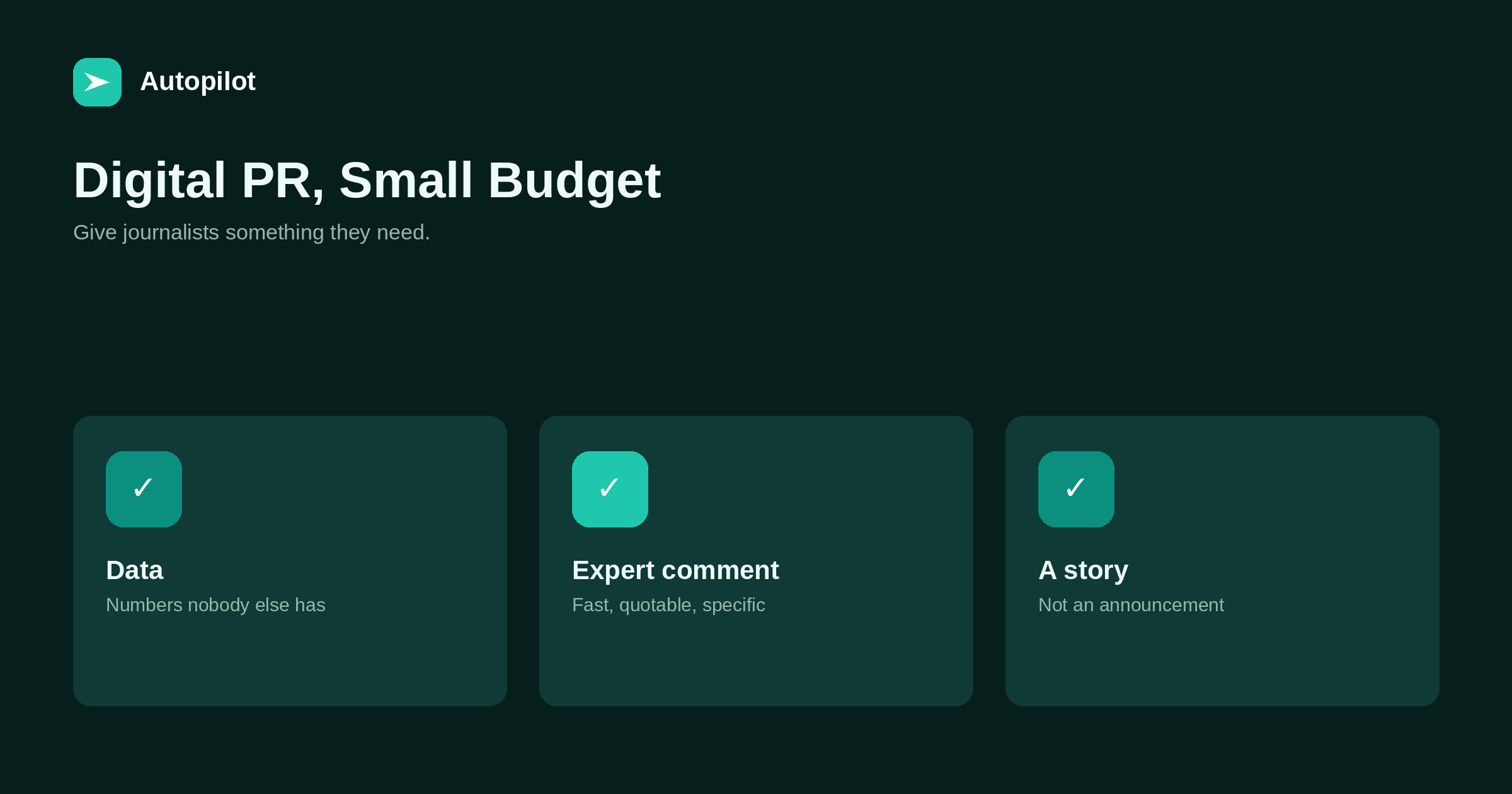
Short answer: digital PR means creating something journalists and writers find newsworthy and offering it to them, earning coverage and links. For a small business the practical forms are: original data from your own operations or a small survey, fast and specific expert comment on developments in your field, and genuine stories about customers or problems. Publish the material on your blog so coverage links to it, pitch a handful of relevant writers individually, and respond quickly to journalists looking for sources. Most pitches get no reply; a few good placements are a good result.
Digital PR sounds like something that needs an agency and a large budget. At its core it is simpler: journalists and writers constantly need data, expert comment and stories, and a small business often has all three without realising it.
The work is recognising what you have that is newsworthy, publishing it properly, and getting it in front of the right people.
What journalists actually need
Coverage happens when you solve a writer’s problem. Their problems are predictable.
- Data to support or start a story.
- Expert comment — a credible person saying something specific, quickly.
- A story with people, a problem and an outcome.
- A fresh angle on something already in the news.
What they do not need is an announcement that your company launched something, unless it genuinely matters to their readers. Most press releases fail for exactly that reason.
Data you already have
Many businesses sit on data that would interest writers in their field: patterns in customer requests, seasonal changes, how long processes take, what customers choose between.
Aggregated and anonymised, a finding like the share of enquiries about a problem doubling in a year, or the most common mistake seen across hundreds of cases, is a genuine story. Publish it on your blog with the method explained honestly — sample size, period, how it was collected — so coverage has something to link to and writers can trust it.
Never inflate the numbers or imply a larger sample than you have. fact-checking before you publish applies with extra force to anything you want quoted.
A small survey
If you lack data, a short survey of your customers or audience can produce it. Keep it to a few questions on something writers care about, report the results honestly including the sample size, and resist the temptation to present a small self-selected sample as representative of a whole industry.
A modest survey honestly reported is more useful to a careful journalist than a dramatic one with weak methods, and it protects your credibility for the next time.
Expert comment
Journalists covering a development need someone who can explain it, often within hours. Being that person is one of the most accessible forms of PR.
| What helps | Why |
|---|---|
| A named expert with a clear specialism | Easy to quote and credit |
| Fast response, same day | Deadlines are short |
| Two or three specific, quotable sentences | Usable without editing |
| An opinion, not a hedge | Hedges are not quotable |
| A relevant article on your blog | Somewhere for the link to point |
Services that connect journalists with sources are one way in; following the writers in your field and offering comment when a relevant story breaks is another.
Pitching
A pitch is a short email to one writer, and it works when it is specific.
Say in the first line what you have and why it fits what they cover — ideally with reference to something they wrote. Give the key finding or the offer of comment in two or three sentences. Link to the published material. Make it easy to say yes, and do not follow up more than once.
Write to a handful of well-chosen writers rather than a list of hundreds. Mass pitches are ignored and damage your reputation with the people who matter.
Local and trade press
For many small businesses the most achievable coverage is in local news and trade publications, not national outlets.
Local press covers local businesses, especially with a community angle or local data. Trade publications need practitioner insight and data from their sector. Both reach people who may become customers, and their links are relevant — which matters more than the size of the outlet, as earning links honestly explains.
Publishing so coverage links back
Coverage without a link still builds awareness, but a link is more likely when there is something specific to link to.
Publish the full data, the method and any charts on your blog before pitching. Writers can then cite the source directly. If a piece mentions you without a link, a polite note offering the source page often results in one being added.
Turning one piece into several
A single piece of original data can support several pitches over months. The headline finding goes to one set of writers; a regional breakdown goes to local press; a sector breakdown goes to trade publications; and when a related story breaks later, the data becomes the basis for expert comment.
Keep the published page updated if you collect the data again, and it becomes a standing source writers return to each year.
Expectations
Most pitches receive no response. That is the normal rate, not a sign of failure. A few good placements a year, in outlets your customers read, is a strong result for a small business.
No one can guarantee coverage or links, and anyone offering guaranteed placements is usually selling paid content presented as editorial. The honest version is slower and builds a reputation that makes the next pitch easier.
Related reading
If this was useful, these cover the questions that usually come next.
- Earning links honestly — where PR fits in link building
- Adding something original — the data PR depends on
- Promoting a blog post — the everyday version of this
The bottom line
Find the data, expertise and stories you already have, publish them properly on your blog, and offer them to a handful of relevant writers individually. Respond fast when a story in your field breaks. Aim at local and trade outlets as well as national ones, report data honestly, and expect most pitches to go unanswered.
FAQ
What is digital PR?
Creating material that journalists and writers find newsworthy — data, expert comment, stories — and offering it to them, earning coverage and links to your site.
Can a small business do digital PR without an agency?
Yes. Original data from your own operations, fast expert comment and genuine customer stories are within reach of a small team.
What makes a good PR pitch?
A short, specific email to one writer, saying what you have, why it fits their coverage, and linking to the published material. Follow up at most once.
Is a survey worth doing for PR?
A short survey honestly reported, with its sample size stated, can produce useful data. Do not present a small self-selected sample as representative of an industry.
How many pitches get a response?
Most receive none. A few good placements a year in outlets your customers read is a strong result for a small business.
Can PR coverage be guaranteed?
No. Editorial coverage depends on the writer’s judgement. Guaranteed placements are usually paid content presented as editorial.