ENEnglish
 LTLietuviškai
 DEDeutsch
 FRFrançais
 RUРусский
 ESEspañol
 PLPolski
 ITItaliano
 UKУкраїнська
 CSČeština
 PTPortuguês
 JA日本語
JA日本語 LVLatviešu valoda
 ETEesti
 HUMagyar
 IDBahasa Indonesia
 TRTürkçe
 HIहिन्दी
 ELΕλληνικά
 ARالعربية
 THไทย
THไทย VITiếng Việt
 RORomână
 MSBahasa Melayu
 BNবাংলা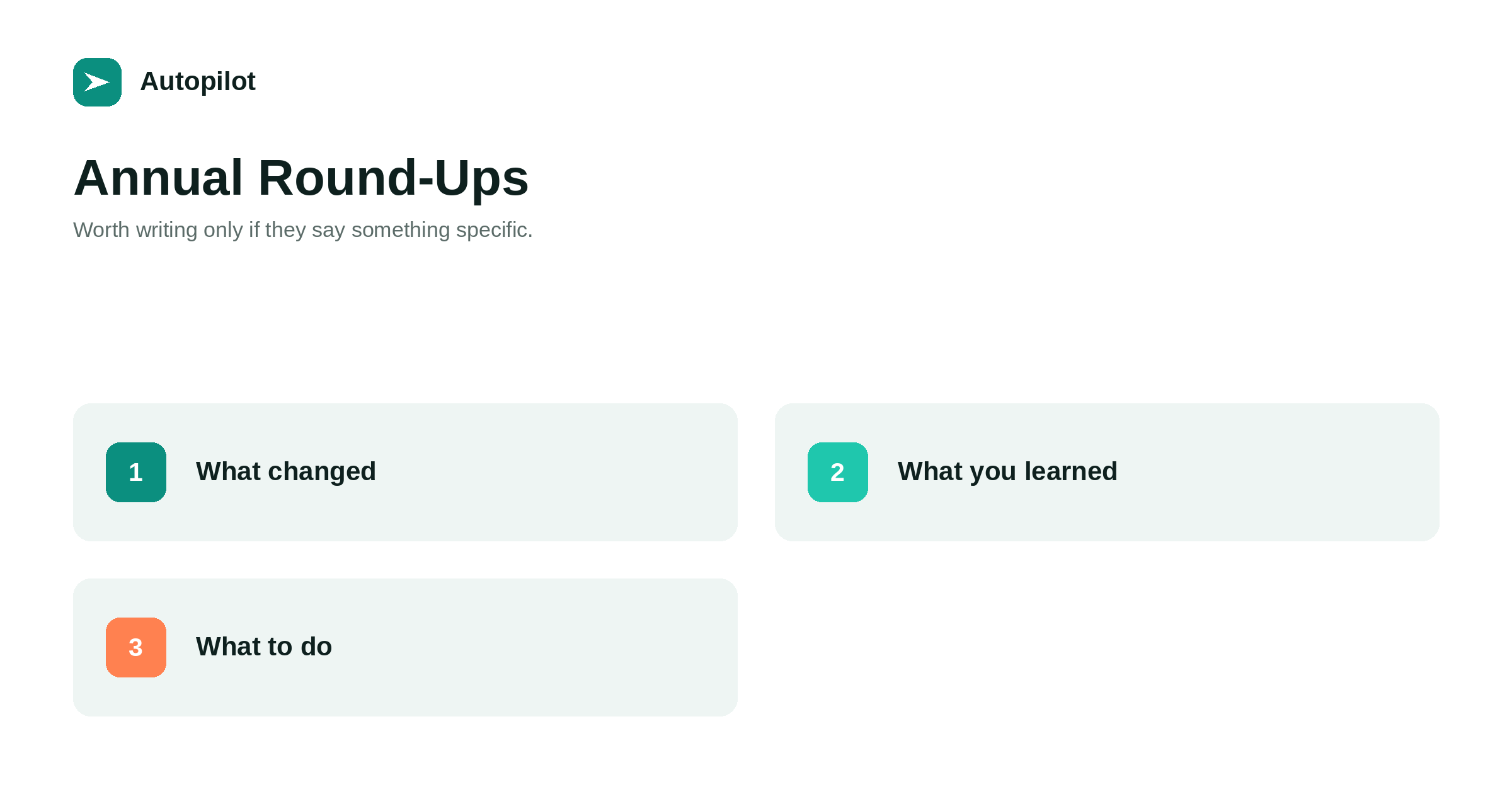
Short answer: annual round-ups are worth writing when they say something specific: what genuinely changed in your field, with evidence; what your business learned, from its own experience; and what readers should do differently. Generic lists of trends everyone else is also predicting add little. Publish at the right time, keep the URL year-free if you plan to update it annually, and make the practical advice evergreen enough to stay useful after the new year begins. Do not predict outcomes you cannot support.
Every December and January, blogs fill with the year in review and trends for the year ahead. Most of them list the same trends, with the same vague predictions, and are forgotten by February.
A few are genuinely useful, and they have things in common.
What makes a round-up worth reading
Useful round-ups share three qualities.
| Quality | Instead of |
|---|---|
| Specific changes, with evidence | Vague trends everyone mentions |
| Your own experience and data | A summary of other people’s lists |
| Practical recommendations | Predictions without consequences |
A round-up that meets all three is closer to an opinion piece backed by evidence than to a list — writing an opinion piece covers that format.
Year in review
A year-in-review article works when it describes what actually changed in your field and what it means for readers. Draw on your own observations: what customers asked about more, what stopped working, what you changed in your own practice.
Be specific and honest. A review that includes what your business got wrong is more credible than one full of successes.
Year ahead
Year-ahead articles are riskier because they predict. Keep predictions modest and grounded in evidence, say how confident you are, and focus on what readers should do regardless of exactly how things turn out.
Never predict outcomes for readers’ businesses — traffic growth, rankings, revenue — that nobody can promise.
Timing
Year-in-review pieces are read in December and January. Publish in early December, or early January for year-ahead pieces, so they are indexed while people are looking — planning seasonal content.
One URL or one per year
If you plan an annual update of the same kind of piece, consider a year-free URL updated each year, so it builds history. If each year’s piece is distinct and worth keeping as a record, separate URLs are fine, with links between them.
writing URL slugs covers the trade-offs of dates in URLs.
Keeping it useful after January
Round-ups date quickly. The parts that stay useful are the practical recommendations and lessons, not the list of trends.
Link the round-up to evergreen articles covering each recommendation in depth. The round-up drives attention for a few weeks; the evergreen articles keep the value — evergreen against news content.
Automated drafts
Round-ups are a format where automated drafting adds little, since their value is the business’s own view and experience. A draft can structure the article, but the observations, lessons and recommendations should come from people who lived the year.
A structure that works
A year-in-review article that holds up usually follows a simple shape. Open with the one or two changes that mattered most to your readers, stated plainly. Then give three to five specific observations, each with evidence: something you saw across customers, a figure from your own operations, a change in what people searched or asked. Then say what you changed in your own practice as a result. Close with a short list of practical recommendations for the coming year.
That structure keeps the article anchored in experience rather than speculation, and it gives readers something to act on.
Using your own data
The most interesting round-ups contain numbers nobody else has: how questions from customers changed over the year, which kinds of article your readers used most, how long typical projects took. Aggregated and anonymised, these make the article distinctive and citable.
State the sample and period honestly. A small number described accurately is more useful than a large claim you cannot support — adding something original covers the practice.
Revisiting last year’s predictions
If you published a year-ahead piece last year, open this year’s review by checking it. Which predictions held, which did not, and why? Readers value the honesty, and it makes this year’s predictions more credible.
It also disciplines the next set of predictions. Knowing you will check them in a year encourages more careful claims.
Distribution
Round-ups are among the articles people share most, especially within a professional network. Share them in the newsletter and on social networks at the time readers are thinking about the year, and ask colleagues to share with a line of their own view.
Involving the team
The best observations for a round-up come from people across the business: sales noticed a new objection, support saw a new kind of problem, the product team changed something because customers asked. A short request in November for each person’s two most significant observations of the year produces better material than any amount of desk research.
Credit contributors by name where they agree. It makes the article more human and gives colleagues a reason to share it.
Keeping it short
Round-ups are read at a busy time of year. A focused article of a moderate length, with the main points visible at a glance, is more likely to be read and shared than an exhaustive one. If there is more to say about a particular change, link to a separate article on it.
A summary box at the top listing the three changes that mattered most lets skimmers get the point in seconds.
Honesty about the year
If the year was difficult, say so. Readers trust a business that describes setbacks alongside progress more than one that presents every year as a triumph.
Linking from the round-up
Each observation in a round-up can link to an article that explores it properly. That turns a seasonal article into a guide to your best evergreen work.
Is it worth doing at all?
If you have something specific to say about the year, a round-up can be one of the more shared articles you publish. If not, skip it; a generic trends list costs effort and adds nothing to what readers will see everywhere else.
Related reading
If this was useful, these cover the questions that usually come next.
- Evergreen against news content — why round-ups date quickly
- Planning seasonal content — timing annual pieces
- Writing an opinion piece — the view a round-up needs
The bottom line
Write an annual round-up only if you have something specific to say: real changes with evidence, your own lessons, and practical recommendations. Keep predictions modest, publish at the right time, link to evergreen articles for depth, and never promise readers outcomes.
FAQ
Are year-in-review posts worth writing?
When they are specific, based on your own experience and practical. Generic trend lists add little.
When should annual round-ups be published?
Early December for reviews, early January for year-ahead pieces.
Should the year be in the URL?
If you will update the same piece each year, keep the URL year-free. For distinct yearly pieces, separate URLs are fine.
How do I keep a round-up useful after January?
Focus on practical recommendations and link to evergreen articles covering each in depth.
Should I make predictions?
Modest, evidence-based ones, with stated confidence. Never predict outcomes for readers’ businesses.
Can round-ups be automated?
The structure can be drafted, but the observations and lessons must come from people.