ENEnglish
 LTLietuviškai
 DEDeutsch
 FRFrançais
 RUРусский
 ESEspañol
 PLPolski
 ITItaliano
 UKУкраїнська
 CSČeština
 PTPortuguês
 JA日本語
JA日本語 LVLatviešu valoda
 ETEesti
 HUMagyar
 IDBahasa Indonesia
 TRTürkçe
 HIहिन्दी
 ELΕλληνικά
 ARالعربية
 THไทย
THไทย VITiếng Việt
 RORomână
 MSBahasa Melayu
 BNবাংলা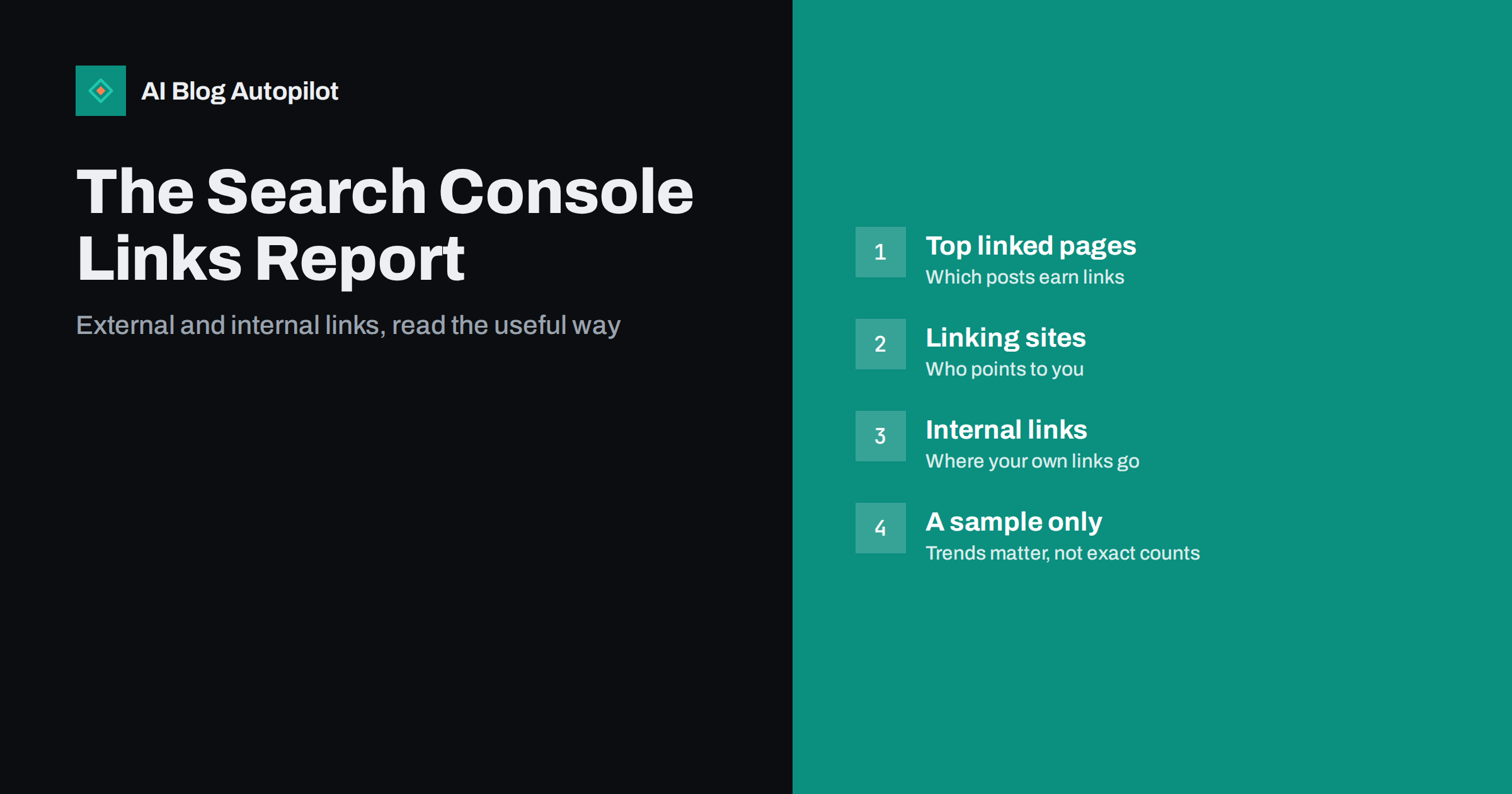
Short answer: the Links report in Search Console shows a sample of the links Google has found to and within your site. The external section lists your most linked pages, the sites linking to you and the most common anchor text; the internal section lists the pages that receive the most links from your own site. Use it to see which content attracts links, whether your most important posts get enough internal links, and whether anything unusual is happening. Do not treat the numbers as complete or as a measure of ranking value.
The Links report is one of the quieter corners of Search Console. It has no charts, no alerts and no scores, so many bloggers glance at it once and never return. That is a pity, because it answers some practical questions better than anything else you have for free: which of your articles people actually link to, which sites mention you, and whether your internal linking matches your priorities.
This guide goes through each part of the report, explains what the numbers do and do not mean, and suggests a short routine for using it.
Where to find it and what it contains
In Search Console, open Links in the left-hand menu, near the bottom. The page is divided into two main sections, each with small tables you can expand with “More”:
- External links
- Top linked pages: your pages that receive links from other sites, with the number of links and linking sites.
- Top linking sites: the domains that link to you most.
- Top linking text: the most common anchor text used in links to your site.
- Internal links
- Top linked pages: your pages that receive the most links from other pages on your own site.
The “Export external links” button at the top offers downloads of latest links and more sample links, which give you actual linking URLs rather than just counts.
What the numbers mean, and what they do not
Before drawing conclusions, it helps to understand the report’s limits.
- It is a sample. The report does not list every link Google knows about. It is representative, not exhaustive.
- Counts are approximate. Link numbers can include many links from one site, such as a link in a sidebar that appears on hundreds of pages. That is why “linking sites” is often more meaningful than “links”.
- It does not show value. A link being listed does not mean it helps rankings, and the report does not indicate which links are nofollow or otherwise discounted.
- It is consolidated by canonical. Links to duplicate versions of a page are generally counted towards the canonical URL.
- It updates periodically. New links can take a while to appear, and removed links a while to disappear.
In short: use the report to spot patterns and changes, not to measure authority or compare exact numbers with third-party tools, which use their own crawlers and will always differ.
External links: which content earns links
The Top linked pages table is the most useful external view for a blogger. Sort by linking sites rather than total links, and ask:
- Which articles attract links on their own? These are usually guides, original data, tools, definitions or strong opinions. They show what kind of content your audience finds worth referencing.
- Are links concentrated on the home page? That is common for young sites. Over time, more links to individual articles is a healthy sign that the content itself is being cited.
- Do any linked pages no longer exist? If a page with links now returns an error, redirect it to the most relevant current page so those links are not wasted.
Once you know which articles earn links, you have a practical content lesson: do more of that type, and link from those articles to related posts that deserve more attention.
External links: who links to you
The Top linking sites table shows domains, not individual links. Expand it and scan for:
- Relevant sites in your field. These are relationships worth nurturing: people who found your content useful once may do so again.
- Your own other properties. Links from your company site, social profiles or other blogs appear here too. They are fine, but do not mistake them for earned links.
- Scraper and spam domains. Almost every site collects links from low-quality domains that copy content automatically. Google generally ignores these. They are not a reason for concern on their own.
Use the export to see the actual linking pages. Visiting a few of them tells you more than any count: how you were mentioned, in what context, and whether the link points to the most appropriate page.
Anchor text: how others describe you
The Top linking text table shows the words other sites use when they link to you. For most small sites it is dominated by the brand name, the domain and generic phrases like “here” or “this article”. That is normal and natural.
What to look for:
- Descriptive anchors that match a topic you want to be known for. These suggest that others see your content as a reference on that subject.
- Odd or unrelated anchors, for example in another language or about unrelated products. A large number of these may point to spam or to links built by a previous owner.
- Heavily repeated exact-match phrases. A natural link profile is varied. Many identical keyword anchors can indicate paid or manipulative links, which is worth investigating, especially if you inherited the site.
Internal links: do your priorities get the most links?
The internal section is where most bloggers can act immediately. The Top linked pages table shows how many internal links each page receives. In most blogs it is topped by pages linked from the navigation or footer: home, about, contact, category pages. Below that, you see which articles your own content links to most.
Compare that list with your priorities:
- Are your most important articles near the top? Pillar guides, articles that lead to enquiries and posts close to ranking well should receive plenty of internal links.
- Which important posts are missing or far down? Those are candidates for new internal links from related articles.
- Which unimportant pages get many links? Old announcements or tag archives linked from every page may be taking attention that should go elsewhere.
The report only lists pages with internal links; pages with none do not appear at all. To find orphan pages, compare the full list of your posts, for example from your sitemap, with the pages shown here.
A practical way to act on this is a small “link hub” exercise. Pick one priority article that sits low in the internal table. Search your own site for the main topic of that article, for example with a site search on your domain. From the results, choose three to five related posts where a link would genuinely help the reader, and add a sentence with a descriptive link in the body text, not only in a related-posts box. Repeat for one or two priority articles each month. After a few months, check the internal table again: the pages you worked on should have moved up, and they often gain impressions in the Performance report as well.
It also helps to look at internal links from the reader’s point of view. If someone lands on your most popular article from search, where can they go next? If the answer is only the menu, you are missing the easiest opportunity on the site to guide readers to your most useful content.
A 20-minute routine every quarter
- Export the external links sample and save it with the date, so you can compare quarters.
- Review top linked pages by linking sites. Note any new entries and check that none of them return errors.
- Scan top linking sites for new relevant domains and for unusual spikes from unknown sites.
- Check anchor text for anything unexpected.
- Review internal top linked pages against your list of priority articles, and add internal links where priorities are under-linked.
- Write down one or two actions: for example, “add links from five related posts to the pricing guide” or “redirect the old event page that still has links”.
When to worry, and when not to
Most things in the Links report are not cause for alarm. Spam domains linking to you are common and usually ignored. Sudden drops in link counts often reflect sampling or recrawling rather than lost links. Numbers that differ from a third-party tool are expected.
Take a closer look if you see a large, sudden influx of links from unrelated or foreign-language sites with keyword anchors, if you receive a manual action for unnatural links, or if you know a previous owner or agency bought links. In those cases, investigate the actual linking pages and consider the options described in Google’s documentation. For a normal blog that has never bought links, disavowing links is rarely necessary.
How AI Blog Autopilot fits
AI Blog Autopilot writes and publishes long-form articles to your WordPress blog and shares each one to your social networks, which gives people more chances to discover and reference your content. Articles planned around real search queries and written in depth tend to be the kind others find worth linking to, although no tool can promise links. The Links report is where you watch what happens. See how Autopilot works.
Related reading
- Internal Linking on Autopilot: Building Link Structure as You Publish
- Earning Backlinks Honestly: What Works for a Small Site
- Digital PR on a Small Budget
- Regex Filters in Search Console: Practical Recipes for Blogs
The bottom line
The Links report shows a sample of external and internal links, not a complete list or a measure of value. Read it for patterns: which articles earn links, who links to you, how others describe you and whether your own internal links support your priorities. Check it quarterly, act on one or two findings each time, and do not panic over spam domains or numbers that differ from other tools.
FAQ
Does the Search Console Links report show all my backlinks?
No. It shows a sample of the links Google has found. It is useful for spotting patterns and changes, but it is not a complete list, and counts are approximate.
Why do the link numbers differ from other SEO tools?
Each tool uses its own crawler, index and counting rules. Search Console reflects what Google found, sampled; other tools estimate from their own data. Compare trends within one tool rather than numbers across tools.
Should I disavow spammy links I see in the report?
Usually not. Google generally ignores low-quality spam links. Disavowing is mainly for cases such as a manual action for unnatural links or links you know were bought or built manipulatively.
How can I use the internal links table?
Compare the most internally linked pages with your priority articles. If important posts receive few internal links, add links to them from related articles. Pages with no internal links do not appear in the table at all.
How often is the Links report updated?
It is refreshed periodically rather than in real time. New or removed links can take some time to be reflected, so check it every few months rather than daily.