ENEnglish
 LTLietuviškai
 DEDeutsch
 FRFrançais
 RUРусский
 ESEspañol
 PLPolski
 ITItaliano
 UKУкраїнська
 CSČeština
 PTPortuguês
 JA日本語
JA日本語 LVLatviešu valoda
 ETEesti
 HUMagyar
 IDBahasa Indonesia
 TRTürkçe
 HIहिन्दी
 ELΕλληνικά
 ARالعربية
 THไทย
THไทย VITiếng Việt
 RORomână
 MSBahasa Melayu
 BNবাংলা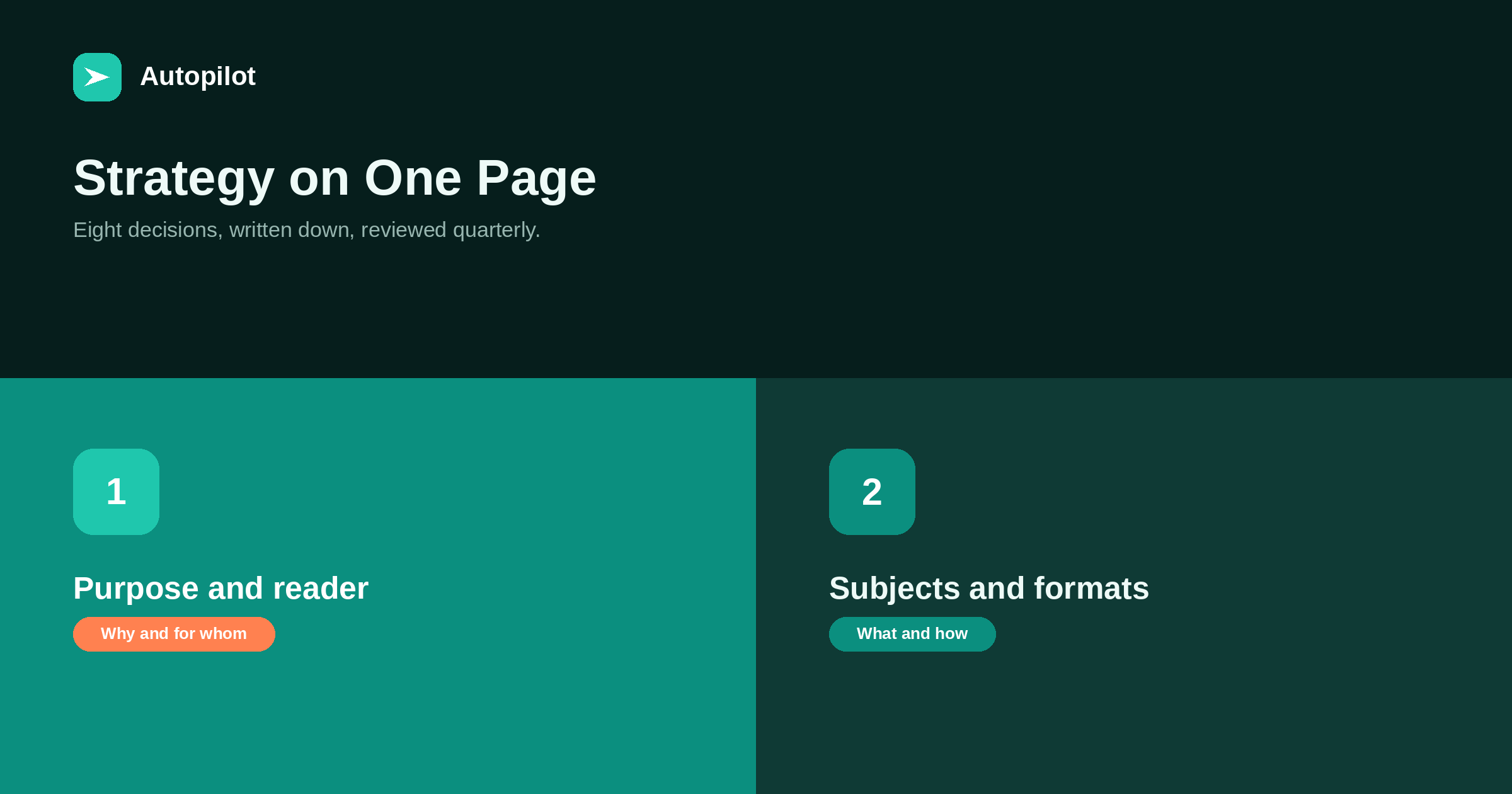
Short answer: a usable content strategy answers eight questions on one page: what the blog is for, who it is for, which three to five subjects it covers, which formats it uses, how often it publishes, how articles are reviewed, how they are distributed, and which single outcome it is measured on. Write each answer in one or two sentences, share the page with everyone involved, check every monthly plan against it, and revise it quarterly based on results. Long strategy documents tend to be written once and never read.
Content strategy documents are often long, thorough and unused. They are written for a presentation, filed, and forgotten, while the actual blog is run on habit.
A strategy that fits on one page can be kept open while planning, checked against every month’s topics and revised when results come in. That is what makes it a strategy rather than a document.
The eight questions
Each line on the page answers one question.
| Question | Example answer |
|---|---|
| Purpose | Generate enquiries from small manufacturers |
| Reader | Operations managers, non-technical, time-poor |
| Subjects | Scheduling, maintenance, supplier management |
| Formats | How-to guides, comparisons, case studies |
| Pace | Two articles a week |
| Review | Every article checked by the operations lead |
| Distribution | LinkedIn, monthly newsletter, sales team |
| Measure | Enquiries from blog visitors per quarter |
If any answer takes more than two sentences, it probably contains a decision not yet made.
Purpose and reader
Purpose decides what counts as success; reader decides everything about how articles are written. Both need to be specific enough to rule things out.
Businesses and to grow are not answers. starting a business blog covers deciding them.
Subjects and formats
Three to five subjects where customer needs, your expertise and your offer overlap — choosing what the blog is about. Formats follow from what readers need: how-to guides for doing, comparisons for choosing, case studies for trusting.
Pace and review
Choose a pace you can sustain for a year, and a review process that can keep up with it. The two are linked: pace without review produces volume of unknown quality; review without pace produces too little to matter.
how often to publish and draft, approve or full auto cover each.
Distribution
Name the two or three channels where your readers are, and how each article reaches them. Articles without distribution rely entirely on search, which takes months.
promoting a blog post covers a routine.
One measure
One outcome measure keeps decisions honest. Traffic, impressions and engagement are useful context but should not be the headline unless the blog exists for reach.
measuring whether a blog is working covers choosing it and setting a target.
Using the page
Share the page with everyone who plans, writes, reviews or distributes content, including agencies and tools’ standing instructions. Check each month’s topic plan against it: every topic should fit a subject, a format and the reader.
Topics that do not fit are either a sign the strategy needs updating or a distraction.
Reviewing it quarterly
Each quarter, compare results against the measure and ask what to change: a subject that produces nothing, a format that works better than expected, a pace that review cannot sustain.
Change one or two lines at a time, and note the date. A strategy that never changes is not being used; one that changes every month is not being followed.
A complete example
To show how it reads in full, here is a one-page strategy for a fictional accounting firm serving small businesses.
Purpose: generate enquiries from small business owners who need bookkeeping or tax help. Reader: owners of businesses with one to twenty staff who handle finances themselves and are not accountants. Subjects: tax deadlines and obligations, bookkeeping systems, cash flow, and hiring staff. Formats: how-to guides, deadline checklists, cost explainers, and anonymised client situations. Pace: two articles a week, with seasonal guides updated six weeks before each deadline. Review: every article checked by a qualified accountant before publication. Distribution: monthly newsletter to clients and prospects, LinkedIn, and links sent by staff in reply to client questions. Measure: consultation requests from blog visitors each quarter.
That fits on a page, rules out many possible topics, and tells everyone involved what to do.
Strategy and automation
When articles are produced with automated drafting, the strategy becomes part of the standing instructions. Reader, subjects, formats and forbidden claims go into every brief; review and distribution become steps in the publishing routine.
A clear strategy is especially important with automation, because a tool follows instructions literally and at volume. A vague strategy produces a large amount of vague content quickly. Writing a brief an AI can use covers turning the strategy into instructions.
Common gaps
The lines most often missing are review and measure. Many strategies describe what to publish in detail and say nothing about who checks it or how success is judged. Those two lines are what turn a publishing plan into a strategy that can improve over time.
Another common gap is saying no. A good strategy makes clear which subjects, formats and audiences the blog will not serve, so that the tempting off-topic idea can be declined without a debate.
Aligning with the rest of marketing
The content strategy should agree with the rest of the business’s marketing: the same audience, the same positioning, the same claims. A blog written for a different reader than the sales team talks to, or promising things the website does not mention, confuses everyone.
Share the page with whoever runs sales, advertising and social media, and ask them to point out anything that conflicts with what they say to customers. Fixing a conflict on one page is much easier than fixing it across a hundred published articles.
When to rewrite it entirely
Most quarters need small adjustments. A full rewrite is warranted when the business itself changes: a new product line, a new market, a different customer, or a new purpose for the blog. In those cases start again from the eight questions rather than patching the old answers.
What a strategy cannot do
A clear strategy does not guarantee results. It makes sure effort goes in a consistent direction, and it makes results interpretable, so you can tell what is working.
Related reading
If this was useful, these cover the questions that usually come next.
- Starting a business blog — putting the strategy into action
- Choosing what the blog is about — the subjects decision
- Measuring whether a blog is working — the measure decision
The bottom line
Answer eight questions on one page: purpose, reader, subjects, formats, pace, review, distribution and one measure. Keep each answer to a sentence or two, share it with everyone involved, check every monthly plan against it, and revise one or two lines each quarter based on results.
FAQ
What should a content strategy include?
Purpose, reader, subjects, formats, publishing pace, review process, distribution channels and one outcome measure.
How long should a content strategy be?
One page is enough for most businesses. Longer documents tend not to be used.
How often should a content strategy be updated?
Quarterly, changing one or two elements at a time based on results.
Who should see the content strategy?
Everyone who plans, writes, reviews or distributes content, including agencies.
How do I use the strategy day to day?
Check each month’s topic plan against it; every topic should fit a subject, a format and the reader.
Does a strategy guarantee results?
No. It keeps effort consistent and makes results easier to interpret.