ENEnglish
 LTLietuviškai
 DEDeutsch
 FRFrançais
 RUРусский
 ESEspañol
 PLPolski
 ITItaliano
 UKУкраїнська
 CSČeština
 PTPortuguês
 JA日本語
JA日本語 LVLatviešu valoda
 ETEesti
 HUMagyar
 IDBahasa Indonesia
 TRTürkçe
 HIहिन्दी
 ELΕλληνικά
 ARالعربية
 THไทย
THไทย VITiếng Việt
 RORomână
 MSBahasa Melayu
 BNবাংলা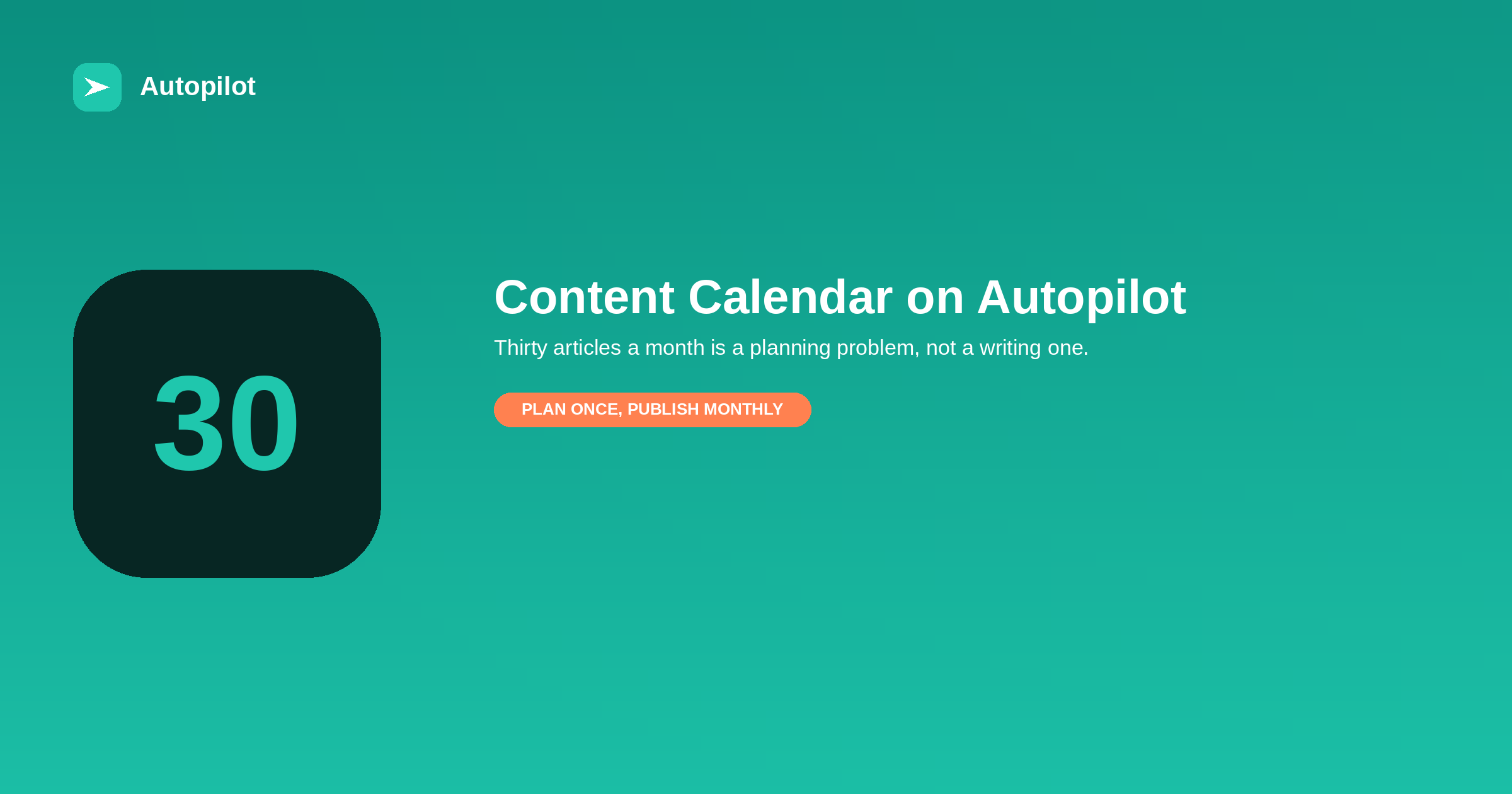
Short answer: build a topic map before you build a calendar. List every question your audience actually asks, group them into themes, weight the themes by how much they matter to the business, and let the month’s articles come out of that map rather than out of a brainstorm under deadline. Thirty articles a month is not thirty times harder than one — it is one planning job done properly, plus a queue that always runs ahead of the schedule. The failure mode at volume is repetition, and repetition is a planning failure, not a writing one.
At two articles a month you can improvise. At thirty you cannot, and the blogs that try produce the thing everyone recognises: four articles circling the same idea, published in the same week, competing with each other for the same query.
The good news is that planning thirty articles is a single exercise, not thirty small ones. Done once, it runs for months.
Start with a topic map, not a calendar
A calendar tells you when. A topic map tells you what, and it is the part that determines whether the blog is worth reading.
Build it in three passes. First, write down every question you have genuinely been asked — by customers, in sales calls, in support tickets. Second, add the questions someone asks before they are ready to buy: definitions, comparisons, "is this even possible". Third, add the questions your existing customers ask afterwards, which are usually the most searched and the least written about.
Most businesses end up with sixty to a hundred and twenty genuine questions. That is four months of thirty-a-month publishing, and it is a far better starting point than a keyword tool’s list, because every item came from a real person.
Group and weight the themes
Sort the questions into five to eight themes. Then weight them — not evenly, but by what the business actually needs.
A theme that brings customers deserves a third of the output. A theme that builds credibility but rarely converts deserves a steady trickle. A theme you include because a competitor does deserves reconsidering.
Weighting is what stops a thirty-article month becoming thirty articles about whatever was interesting that week. It also makes the calendar almost mechanical: if a theme carries thirty per cent, it gets nine of the thirty slots, and the only remaining decision is which nine questions.
Building the month
With a weighted map, a month assembles itself.
| Slot type | Share of the month | What it is |
|---|---|---|
| Core questions | About half | The theme that brings customers |
| Supporting explainers | About a quarter | Definitions and background the core relies on |
| Comparisons | A few | "X vs Y", chosen from real alternatives |
| Updates and refreshes | A few | Existing articles that aged, not new ones |
| Opportunistic | One or two | Something that changed this month |
The refresh row matters more than it looks. At thirty a month, a year produces three hundred and sixty pages, and some of the earliest ones will be wrong before the year ends. Building refreshes into the calendar is the only way that maintenance ever happens.
Who decides what goes in
At thirty articles a month the bottleneck moves from writing to approving, and an approval process nobody designed becomes an approval process nobody follows.
Keep it small. One person owns the topic map and can add or remove from it. Anyone can propose a topic, ideally with the question a customer asked attached. Themes and weights are reviewed once a quarter, not whenever somebody has an opinion. Individual articles do not need approval if the topic was approved, which is the whole point of approving topics.
Teams that skip this end up approving thirty articles a month one at a time, which costs more attention than writing them used to.
Keeping the queue ahead of the schedule
The single habit that separates a calendar that survives from one that collapses: the approved topic queue must always hold more than the next two months need.
When the queue runs dry, someone invents a topic to fill a slot, and invented topics are where repetition comes from. When the queue is full, a busy month costs you nothing, because the decisions were made when there was time to make them.
Practically: review the map monthly for twenty minutes, add anything new that customers asked, remove anything that turned out to be a duplicate, and check nothing in the queue answers a question an existing article already answers.
What this looks like with automation
Autopilot works from exactly this structure: a set of topics with weights, keywords and an audience, from which the month’s articles are produced, published and shared. That is why the planning matters more than it used to — the map is the input, and a vague map produces a vague blog at thirty times the rate.
Two practical notes on plans. Monthly article credits do not roll over, so a plan should match the cadence you will keep rather than your most ambitious month; and topic import from Search Console, available from Pro, lets the map grow from queries you already receive rather than only from memory. Current limits are on the pricing page.
Everything else in automating a blog without losing quality still applies: read a sample, keep claims under human control, and check the queue before it empties.
The bottom line
Thirty articles a month is a planning problem wearing a production costume. Build the topic map from questions real people asked, weight the themes by what the business needs, keep the queue two months ahead, and reserve slots for refreshing what you already published. With that in place volume is safe. Without it, volume just produces a larger pile of articles competing with each other.
FAQ
Is thirty articles a month too many?
Only if you do not have thirty distinct questions to answer. With a full topic map it is a production question; without one it guarantees overlap.
How far ahead should the calendar be planned?
The topic queue should run two months ahead. The calendar itself only needs to be firm for the current month, so you can still react to something that changed.
What if I run out of topics?
Then the blog has covered its subject, which is a good outcome. Switch the ratio towards updating and deepening existing articles rather than inventing new ones.
How do I stop two articles covering the same thing?
Check every new topic against the published list before it enters the queue, matching on the question rather than the title. Two different titles asking one question is the usual form.
Should the calendar include social posts?
It can, but it does not have to. If sharing is automatic, each article carries its own distribution, and the calendar stays about articles.
Do unused article credits carry over?
No. Credits are monthly and do not roll over, which is a good reason to pick the plan that matches a realistic cadence.