ENEnglish
 LTLietuviškai
 DEDeutsch
 FRFrançais
 RUРусский
 ESEspañol
 PLPolski
 ITItaliano
 UKУкраїнська
 CSČeština
 PTPortuguês
 JA日本語
JA日本語 LVLatviešu valoda
 ETEesti
 HUMagyar
 IDBahasa Indonesia
 TRTürkçe
 HIहिन्दी
 ELΕλληνικά
 ARالعربية
 THไทย
THไทย VITiếng Việt
 RORomână
 MSBahasa Melayu
 BNবাংলা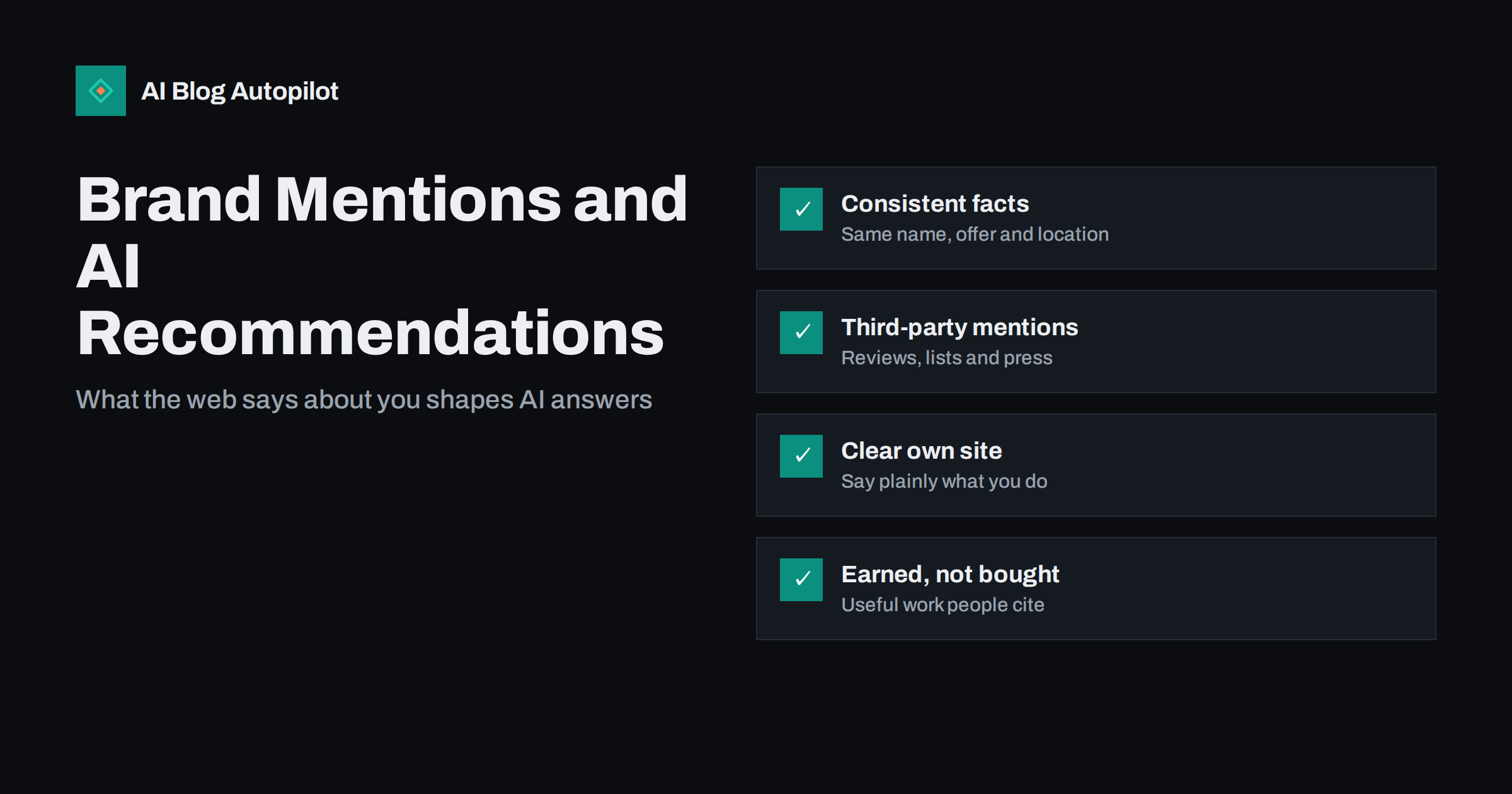
Short answer: AI assistants recommend businesses they can clearly identify and that are described consistently across many independent sources: reviews, directories, industry lists, articles and discussions. Mentions of your brand, even without links, help those systems understand who you are, what you do and how others see you. You earn more of them by being specific about your offer on your own site, keeping your facts consistent everywhere and doing work that other people have a reason to write about.
Ask an AI assistant for “a good accountant for freelancers in Manchester” or “tools for scheduling social media posts” and it will often name specific businesses. For many owners, that raises an obvious question: why those names, and how do we become one of them?
Nobody outside these systems can give a complete answer, and anyone promising a guaranteed spot in AI recommendations is overselling. But the general mechanics are understandable, and they point to practical, honest steps. This guide explains the role brand mentions play and what a small business can realistically do about it.
What counts as a brand mention
A brand mention is any place on the web where your business, product or name appears. It may or may not include a link. Typical examples:
- A customer review on a review platform or map listing.
- Your business in an industry directory, association member list or local chamber of commerce page.
- A “best tools for” or “recommended suppliers” list on someone else’s blog.
- A news article, interview or podcast page that names you.
- Forum and community discussions where people mention you by name.
- Comparison pages that include you alongside competitors.
In traditional SEO, links got most of the attention, because they were the clearest measurable signal. Unlinked mentions were often dismissed. For AI answers, the text around a mention carries meaning in its own right: “X is a small bookkeeping firm that specialises in freelancers” tells a language-based system something useful whether or not “X” is a link.
Why mentions influence AI recommendations
AI assistants that answer recommendation questions draw on two broad sources of knowledge: what they learned from large amounts of text during training, and, in many products, what they retrieve from the web at the time of the question. Both depend on what is written about you.
Recognition. A system can only recommend a business it can identify as a distinct entity. If your name appears in many places with consistent details, it becomes a recognisable entity with known attributes. If it barely appears anywhere, there is little to work with.
Association. Mentions connect your name with topics, locations and qualities. If many independent sources describe you as “a bakery in Leeds known for sourdough”, those associations shape which questions you are likely to come up for.
Corroboration. Recommendations carry risk for the system: suggesting a poor or non-existent business is a visible failure. Consistent descriptions across independent sources make a recommendation safer to give.
Retrieval. When an assistant searches the web while answering, pages that list or compare options, such as “best X for Y” articles, reviews and discussions, are natural sources to cite. Being present on those pages matters directly.
None of this is a published formula. It is a reasonable reading of how language-based systems work, and it lines up with what search engines have long said about trust and reputation.
Start with your own site
Before chasing mentions elsewhere, make sure your own website describes you clearly. Other people, and automated systems, often take their description of you from your own pages.
- Say plainly what you do, for whom and where. “We are a two-person bookkeeping firm serving freelancers and small agencies across the UK” is far more useful than “We help businesses thrive”.
- Have a proper About page. Include the business name, the people behind it, when it started, where it operates and what makes it different, in plain text.
- Use one consistent name. If you are “Smith & Co Bookkeeping” on the site, do not become “SmithCo” on one profile and “Smith Accounting” on another.
- Add organisation structured data. Organization or LocalBusiness markup with your name, logo, address and official profiles helps search engines connect the dots.
- Publish content that shows expertise. Articles that answer your customers’ real questions demonstrate what you know and give others something to reference.
Keep your facts consistent everywhere
Inconsistency is one of the quiet reasons a business is hard to recognise. Old addresses, different phone numbers, abandoned profiles with outdated descriptions and slightly different names all make it harder for any system to be confident that these mentions refer to the same business.
A simple consistency pass is worth doing once and then maintaining:
- List every profile you control: map listings, social profiles, directories, marketplaces and review sites.
- Update name, address, phone, website, opening hours and description so they match your website.
- Write one short standard description of the business and reuse it, adapted to each platform’s length.
- Close or update abandoned profiles, especially ones with old branding or contact details.
- Repeat the check whenever something changes, such as a move or a new service.
Earning third-party mentions honestly
The mentions that carry the most weight are the ones you cannot simply write yourself. They come from customers, peers, journalists and communities. There is no shortcut, but there are reliable habits.
Ask happy customers for reviews. Reviews are among the most common places businesses are described in detail. Make it easy to leave one, ask at the right moment, and respond to reviews, including critical ones, professionally.
Be useful in your industry. Speak at local events, contribute to association newsletters, answer questions in professional communities under your real name. Mentions follow visible helpfulness.
Publish something worth citing. Original data from your own work, a clear guide to a confusing regulation or a free template often gets referenced by other writers. Be honest about methods and limits.
Get included in relevant lists. Many “best tools” and “recommended providers” articles are updated regularly. If you genuinely fit, a short, polite note to the author with the relevant facts is reasonable. Do not pay for inclusion without the placement being clearly marked as sponsored.
Work with partners. Suppliers, integration partners and complementary businesses often have partner or customer pages. A mention there is natural and credible.
Local businesses versus online businesses
The same principles apply to every business, but the most valuable sources of mentions differ.
For a local business, such as a dentist, plumber, restaurant or accountant, the core sources are map listings, local review platforms, local directories, local news and community groups. Recommendation questions usually include a place, so consistent location details matter a great deal. A complete, accurate map profile with genuine reviews is often the single most important asset.
For an online or national business, such as a software tool, an online shop or a consultancy working remotely, the important sources are comparison articles, “best of” lists, software review platforms, industry publications and professional communities. Recommendation questions tend to be about categories and use cases: “best tool for X”, “alternative to Y”. Being clearly described in those contexts, with an honest explanation of who you are best for, is what matters.
In both cases, specificity helps. A business that is described as good for a particular kind of customer or problem is easier to recommend for that question than one described only in general terms.
What does not work
- Fake reviews and sock-puppet posts. They breach platform rules and consumer protection laws in many countries, and they are increasingly detected. A handful of genuine reviews is worth more than dozens of invented ones.
- Mass directory submissions. Hundreds of low-quality directory listings add noise, not trust. A few relevant, well-maintained listings are enough.
- Self-promotional spam in communities. Dropping your name into every thread gets you banned and leaves a negative impression, which is also a kind of mention.
- Paying for undisclosed placements. Paid mentions presented as independent recommendations mislead readers and, where links are involved, breach search engine policies.
- Stuffing your brand name into content. Repeating your name unnaturally on your own site adds nothing. Clear, specific description matters more than frequency.
Tracking your brand presence
You cannot see inside AI systems, but you can watch the inputs and some of the outputs. Set up alerts for your brand name to catch new mentions. Search for your name with quotes to see how others describe you. Periodically ask the assistants your customers use the kinds of questions you want to be recommended for, and note which businesses come up and what sources are cited. Over months, these observations show whether your presence is growing. Treat single answers as anecdotes: AI responses vary between sessions and change as the systems are updated.
How AI Blog Autopilot helps
A steady flow of useful articles on your own site is one of the foundations described above: it shows what you know and gives others something to reference. AI Blog Autopilot writes and publishes long-form SEO articles on your WordPress blog around the topics, audience and tone you set, and shares each one to your social networks. It will not generate reviews or third-party mentions, which have to be earned, but it keeps your own site active and specific. See how AI Blog Autopilot works.
Related reading
- Digital PR on a Small Budget
- How to Get Your Blog Cited by ChatGPT, Perplexity and Google AI Overviews
- The About Page a Business Blog Needs
- AI Answers in Search Results: What They Mean for Traffic
The bottom line
AI assistants recommend businesses they can recognise and that independent sources describe consistently. Make your own site specific about what you do, keep your facts identical across every profile, and earn genuine mentions through reviews, useful expertise, citable content and relevant lists. Avoid fake reviews and paid placements presented as independent. There is no guaranteed route into AI recommendations, but a clear, well-described, well-regarded business is the kind these systems are built to find.
FAQ
Do unlinked brand mentions matter for AI search?
They can. Language-based systems read the text around a mention, so a sentence describing your business adds meaning even without a link. Links remain useful for search engines, but mentions themselves help systems recognise and describe you.
How do AI assistants decide which businesses to recommend?
The exact methods are not public and vary between products. In general, they favour businesses they can clearly identify and that are described consistently by independent sources such as reviews, lists, directories and articles.
Can I pay to be recommended by AI assistants?
There is no legitimate way to buy organic recommendations. Paying for placements on third-party sites is only acceptable when they are clearly marked as sponsored, and such placements do not guarantee inclusion in AI answers.
How important are reviews for AI recommendations?
Reviews are one of the most common places businesses are described in detail by independent people, so they are a valuable source of mentions. Genuine reviews, a steady flow of them and professional responses all help build a trustworthy picture.
How long does it take to build brand mentions?
It is a gradual process measured in months and years rather than weeks. Consistency fixes and review requests can show results relatively soon, while earning coverage and list inclusions builds up over time.