ENEnglish
 LTLietuviškai
 DEDeutsch
 FRFrançais
 RUРусский
 ESEspañol
 PLPolski
 ITItaliano
 UKУкраїнська
 CSČeština
 PTPortuguês
 JA日本語
JA日本語 LVLatviešu valoda
 ETEesti
 HUMagyar
 IDBahasa Indonesia
 TRTürkçe
 HIहिन्दी
 ELΕλληνικά
 ARالعربية
 THไทย
THไทย VITiếng Việt
 RORomână
 MSBahasa Melayu
 BNবাংলা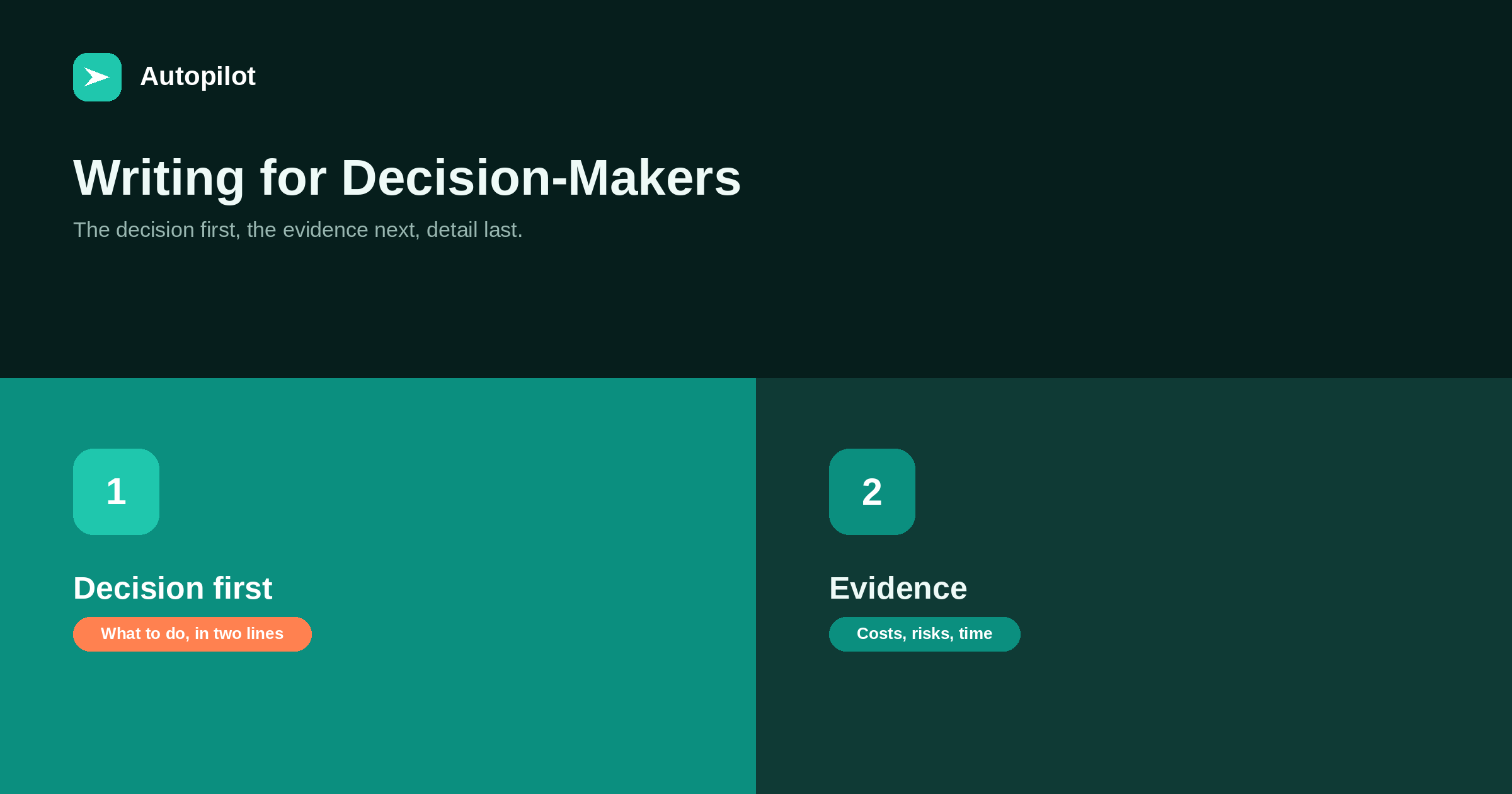
Short answer: decision-makers read quickly and look for what to decide and why. Put the recommendation or conclusion in the first two lines, follow with the evidence that matters to them — cost, risk, time, effort, impact — and present trade-offs honestly. Use headings and short sections so they can skim, tables for comparisons, and plain language without jargon. Make the article easy to forward, since decisions often involve others: a clear title, a summary at the top, and no reliance on context only you have.
In business-to-business content, the person who decides is often not the person who researches. Managers and executives read in short gaps, often on a phone, often an article forwarded by a colleague with a one-line note.
An article written for that reader looks different from one written for a practitioner, and it can be the difference between a decision in your favour and a decision deferred.
What decision-makers look for
Decision-makers want to know what to decide and what it means for the business.
| They ask | Give them |
|---|---|
| What should we do? | A clear recommendation or conclusion |
| What does it cost? | Money, time, people, in ranges |
| What are the risks? | What could go wrong, and how likely |
| What are the alternatives? | Honest trade-offs |
| How long until we see results? | A realistic timeline |
Details of how something works matter less to them than to practitioners, unless the details change the decision.
The decision first
Put the conclusion in the first two lines. Not a warm-up, not context, but what the reader should take away: for most small teams, automating drafting with human review costs less than hiring and publishes more consistently.
introductions that do not waste time covers the principle; for decision-makers it matters even more.
Quantify what you can
Decision-makers compare options on cost, time and risk. Give ranges where precise figures are not possible, and say what they depend on. State assumptions.
Never invent figures to sound precise. An honest range with stated assumptions is more useful and more credible — fact-checking before you publish.
Show the trade-offs
Every option has downsides. Articles that present only benefits are read as sales material. Showing trade-offs honestly — what you give up, what could go wrong — is what makes a recommendation credible to someone responsible for the outcome.
Structure for skimming
Descriptive headings, short sections, a table for comparisons, and a summary at the top let a decision-maker extract what they need in two minutes. The detail can follow for those who want it.
how to structure an article and when a table beats three paragraphs cover the mechanics.
Plain language
Decision-makers are often not specialists in the subject. Avoid jargon, or explain it on first use. Talk about outcomes in business terms: time saved, cost, risk, customers, rather than technical features.
Make it forwardable
Many B2B articles reach decision-makers because someone forwarded them. Make that easy: a clear title, a summary at the top that makes sense without the rest, no dependence on having read other articles, and a clear next step at the end.
content for a buying committee covers the wider group of people involved in business decisions.
Length
Decision-makers do not necessarily want short articles; they want articles where the important part is quick to find. A comprehensive article with a strong summary and clear structure serves both the decision-maker and the colleague who reads every word.
An example opening
Compare two openings for an article on content automation aimed at a marketing director.
The first: Content marketing has become essential for modern businesses, and many are exploring new ways to produce it. The second: For a team publishing fewer than eight articles a month, automated drafting with a twenty-minute review per article typically costs less than a freelance writer and removes the gaps when someone is busy; the trade-off is that someone on your team must own the review.
The second tells the director what to consider, what it costs in effort, and what the catch is. They can decide whether to read on in five seconds.
Summaries and key points boxes
A short box near the top listing three or four key points gives a skimming reader the substance before they commit to the article. It also gives a colleague something to paste into an email when forwarding.
Keep the points specific: numbers, decisions, trade-offs. Generic points such as automation saves time add nothing a reader did not already assume.
Anticipating the next question
After reading a recommendation, a decision-maker’s next question is usually what happens next, what it involves for their team, or what it would cost to try. Answer it at the end of the article, and link to the page that goes further: a pricing page, a case study or a short call.
Calls to action that fit the article covers matching that next step to the reader.
Reading on phones
Decision-makers frequently read on phones between meetings. Tables with many columns, long paragraphs and embedded content that loads slowly all work against them. Check important articles on a phone and make sure the summary and recommendation are readable without scrolling far.
Avoiding hype
Decision-makers see a great deal of marketing and are practised at discounting it. Words such as revolutionary, game-changing and effortless lower credibility. Specific claims, stated plainly with their limits, raise it.
If an article cannot make its case without superlatives, the case probably needs more evidence rather than stronger adjectives.
Testing with a real reader
Before publishing an article aimed at decision-makers, ask a manager outside the subject to read the first screen and say what they would decide. If they cannot, the opening needs work.
What it cannot do
A well-written article can make a decision easier. It cannot guarantee one in your favour, and it should not try to by hiding downsides. Decision-makers who feel they were given the full picture are more likely to trust the business behind it.
Related reading
If this was useful, these cover the questions that usually come next.
- Content for a buying committee — the other readers involved
- Introductions that do not waste time — opening with the point
- How to structure an article — structure for skimmers
The bottom line
Put the decision in the first two lines, then the evidence that matters to decision-makers: cost, risk, time and alternatives, quantified honestly with stated assumptions. Show trade-offs, structure for skimming, use plain language, and make the article easy to forward with a clear summary and next step.
FAQ
How do I write for executives?
Lead with the conclusion, give cost, risk and time in plain terms, show trade-offs, and structure for skimming.
Should B2B articles be short for decision-makers?
Not necessarily. They should make the important part quick to find, with a strong summary and clear structure.
How do I handle numbers I cannot be precise about?
Give honest ranges, say what they depend on, and state assumptions. Never invent precise figures.
Why show downsides in a business article?
Decision-makers are responsible for outcomes and distrust articles that show only benefits.
What makes an article easy to forward?
A clear title, a summary that stands alone, no dependence on other articles, and a clear next step.
Should I avoid technical detail?
Put it after the summary, for readers who want it, and explain any jargon.