ENEnglish
 LTLietuviškai
 DEDeutsch
 FRFrançais
 RUРусский
 ESEspañol
 PLPolski
 ITItaliano
 UKУкраїнська
 CSČeština
 PTPortuguês
 JA日本語
 LVLatviešu valoda
 ETEesti
 HUMagyar
 IDBahasa Indonesia
 TRTürkçe
 HIहिन्दी
 ELΕλληνικά
 ARالعربية
 THไทย
 VITiếng Việt
 RORomână
 MSBahasa Melayu
 BNবাংলা
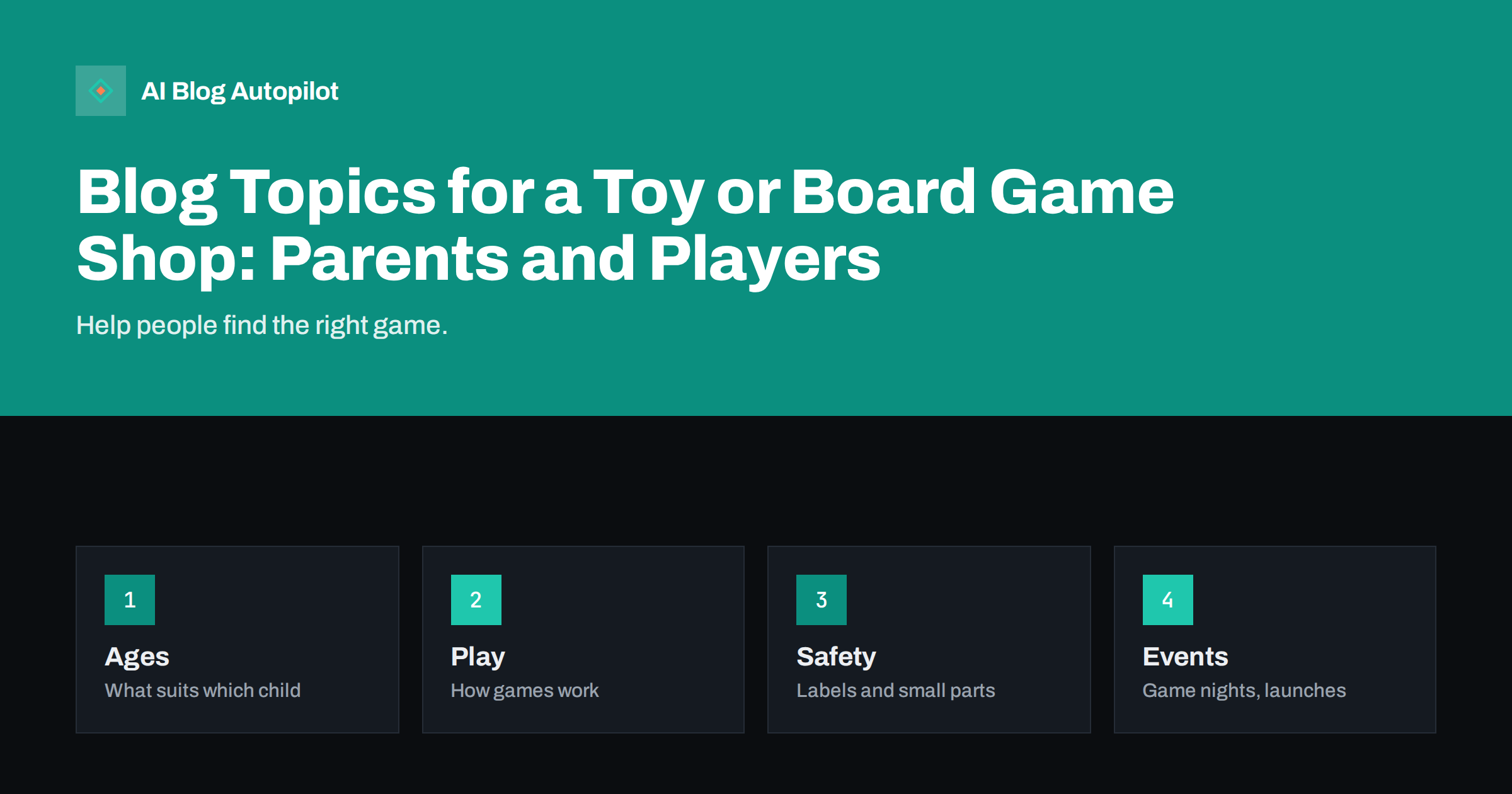
Short answer: a toy or board game shop should blog about helping people choose and enjoy what they buy: guides by age and interest, plain explanations of how games are played and how long they take, safety notes on labels and small parts, honest reviews, event pages for game nights and launches and seasonal ideas. Write like the friendly expert at the counter, show real photographs and name the products you actually stock.
Shoppers in a toy or game shop often have a question rather than a product in mind. A grandparent wants something for a seven-year-old, a parent wants a game that does not need a screen and a group of friends wants something new for Friday night. The staff who can ask two questions and suggest the right box are the heart of such a shop, and a blog can bring that help to people before they arrive.
This guide lists topic groups for an independent toy shop, a board game cafe or a hobby store, explains how to turn counter conversations into pages and describes how to keep content accurate on age ratings, safety and availability. It works whether you sell online, in the shop or both.
Include guides for children with different needs: toys that suit children who are shy, active, easily frustrated or learning another language. Explain what to look for, such as open-ended play, large pieces or cooperative rules, without suggesting that a toy can treat or diagnose anything. A gentle, practical tone helps parents who often feel unsure.
Remember budget buyers. Pages such as good games under a fixed price, toys that last or toys to swap and share show that you understand real households. Say honestly when an expensive item is worth the cost and when a simpler one will do. Customers who feel respected return year after year.
Guide buyers by age, interest and occasion
Start with age-based guides: toys for babies, toddlers, preschoolers, school-age children and teenagers. For each group, describe what children usually enjoy and learn at that age, and suggest types of toys, not only specific products. Explain that children develop at different rates, and that the age on the box is a guide.
Add interest-based pages: building and construction, role play, creative art, science and nature, puzzles, outdoor play, games for quiet time and gifts for children who love animals or vehicles. A page that begins with what the child likes is easier to use than a list of brands, and it matches how people search.
Write for occasions: a birthday party, a long journey, a rainy day, a sick day at home, a family gathering, a first day at school. Offer a short list with the reasons for each choice and the approximate price range. Link each suggestion to the product page or to the department in the shop.
Cover the adult buyer too. Many games and puzzles are bought by adults for adults. Pages such as games for two players, games for a mixed group or a relaxing puzzle for a long weekend help readers who are not shopping for children.
Write about teaching a game. A short guide on how to explain rules to a group, how to set up quickly, how to play a first round with open hands and how to handle a player who is losing helps people enjoy the game they bought. It also reduces the number of boxes that end up unopened on a shelf.
Explain how games are played
Board and card games can look complicated on the shelf. Write short, clear pages that describe how a popular game works: the goal, the main turn, how long it takes, how many people can play and how difficult the rules are. Avoid copying the rulebook, and describe the feel of the game in your own words.
Create guides to types of games: cooperative games, party games, strategy games, family games, card games, dice games and quick games for two. Explain what each type is like, who enjoys it and which games make a good first purchase. A reader who understands the types can choose with confidence.
Add difficulty and time ratings that you define yourself, and explain them. For example, mark games as easy, medium or heavy, and show playing time in minutes with a note that the first game usually takes longer. Honest ratings reduce returns and build trust.
Offer beginner paths. A page that suggests a first game, a second step and a third challenge for people who are new to modern board games is useful, shareable and likely to be repeated by assistants when someone asks where to start. Update it when new releases arrive.
Be careful and clear about safety
Safety is important for toys. Explain the age grading and warning labels in plain language: what small parts warnings mean, why some items are not suitable for children under three, what the safety marks stand for and how to check that a product meets the standards of your country. Link to the official authority.
Write about battery safety, magnets, balloons, cords and secondhand toys. Keep the advice factual and link to official guidance. Parents appreciate a shop that treats these matters seriously, and the pages are valuable to anyone who searches before buying.
Explain how you choose products. If you buy only from established suppliers, test samples or avoid certain items, say so. Do not make claims about safety that you cannot support, and never suggest that a toy is guaranteed safe in all conditions. Supervision remains the responsibility of the adult.
Write about caring for toys and games: cleaning, storing pieces, replacing missing parts and handling wooden toys. A short page on how to keep a game complete is surprisingly popular, and it links naturally to replacement pieces or accessories if you offer them.
Describe accessibility. Note whether a game relies on colour, reading, fine motor skills or quick reactions, and whether there are options for different abilities. Readers who need such information are often ignored by other shops, and a few clear lines can win their loyalty and help many families choose well.
Review products honestly
Reviews are the most useful content when they are real. Play the game or test the toy with the intended audience, and say how long and with whom. Describe what works, what does not and who will like it. Include photographs that you took, showing the contents and the play in progress.
Explain your approach. Say whether you received samples, whether you sell the product and how you rate. Be fair even when the product is one you sell. A balanced review that admits a flaw and explains who can ignore it is more trustworthy than uniform praise. The guide on how to write product reviews explains how to structure them.
Compare similar items. A page that puts three party games side by side, with player counts, time, difficulty and the type of fun, helps buyers choose. Keep tables simple, and add one sentence on which is best for what kind of group.
Update reviews as products change. New editions, revised rules and different components can alter a verdict. Add a date, and note changes at the top. Remove reviews for items you no longer stock, or explain that they are out of print.
Promote events, community and local life
If you run game nights, tournaments, painting sessions, demo days or launch events, write a page for each type with the schedule, price, age range, what to bring and how to book. Keep the pages after the events and add photographs and a summary. They show that the shop is a living place.
Publish a regular events page that lists upcoming dates, with a clear link from the home page. Add an easy way to sign up, and state the rules for children and for supervision. The guide on event announcement posts explains how to write them so that they bring people in.
Share community stories with permission: a family who found a favourite game, a club that meets weekly, a school that borrowed games for an event. Do not publish photographs of children without written consent from a parent, and follow the rules of your country on images of minors.
Connect with local groups: schools, libraries, parent groups and clubs. A guide that lists local places to play, or a page on how to start a game club, brings goodwill and traffic, and can lead to partnerships. Keep information current and check all details with the organisers.
Plan the year and make buying easy
Toy and game sales are seasonal. Plan content around birthdays, school holidays, the end-of-year season and local events, and publish guides several weeks before each peak. Keep one page per season and update it every year. The guide on planning seasonal content without scrambling every year shows how to schedule this.
Make buying easy. Show stock and prices clearly, offer gift wrapping, a gift note or a click and collect option if you provide them, and explain delivery times and returns in plain words. Add opening hours, address and parking details, identical across your site and listings.
Offer help by phone or chat. Many customers still prefer to describe a child and ask for suggestions. Say who answers, when and how quickly, and make the number visible. A friendly, knowledgeable reply often turns a question into an order.
Measure what the pages bring. Count visits, enquiries, sales and event sign-ups by page, and ask customers what they read before they came. Expand the guides that work and retire those that do not. A small shop can build an impressive library over a year with steady effort.
How AI Blog Autopilot helps
AI Blog Autopilot can write and publish articles on your chosen topics, with FAQ sections, tags and SEO meta, and share them to your social networks. Give it your range and your events, and have a member of staff check every age rating, rule and safety note before each article goes live. See the pricing page for plans and monthly credits.
Related reading
- A Blog for a Handmade Goods Seller
- Event Announcement Posts That Bring People In
- Planning Seasonal Content Without Scrambling Every Year
The bottom line
Guide shoppers by age and interest, explain how games work, treat safety seriously, review honestly and use events to bring the community in.
FAQ
What should a toy shop blog about first?
Start with age and interest guides, how popular games are played and clear safety notes on labels and small parts.
How do I write about age ratings?
Explain that the age on the box is a guide, describe what labels mean and link to the official authority for your country.
Can I publish photos of children at events?
Only with written consent from a parent, and follow the rules about images of minors in your country.
Should I review products I sell?
Yes, but say you sell them, describe how you tested them and be fair about flaws and who the product suits.
How do I plan seasonal content?
Publish gift and holiday guides several weeks before each peak, and update the same pages every year.