ENEnglish
 LTLietuviškai
 DEDeutsch
 FRFrançais
 RUРусский
 ESEspañol
 PLPolski
 ITItaliano
 UKУкраїнська
 CSČeština
 PTPortuguês
 JA日本語
JA日本語 LVLatviešu valoda
 ETEesti
 HUMagyar
 IDBahasa Indonesia
 TRTürkçe
 HIहिन्दी
 ELΕλληνικά
 ARالعربية
 THไทย
THไทย VITiếng Việt
 RORomână
 MSBahasa Melayu
 BNবাংলা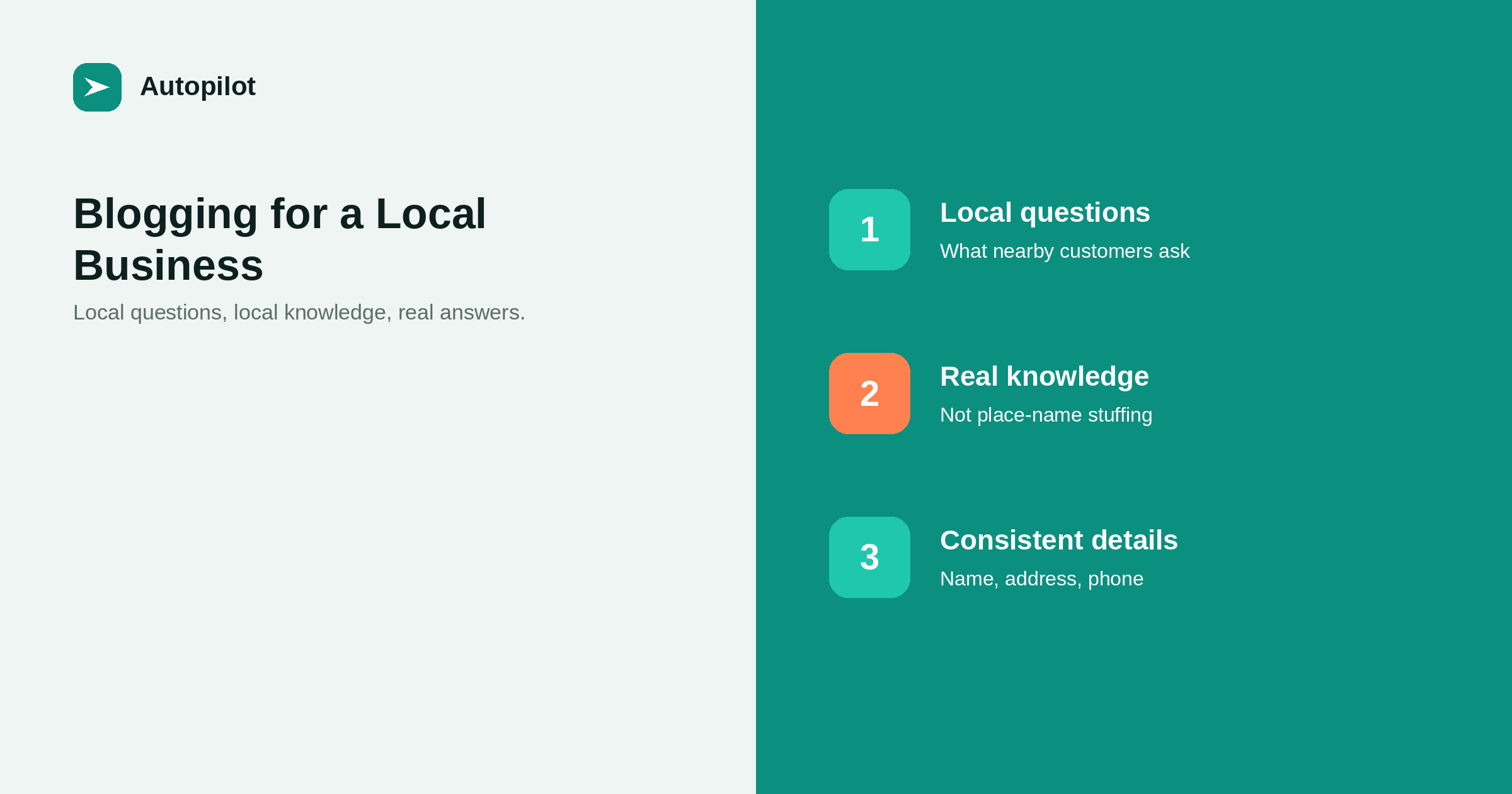
Short answer: answer the questions customers in your area actually ask, using knowledge only a local business has: local regulations and permits, how the climate or local housing affects the service, typical local costs described honestly, and what to expect when working with a business like yours. Articles support your service pages and business profile rather than replacing them. Avoid creating near-identical pages for every town with only the place name changed, and keep your business name, address and phone number consistent everywhere they appear.
For a local business, most visibility comes from the business profile shown in maps and local results, and from a handful of service pages. A blog is a supporting player — but a useful one, when it answers the questions local customers actually have.
The mistake to avoid is treating local blogging as the production of pages that repeat a town name as often as possible. That approach is dated and increasingly ineffective.
What local customers actually ask
The best topics come from conversations with customers, and they are usually specific to the area.
- Regulations and permits that apply locally.
- How local conditions affect the job — climate, soil, building age, traffic.
- What things cost here, described honestly as ranges and factors.
- Timing — the best season, how long it takes, local lead times.
- What to expect when hiring a business like yours.
These are questions a national site cannot answer well, and they show you know the area.
How the blog fits with everything else
Local visibility has several parts, and the blog is one of them.
| Part | Role | Priority |
|---|---|---|
| Business profile on maps | Most local searches start here | Highest |
| Service pages | One page per main service | High |
| Reviews | Trust and local ranking signal | High |
| Consistent business details | Name, address, phone everywhere | High |
| Blog articles | Answers, knowledge, internal links | Supporting |
If the profile and service pages are weak, fix those first. The blog then supports them: articles link to the relevant service page, and give the profile something current to point to.
Avoiding doorway pages
A common tactic is creating a page per town — plumber in Town A, plumber in Town B — each identical apart from the name. Search guidelines describe these as doorway pages, and they can harm visibility rather than help it.
If you genuinely serve several areas and have something specific to say about each — different regulations, different typical jobs, local projects — a page per area can be legitimate. If the only difference is the name, one page listing the areas you serve is better.
Genuine local knowledge
The strongest local articles contain things only someone working in the area knows: which neighbourhoods have older buildings that need particular care, what the local authority usually asks for, which months are busiest and why.
That is the kind of first-hand material described in adding something original, and for a local business it is usually abundant. Photographs of real local jobs, with permission, add to it.
Keeping business details consistent
Your business name, address and phone number should be identical wherever they appear: website, business profile, directories, social profiles. Inconsistencies confuse customers and search engines.
Put the details in the site footer and on a contact page, mark them up with Organisation or LocalBusiness structured data, and check the main directories once a year for outdated entries.
Local seasons and events
Local businesses have local seasons: weather-driven demand, tourist periods, school terms, local events. Articles that anticipate them — published six to eight weeks ahead — meet customers when they start looking.
planning seasonal content covers the method. For a local business the calendar is usually short and very predictable.
Showing real work
For many local businesses the most persuasive content is evidence of real work in the area: a short account of a job, the problem, what was done and the result, with photographs where the customer agrees.
These pieces are simple to produce, they are unique by definition, and they answer the question every local customer has, which is whether you have done this kind of job nearby before. Keep them honest, include the complications as well as the successes, and link each to the relevant service page. A handful of these each year does more for a local business than dozens of generic articles.
How much to publish
A local business rarely needs a high volume of articles. Two to four good local answers a month, kept current, usually serves better than daily generic posts.
Generic articles that could appear on any business’s site in any country add little for a local business. If you use automation, give it strong local instructions and add local detail at review; the value is in what is specific to your area.
Reviews and replies
Reviews matter more for local visibility than almost any article. Ask satisfied customers for them, reply to every one, and treat negative reviews as a chance to show how you handle problems. A thoughtful public reply is read by more future customers than most blog posts.
Measuring it
Local businesses should measure calls, direction requests and enquiries, not only visits. Your business profile’s own statistics show calls and direction requests; your analytics show enquiries from sessions that included an article.
No article guarantees a place in local results, which depend heavily on proximity, reviews and the profile. Articles make the business more useful and more credible to the people who find it.
Related reading
If this was useful, these cover the questions that usually come next.
- The first ten posts — a starting plan that suits local businesses
- Setting up a new blog — the technical basics
- Planning seasonal content — local seasons and events
The bottom line
Answer the questions nearby customers really ask, with knowledge only a local business has, and link each article to the relevant service page. Strengthen your business profile, service pages and reviews first, keep business details consistent everywhere, avoid near-identical town pages, and publish a few good local answers a month rather than many generic ones.
FAQ
Does a local business need a blog?
It helps as a supporting part of local visibility, alongside the business profile, service pages and reviews. It is most useful for answering local questions customers ask.
What should a local business blog about?
Local regulations and permits, how local conditions affect the service, honest cost ranges, timing, and what to expect when hiring a business like yours.
Should I create a page for every town I serve?
Only if you have something genuinely specific to say about each. Pages differing only in the town name are treated as doorway pages and can harm visibility.
How often should a local business publish?
Two to four good local articles a month is usually plenty. Specific local answers matter more than volume.
Why do consistent business details matter?
Identical name, address and phone number everywhere help customers and search engines trust that the details are correct.
Can a blog get my business into the map results?
Not directly; map results depend mainly on proximity, the business profile and reviews. Articles support credibility and give people more reasons to choose you.