ENEnglish
 LTLietuviškai
 DEDeutsch
 FRFrançais
 RUРусский
 ESEspañol
 PLPolski
 ITItaliano
 UKУкраїнська
 CSČeština
 PTPortuguês
 JA日本語
 LVLatviešu valoda
 ETEesti
 HUMagyar
 IDBahasa Indonesia
 TRTürkçe
 HIहिन्दी
 ELΕλληνικά
 ARالعربية
 THไทย
 VITiếng Việt
 RORomână
 MSBahasa Melayu
 BNবাংলা
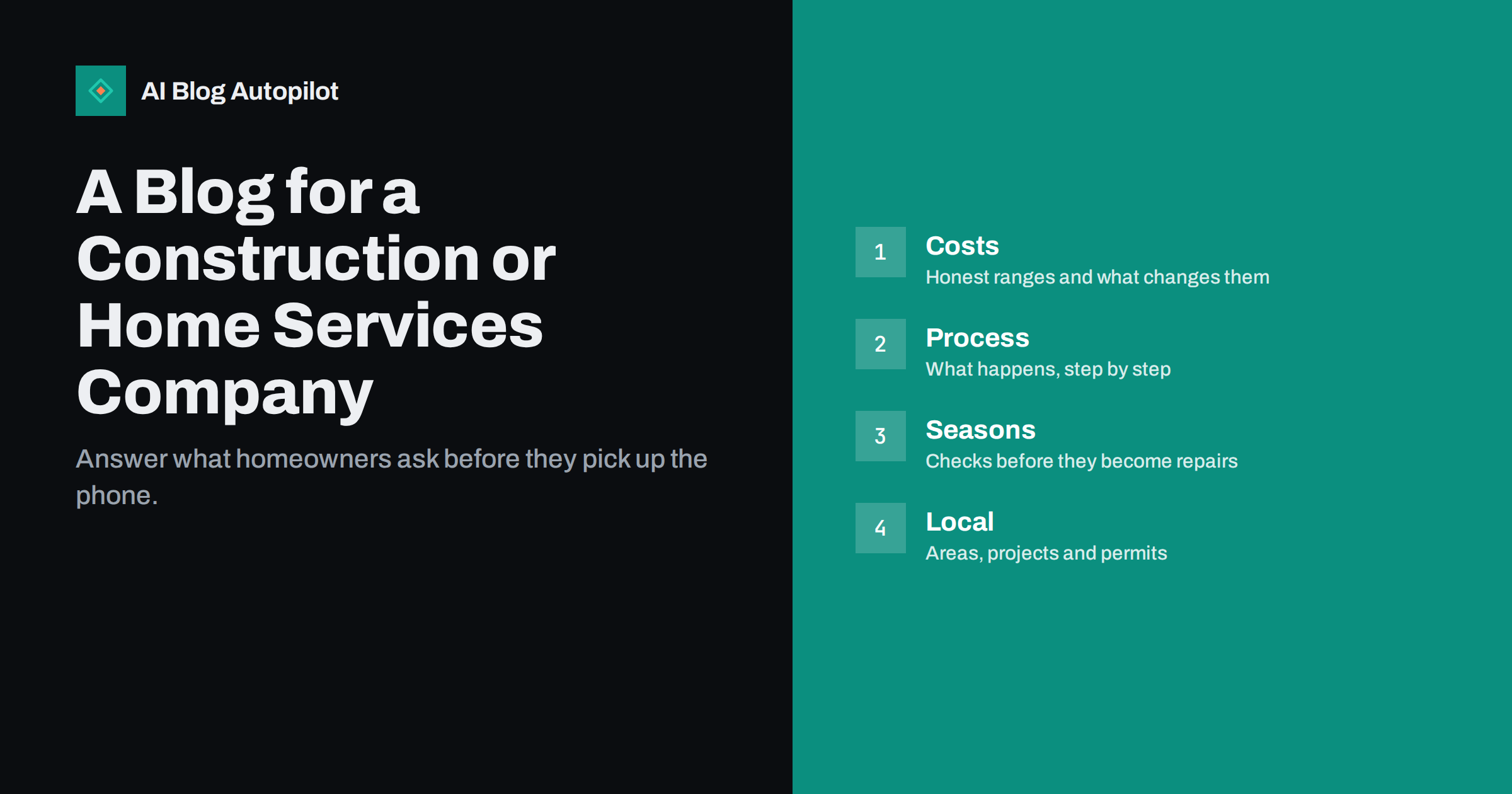
Short answer: a blog for a construction, renovation or home services company should answer the questions homeowners ask before they hire: what a job costs and why prices vary, how long it takes, what the process looks like, what permits or rules apply and how to tell a good quote from a poor one. Add seasonal maintenance guides, explanations of common problems, honest comparisons of materials and options, and pages tied to the areas you serve. The aim is not traffic for its own sake but trust: a homeowner who has read three clear, local, honest articles is already half-convinced when the quote arrives.
Hiring a tradesperson is a stressful purchase. The work is expensive, the customer usually cannot judge quality until it is too late and horror stories are easy to find. That makes trust the main currency, and a blog is one of the few places where a small company can demonstrate expertise, honesty and care before the first phone call. It also reaches people at the moment they search: “why is my boiler losing pressure”, “how much does a loft conversion cost”, “do I need permission to remove a wall”. This article describes what to write, how to structure it for search and enquiries and which pitfalls are particular to this trade.
What homeowners are really searching for
Search behaviour in this field falls into a few predictable groups, and each deserves its own type of content.
- Emergency and urgent problems: a leak, a tripped circuit, no heating. These searches are local and immediate, and the page that wins is the one that helps right now and makes contact easy. A blog article can give safe first steps and an honest sense of when to call a professional.
- Planning and cost questions: “how much does it cost to rewire a house”, “how long does an extension take”. These readers are early in the process, comparing options and budgets.
- How-it-works questions: what a survey includes, what happens on the first day, what needs to be moved out of the room. These reduce anxiety and increase the chance the reader chooses a firm that explained things clearly.
- Rules and permissions: building regulations, planning rules, safety certificates and warranties. They vary by country and region, so write for the places you serve.
- Choosing a provider: how to compare quotes, what to ask, what is a red flag. Few firms write about this honestly, so there is room to stand out.
Our article on turning customer questions into topics shows how to collect these from calls, emails and quote requests. Your own team’s most frequent questions are your best keyword list.
Cost guides without false precision
Cost is the question every customer has and most firms avoid answering. Avoiding it hands the search results to national directories and comparison sites. You can write a useful cost article without committing to a fixed price. Explain what drives the price: the size of the job, the condition of the property, access, materials, the level of finish, rules that apply and how long the job takes. Describe the difference between a small and a large version of the work, and say which items are commonly missed in a quote, such as making good, waste removal, certificates and VAT or sales tax where relevant. Give ranges only if you can stand behind them, label them with the date and region, and say that they are guides, not quotations. Our article on writing honestly about what things cost explains the approach in detail.
Such articles also filter enquiries. A reader who knows the likely range and still contacts you is better qualified than one who expected a different order of magnitude.
Process and project explainers
Explain what happens from first contact to completion. Cover the survey or site visit, the written quote, the order of work, the disruption to expect, the points at which the customer must make decisions, how changes to the plan are handled and what the handover includes. Use real photographs of your own projects wherever the client agrees, with captions describing the problem, the solution and the time taken. Anonymise addresses and personal details, and keep consent records. A short project write-up with before and after images, the challenges faced and the final result is more persuasive than a gallery with no context. Our article on case studies explains how to write them without exaggeration.
Avoid jargon, or explain it. A homeowner reading about “first fix” and “second fix” needs a sentence on what each means.
Seasonal and maintenance content
Home maintenance follows the calendar, and seasonal articles give you predictable, recurring relevance. Examples include checks before winter for heating, pipes and roofs, spring inspections of gutters and drainage, summer guides to outdoor work and cooling, and autumn preparations for storms and leaves. Publish them a few weeks ahead of the season, update them each year rather than creating new pages and link them to the services you provide. Our article on planning seasonal content explains how to schedule the work. Keep safety first: when an article describes a task, say clearly which jobs are safe for a homeowner and which should be left to a qualified person, particularly for gas, electrical, structural and roofing work.
Local pages and proof
If you serve particular towns or districts, build useful local content instead of near-identical pages with the place name swapped. Write about the type of housing common in an area, the local rules or conservation constraints that affect work, typical problems with older properties nearby and examples of projects you have completed there. Link them to your Google Business Profile and keep your name, address and phone details consistent everywhere. Reviews and testimonials add proof, and our article on Google Business Profile updates explains how to reuse blog posts there. Do not publish fake reviews, stock photos presented as your work or claims of accreditation you do not hold; they are easy to check and damaging when found out.
A starter list of topics
- How much does [your main service] cost, and what changes the price?
- How to compare quotes from different contractors.
- What to expect on the first day of a project.
- Do you need permission or an inspection for [common job] in [your region]?
- Signs that [component or system] needs attention, and what to do first.
- Materials compared: advantages, limits and costs of the common options.
- A seasonal checklist for the home, published each year before the season.
- Questions to ask before hiring a contractor.
- A project write-up with before and after photographs.
- Warranty, certificates and aftercare: what the customer receives.
Ten articles like these, kept accurate, give a small firm a solid base. Add more as customers ask new questions.
Turning readers into enquiries
Every article should offer a sensible next step: a phone number that is easy to tap on a mobile, a short enquiry form, a request for a survey or a downloadable checklist. Match the call to action to the intent. A reader of an emergency article wants a phone number; a reader of a cost guide may want a form to describe the job and request a quote. Show service areas, opening hours and response times if you can keep your promises about them. Our article on calls to action that fit the article they sit in applies directly. Also make sure the site loads quickly on a phone, because most homeowners search on one, often in a hurry.
Think also about who writes the articles. The best material comes from the people doing the work, because they know the problems customers actually have. A foreman can dictate the steps of a job in ten minutes; an editor can turn that into a clear article with headings, a checklist and photographs. Our article on turning voice notes into blog drafts describes a practical way to do this. Make time for a monthly session in which the team lists the questions they heard that month, and let that list decide the next articles. It keeps the blog grounded in real demand and ensures the advice reflects how the firm really works, which is exactly what experienced readers and search engines look for.
Finally, remember the after-sales stage. Articles about aftercare, servicing intervals, warranty claims and what to do when something goes wrong keep existing customers engaged, reduce avoidable calls and give satisfied customers something to share with friends and neighbours, which in this trade is still the strongest source of new work.
Mistakes to avoid
- Hiding prices completely, which gives the search results to national comparison sites.
- Copying manufacturers’ descriptions instead of writing from your own experience.
- Giving unsafe advice about gas, electricity, structures or asbestos. Always point to professional help for risky tasks.
- Duplicated town pages that differ only by the place name.
- Using projects, photos or names without permission.
- Letting guides age, especially those that cite rules, prices or standards.
How AI Blog Autopilot helps
Trades are busy, and blogs are the first thing to be dropped. AI Blog Autopilot writes full SEO articles for your WordPress site from the topics, keywords, audience and tone you give it, with FAQ, tags and SEO meta, and shares each one to your social networks. Your real projects, photographs and local knowledge are what make the blog yours, so use approval mode to review each article and add them before it goes live. Plans are on the pricing page.
Related reading
- Blog Strategy for a Local Business
- Turning Customer Questions Into Useful Blog Topics
- How to Write a Case Study That Persuades Without Exaggerating
- Google Business Profile Updates: Reusing Blog Posts Locally
The bottom line
A construction or home services blog wins by being the firm that explains. Answer the questions about cost, process, rules and choosing a contractor, publish seasonal and local guidance, show real work with permission and give every article a clear next step. Keep everything accurate and safe, and the blog becomes a quiet salesperson that earns trust before the first conversation.
FAQ
Should a contractor publish prices on the blog?
Publish ranges and the factors that change the price, labelled with date and region, rather than fixed prices. This builds trust and filters out poorly matched enquiries.
How often should a home services company publish?
Consistency matters more than volume. One or two useful articles a month, kept accurate, is a solid start for a small firm.
Can I use photos of my customers’ homes?
Only with their permission, and with addresses and personal details removed. Keep a record of consent for each project.
Do I need separate pages for each town I serve?
Only if you can make each one genuinely useful with local detail. Near-identical pages with a changed place name are weak and risky.
What should an article say about DIY work?
Say which tasks are safe for a homeowner and which need a qualified professional, especially for gas, electrical, structural and roof work.