ENEnglish
 LTLietuviškai
 DEDeutsch
 FRFrançais
 RUРусский
 ESEspañol
 PLPolski
 ITItaliano
 UKУкраїнська
 CSČeština
 PTPortuguês
 JA日本語
 LVLatviešu valoda
 ETEesti
 HUMagyar
 IDBahasa Indonesia
 TRTürkçe
 HIहिन्दी
 ELΕλληνικά
 ARالعربية
 THไทย
 VITiếng Việt
 RORomână
 MSBahasa Melayu
 BNবাংলা
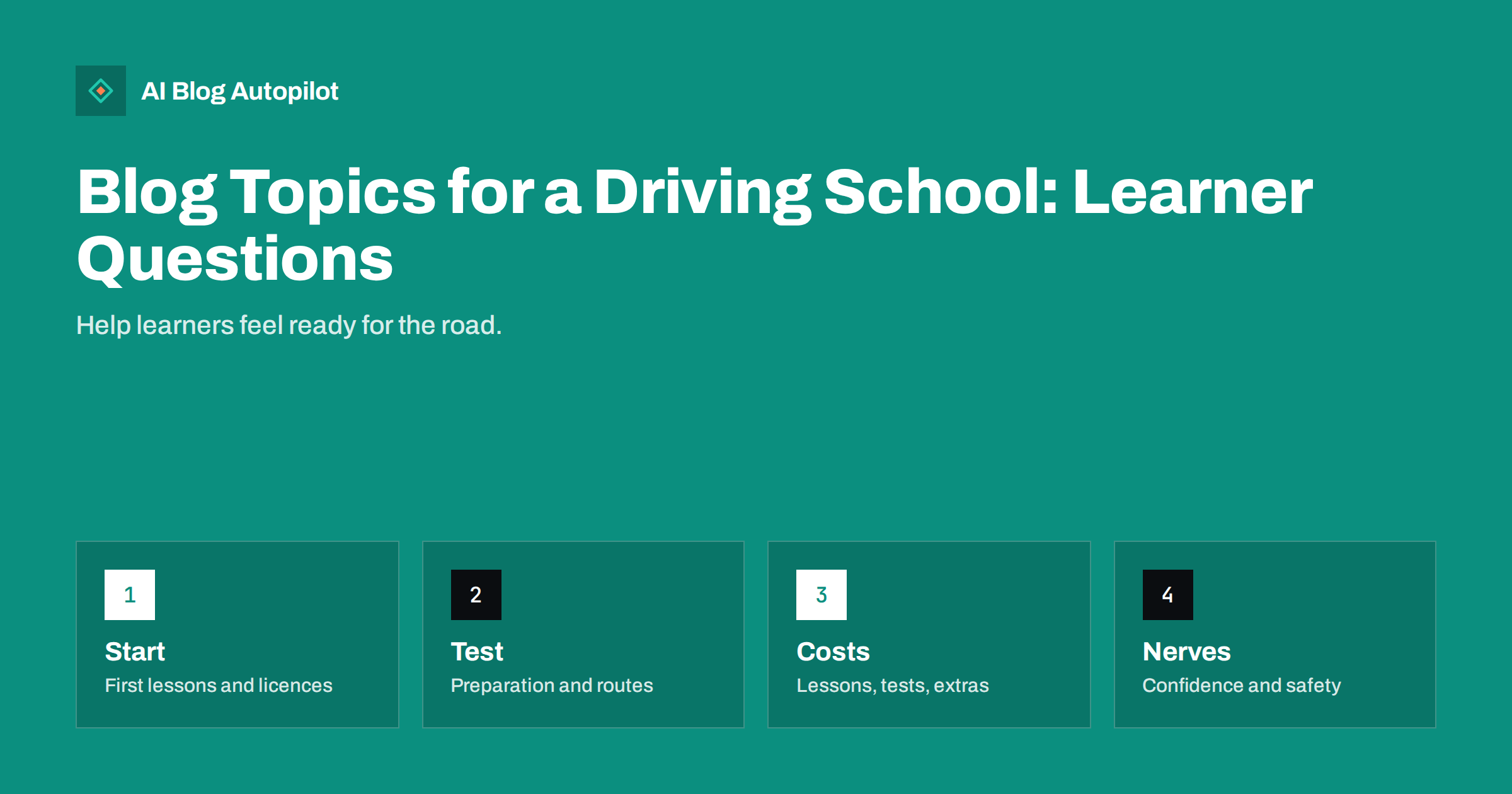
Short answer: a driving school should blog about the questions learners and parents ask before they book: how to start, what a first lesson involves, how many lessons people usually need, what affects the cost, how the test works, how to deal with nerves and what to practise between lessons. Keep rules and fees accurate for your country, show the local test area, treat learners kindly and end each page with a simple way to book a lesson.
Learning to drive is a big step, and most learners begin with a search. They ask what the process is, how much it costs, how long it takes and whether they will manage. A school that answers these questions clearly on its site is easy to choose, because the learner already feels it understands their worries.
This guide lists topic groups for a driving school and shows how to write them so they attract local learners, reassure parents and stay correct when rules change. It also covers how to show instructors, cars and results honestly.
Starting out: licences, rules and the first lesson
Begin with the path from nothing to the first lesson. Explain who can learn to drive, what documents are needed, how a provisional licence or learner permit is obtained, which medical or eyesight conditions matter and what the minimum age is. The rules differ by country, so say clearly which country the page covers and link to the official source.
Describe the first lesson in detail. Many learners fear it more than any other. Explain where it starts, what the instructor will do, how long it lasts, how the car controls are introduced, how fast the learner is expected to progress and what they should bring. A calm page with an honest picture of the first hour removes a barrier to booking.
Write about different kinds of learners: teenagers, adults who are learning late, people who have driven abroad, people who have failed before and people who are nervous. Each group has its own questions, and a page aimed at one of them speaks directly to a real person instead of to everyone.
Include guides on the car as well: manual or automatic, how to choose, what dual controls are for and what a lesson car offers. State the differences fairly, including any limits on the licence that follow from the choice, and check them against the official rules.
Explain how you give feedback after each lesson. Some schools send a short summary of what was practised, what went well and what to work on next, and learners value it because it shows progress and keeps parents informed. If you use a progress record, describe it and show an example with made-up details. A clear picture of how learning is tracked helps people choose a school that takes teaching seriously.
Lessons, progress and practice
Learners and parents ask how many lessons they will need. Be honest: it varies with age, confidence, practice between lessons and the area. Explain what the typical range is, if you have one, what makes it shorter or longer and how you track progress. Avoid promises of a pass in a set number of lessons.
Write a series that follows the skills: moving off and stopping, steering, junctions, roundabouts, parking, driving in towns, rural roads, dual carriageways, motorways, night driving and bad weather. Each page explains what to practise, what instructors look for, what mistakes are common and how to improve. Use diagrams or photographs of real local junctions where permitted.
Explain how to practise between lessons. If the rules allow private practice with a family member, describe what the supervisor should check, what to avoid and how to keep the car and the learner safe. Offer a checklist for the supervisor, since many parents have not taught anyone to drive before.
Add a short page on how to book, change or cancel lessons, what the cancellation rule is, how long a lesson is and how payments work. Clear rules prevent disputes and save time for reception.
Write a guide to the theory side of learning too. Explain how to study, which official materials to use, how practice questions work, how hazard perception is tested and what to do if reading is difficult. Learners who pass the theory part with confidence arrive at their first lesson ready to concentrate on driving, and a helpful guide is often shared between friends.
The test: what happens and how to prepare
The test is the biggest search topic. Explain the structure: the theory part, if any, and the practical part. Describe what is checked, how long it lasts, what the examiner says and does, how faults are marked, what happens at the end and what to do after a pass or a fail. Keep all rules accurate and link to the official source.
Write about your local test centre and the routes around it. Explain where to park, how to find the centre, which junctions and roundabouts are tricky and what the area is like at different times of day. Do not publish precise test routes if your authority discourages it, and never suggest that a learner can memorise a route in place of learning to drive.
Prepare learners for test day with a short list: documents to bring, vehicle checks, eyesight, time to arrive, what to wear, what to eat and how to breathe. Include a guide on what to do after a fail, with a kind, constructive tone that shows how to learn from the feedback and rebook.
Explain the show-me and tell-me style questions or equivalent checks that your country uses, with simple pictures. The guide on step-by-step instructions that AI answers can reuse shows how to write steps that are easy to follow.
Explain how to choose between schools in a way that helps even when readers do not pick you. Suggest that they check that the instructor is properly registered, ask what the lesson length really is, find out how cancellations work and read recent comments. Advice like this signals confidence and honesty, and people remember who gave them straight answers when they chose their instructor.
Costs and packages
Price is among the first things learners ask. You may not wish to publish every detail, but you can explain what the cost includes: lessons, car hire for the test, test fees, books or apps and any theory support. If you offer block bookings, describe how they work, what the discount is and what happens to unused hours.
Show the total cost of learning in an honest way. Explain which costs are paid to the school and which to the authority, how the number of lessons changes the total and how to save money without cutting safety. A learner who understands the cost is less likely to feel misled. The article on writing honest articles about what things cost provides a structure.
Be clear about refunds and rescheduling. Explain what happens if a test is cancelled by the authority, if an instructor is ill or if a learner is unwell. Publish your terms in plain words and keep them in line with your booking form.
If you offer intensive courses, refresher lessons, pass-plus style add-ons or lessons for drivers who have lost confidence, give each its own page with who it suits, how it works and what it costs in general terms.
Nerves, confidence and safety
Many learners are anxious, and a gentle, practical guide can bring them in. Explain how nerves show up, what helps before and during a lesson, how an instructor can adapt, how to talk about worries and how to build skills in small steps. Do not make medical claims. Say that if anxiety is severe, a doctor or counsellor may help alongside lessons.
Write about safety in plain terms: seat and mirror setup, distance to the vehicle ahead, speed in different conditions, phones, tiredness, alcohol and medicines. Use facts from official road safety bodies and link to them. Keep the tone respectful, since learners respond better to guidance than to scare tactics.
Include a guide for parents who worry about a young driver: how to support without taking over, what the licence rules are, what insurance questions arise and how to agree rules for the first months after the test. This audience often pays for lessons and makes the choice of school.
Offer accessible information as well. Explain how you support learners with disabilities, learning differences or language needs, which adaptations you can offer and who to contact. State only what you really provide.
Write a few local articles that are not strictly about lessons: how to get to the test centre by public transport, where to find a safe quiet place for practice, how local roads change in winter and what the main hazards are in your area. These pages draw people who live nearby and show real knowledge of the place.
Local trust: instructors, cars and results
Introduce the instructors with a short profile each: name, training, years of experience, languages, areas covered and teaching style. Take photographs with consent. Learners often choose a person, not a company, so a friendly, honest profile helps. The article on meet the team posts shows how to write them.
Show the cars with photographs, the transmission type, safety features and how they are cleaned. State the areas you serve, the pick-up options and the hours. Keep this information identical to your business profile, as explained in the guide on Google Business Profile updates.
Be careful with pass rates. If you publish a figure, explain how it is calculated, what period it covers and what it includes, and be ready to prove it. Avoid claims such as the best pass rate in town unless you can document them. Use real comments from learners with their permission, as the article on customer quotes and testimonials explains.
Check any advertising rules that apply to driving instructors in your country, including requirements to display registration details.
Keeping content correct
Rules, fees and test procedures change. Mark each guide with a review date, link to the official source and check it at least once a year. Remove pages about rules that no longer exist, or redirect them to the current page, as the guide on 301 and 302 redirects explains.
Use real learner questions as a source. Ask instructors to note what learners ask more than twice, and write a page for each. When a question arrives by phone, send the link, and see whether the number of such calls drops. Measure which pages lead to bookings and which only attract visitors.
Share the best guides in your newsletter and social channels, but keep to facts and avoid pressure. A calm, useful school is remembered when the learner finally passes.
How AI Blog Autopilot helps
AI Blog Autopilot can write and publish articles on your chosen topics, with FAQ sections, tags and SEO meta, and share them to your social networks. Give it your services and your area, and check licence rules, fees and test details before each article goes live. See the pricing page for plans and monthly credits.
Related reading
- Blog Strategy for a Local Business
- A Blog for a School, Nursery or Tutoring Centre
- Turning Customer Questions Into Useful Blog Topics
The bottom line
Explain each step from licence to test in plain words, be honest about lessons and costs, show real instructors and keep every rule current.
FAQ
What should a driving school blog about first?
Start with how to begin, what the first lesson is like, the cost and how the test works.
Can I promise a pass in a set number of lessons?
No. Progress varies, so explain what affects it instead.
Should I publish pass rates?
Only if you can explain how they are calculated and prove them. Avoid vague best-in-town claims.
How do I help nervous learners?
Write a gentle guide on small steps, adapted lessons and talking about worries, without making medical claims.
How often should rules be checked?
At least once a year and whenever the authority changes a rule or fee.