ENEnglish
 LTLietuviškai
 DEDeutsch
 FRFrançais
 RUРусский
 ESEspañol
 PLPolski
 ITItaliano
 UKУкраїнська
 CSČeština
 PTPortuguês
 JA日本語
JA日本語 LVLatviešu valoda
 ETEesti
 HUMagyar
 IDBahasa Indonesia
 TRTürkçe
 HIहिन्दी
 ELΕλληνικά
 ARالعربية
 THไทย
THไทย VITiếng Việt
 RORomână
 MSBahasa Melayu
 BNবাংলা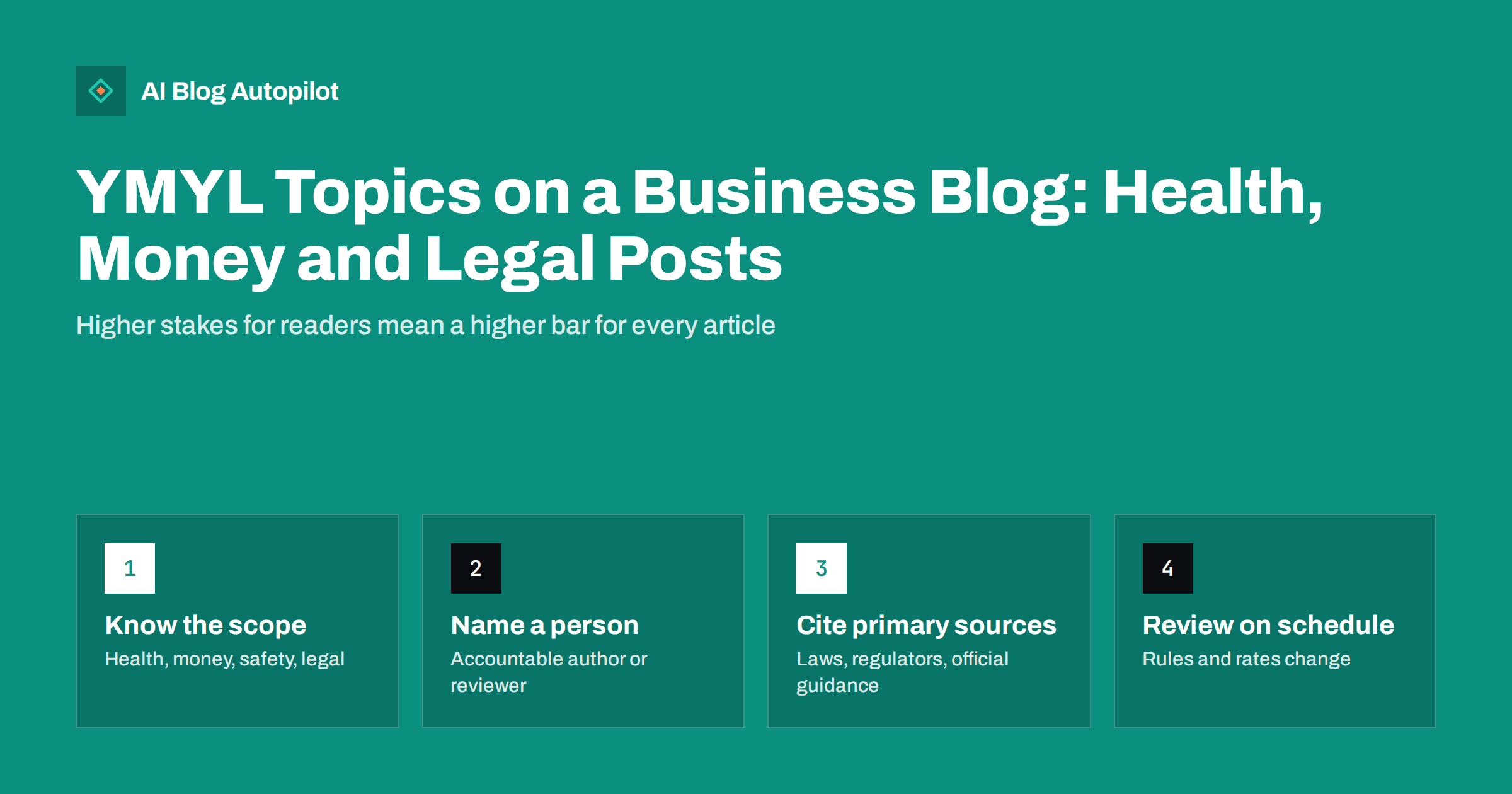
Short answer: YMYL stands for “Your Money or Your Life”, the label Google’s search quality guidelines use for topics that could significantly affect a person’s health, financial stability, safety or the wellbeing of society. Pages on these topics are held to a higher standard of trust, so a business blog writing about them needs accurate, sourced, regularly reviewed content with a clearly accountable author or reviewer. Many ordinary business topics touch YMYL only lightly, and those need care rather than panic.
Plenty of business blogs drift into YMYL territory without noticing. An accountant writes about tax deadlines, a gym about injury recovery, a lettings agent about tenant rights, an e-bike shop about battery safety. None of these are medical journals or law firms, yet a wrong answer can cost a reader money or put them at risk. This guide explains what the label means, how to judge whether your topic is affected, and the practical editorial habits that make such articles trustworthy.
What YMYL means and where the term comes from
The term comes from the Search Quality Rater Guidelines, a long document Google gives to the people who evaluate search results. Raters do not change rankings for individual sites. Their assessments help Google test whether its ranking systems are surfacing reliable pages. The guidelines are still worth reading, because they describe what the systems are designed to reward.
In the guidelines, a topic is YMYL when content about it could significantly harm a person or society if it were inaccurate. The main groups are:
- Health and safety: medical conditions, medicines, mental health, nutrition advice with health claims, and anything about physical safety, such as electrical work or dangerous equipment.
- Financial security: investing, taxes, loans, insurance, pensions, and major purchases where a mistake is expensive.
- Society: civic information such as voting, public institutions, and content about groups of people.
- Other high-stakes areas: legal questions, such as tenancy rights, employment law or immigration, where acting on wrong information has real consequences.
Google’s public guidance on creating helpful, reliable, people-first content makes the same point in plainer words: its systems give more weight to signals of experience, expertise, authoritativeness and trust for topics that could affect health, financial stability, safety or society.
It is a spectrum, not a switch
The guidelines treat YMYL as a matter of degree. A recipe for banana bread is not YMYL. A recipe claiming to cure a disease is. An article comparing two accounting apps touches money only lightly; an article telling freelancers which expenses they can deduct touches it directly. A useful test is to ask two questions about each article:
- If a reader follows this exactly and it is wrong, what happens? Mild inconvenience is low stakes. Losing money, breaking a law or getting hurt is high stakes.
- Would a reasonable person need an expert to answer this safely? If the honest answer is yes, the article needs expert input or review, not just good writing.
Most business blogs have a mix. A plumbing company’s post on choosing a tap is ordinary; its post on gas boiler safety is not. It helps to mark high-stakes topics in your content plan so they automatically get the extra steps described below.
Why the bar is higher for these pages
Search systems have limited ways of verifying facts, so for high-stakes topics they lean more heavily on signals that a page is reliable. In practice this means several things for a small site:
- Consensus matters. On topics where there is established expert or official consensus, pages that contradict it without strong evidence are unlikely to be treated as reliable, however well written.
- Accountability matters. Readers and quality raters look for who wrote or reviewed the content and why they are qualified. Anonymous advice on medication or tax is harder to trust.
- Accuracy over time matters. Tax thresholds, interest rates, regulations and medical guidance change. An article that was correct two years ago can now be harmful.
- The whole site counts. A site that publishes careless content on many topics is a weaker source for its careful articles too.
None of this means small businesses cannot rank for YMYL topics. Local and specialist businesses often have exactly the first-hand experience the guidelines value. It means the content has to show that experience and back up its claims.
Who should write or review a YMYL article
The single most useful change is to attach a real, qualified person to each high-stakes article. That person does not always have to write it. A common and honest arrangement is:
- A writer, or a drafting tool, produces the draft from a clear brief.
- A qualified person checks it: the accountant for tax posts, the licensed electrician for wiring posts, the physiotherapist for injury posts.
- The article shows the reviewer’s name, role and relevant qualification, ideally linking to a short profile page.
Only name a reviewer who actually reviewed the article. Listing a qualified name on content they never read is misleading to readers and exactly the kind of signal quality guidelines warn against. If nobody qualified can review a piece, consider whether you should publish it at all, or narrow it to what you can stand behind, such as your own service process rather than general legal advice.
The guide on bylines and author bios covers how to present authors and reviewers on each post.
Sourcing: cite the primary source, not a blog about it
For YMYL claims, the strongest source is usually the original one: the law or regulation itself, the tax authority’s guidance, the regulator’s page, the official public health body, or the manufacturer’s safety instructions. A few habits make sourcing reliable:
- Link to the primary source near the claim it supports, not in a list at the bottom that nobody connects to anything.
- State the jurisdiction. Tax, employment and tenancy rules differ between countries and often between regions. “In the UK” or “in most EU countries” is more honest than an unqualified rule.
- Give dates for figures. “The threshold for the 2026 tax year” is checkable; “the current threshold” goes stale silently.
- Avoid invented precision. If you do not have a reliable figure, say “typically” or explain the range, rather than guessing a number that looks authoritative.
The process in fact-checking content before you publish applies to every article, but for YMYL it should be mandatory rather than occasional.
Writing YMYL content that helps without overreaching
Good YMYL writing is careful about scope. It answers the question clearly, then says where the general answer stops and individual advice begins. Some practical patterns:
- Answer first, then qualify. Readers still want a direct answer. Give it, then explain the main exceptions.
- Separate facts from opinion. “In England, a tenancy deposit must be protected in an approved scheme within 30 days” is a fact to verify against the official source. “We think tenants should photograph everything on move-in” is advice, and should read as such.
- Explain when to get professional help. A short, specific note, such as “if you have received a court notice, speak to a solicitor”, is more useful than a generic disclaimer.
- Do not frighten or sell with fear. Alarmist framing around health or money erodes trust and often misleads.
- Keep disclaimers honest and short. A disclaimer does not fix inaccurate content, and a long legal block at the top pushes the answer out of view.
Review dates and update routines
A high-stakes article needs an owner and a review date. A simple routine works for most blogs:
- Tag every YMYL article in your content inventory.
- Set a review interval by volatility: tax and rates yearly or when the rule changes; legal and safety guidance at least yearly; medical content whenever official guidance changes.
- When you review, check every figure, link and rule against the primary source, then update the visible “last reviewed” date only if someone actually reviewed it.
- If the article is no longer accurate and you cannot fix it soon, unpublish it or add a clear note at the top. A wrong answer that ranks is worse than no answer.
A visible note such as “Reviewed by [name], [qualification], on [date]” tells readers the content is maintained. It only helps if it is true.
Common mistakes on business blogs
- Publishing general legal or tax rules without a jurisdiction, so readers in another country act on the wrong rule.
- Health claims in product content, for example supplements or equipment described as treating conditions. Beyond search quality, such claims are often regulated.
- Copying numbers from other blogs instead of the official source, which spreads outdated figures.
- Fake or borrowed expertise, such as stock photos presented as staff experts or reviewers who never saw the text.
- Publishing YMYL posts in bulk without review, which is where automated or outsourced content is most likely to cause real harm.
How AI Blog Autopilot fits in
AI Blog Autopilot writes and publishes SEO articles from the topics, audience and tone you set, and runs an automatic quality check before anything goes live. For high-stakes subjects, you can switch on approval so each article waits for a qualified person to review and edit it before publication, while ordinary topics continue in AUTO mode. It cannot supply professional expertise or a reviewer’s judgement, so for health, money and legal topics that review step is yours. See how Autopilot works.
Related reading
- E-E-A-T on a Blog That Publishes Automatically
- Writing an Editorial Policy Page for a Business Blog
- When Not to Automate Content
The bottom line
YMYL is not a penalty or a banned list. It is a reminder that some topics can hurt readers if you get them wrong, so they need more care. Identify those topics in your plan, put a qualified and named person behind each one, cite primary sources with dates and jurisdictions, and review the articles on a schedule. Ordinary topics can move faster; high-stakes ones should not.
FAQ
What does YMYL stand for?
YMYL stands for “Your Money or Your Life”. It is a term from Google’s Search Quality Rater Guidelines for topics where inaccurate content could significantly harm someone’s health, finances, safety or society.
Is YMYL a ranking factor?
YMYL is not a single ranking factor or setting. It describes topics for which Google’s systems give more weight to signals of expertise, authoritativeness and trust, so weak or unsourced content on these topics is less likely to perform well.
Can a small business blog rank for YMYL topics?
Yes, if the content is accurate, sourced and backed by a real, qualified person. Small businesses often have genuine first-hand experience in their field, which is valuable when it is shown clearly and the claims are checked.
Do I need a disclaimer on YMYL articles?
A short, specific note about when to seek professional advice is useful for readers. A disclaimer does not make inaccurate content acceptable, so accuracy and review matter far more than the wording of the disclaimer.
How often should YMYL articles be reviewed?
Review them whenever the underlying rule, rate or guidance changes, and at least once a year. Articles with figures such as tax thresholds or interest rates should carry dates so readers can tell which period they apply to.