ENEnglish
 LTLietuviškai
 DEDeutsch
 FRFrançais
 RUРусский
 ESEspañol
 PLPolski
 ITItaliano
 UKУкраїнська
 CSČeština
 PTPortuguês
 JA日本語
 LVLatviešu valoda
 ETEesti
 HUMagyar
 IDBahasa Indonesia
 TRTürkçe
 HIहिन्दी
 ELΕλληνικά
 ARالعربية
 THไทย
 VITiếng Việt
 RORomână
 MSBahasa Melayu
 BNবাংলা
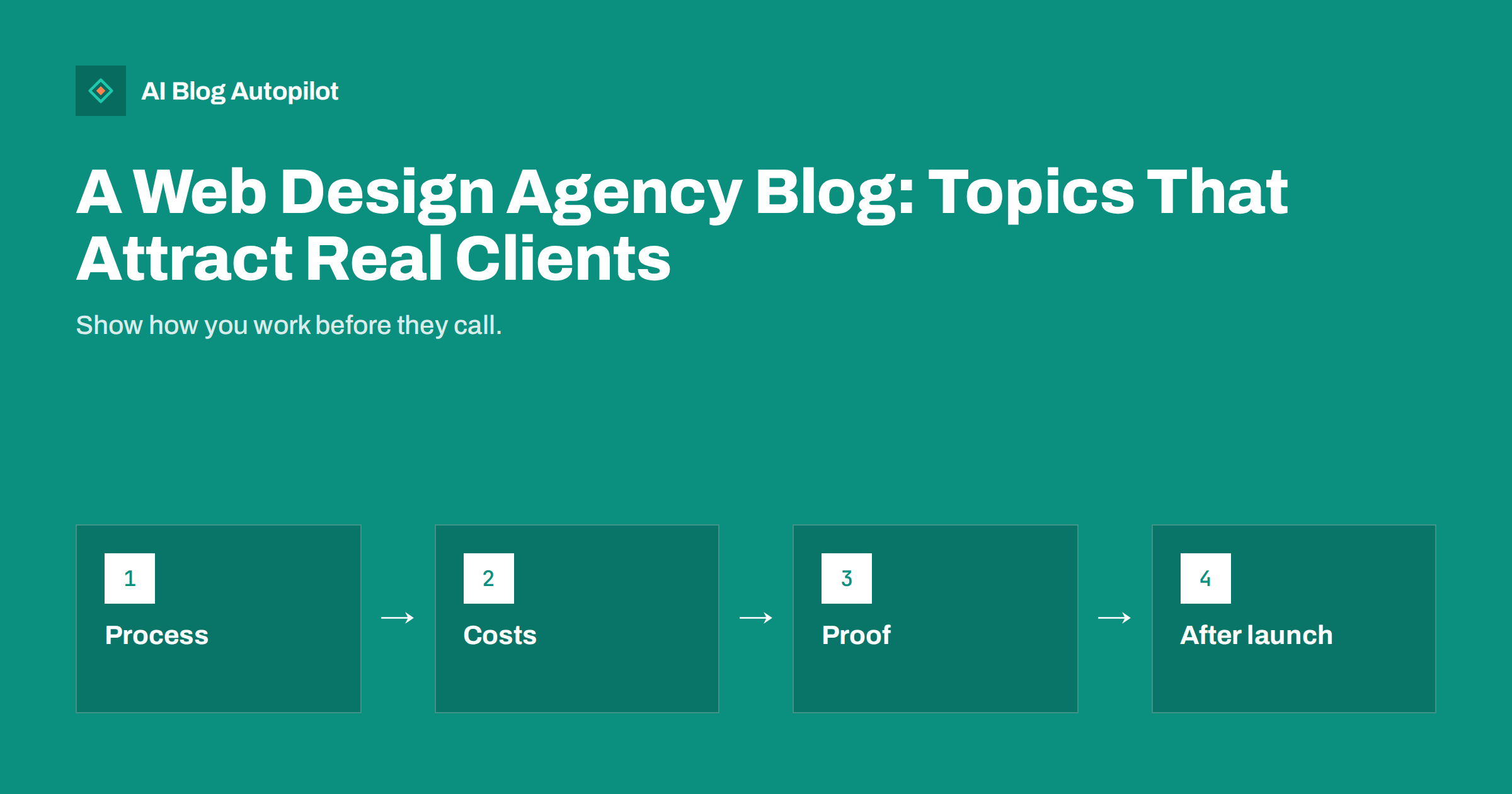
Short answer: a web design agency should blog for the people who hire it, not for other designers: explain how a project runs from brief to launch, what affects cost and timing, what clients must provide, how you handle content, search, speed and accessibility, and what happens after launch. Show real work with permission, use plain words, avoid promising rankings or sales, and end each page with a clear way to start a conversation.
Most agency blogs are written for peers. They discuss trends, tools and awards, and they attract other designers who will never become clients. The people who hire an agency are owners, marketing managers and office managers. They worry about budget, delays, hidden extras and whether the finished site will bring enquiries. A blog that answers those worries earns attention and trust.
This guide lists topic groups for a studio or agency, explains how to show proof without breaking confidentiality and describes how to write about prices and results without overselling. It applies equally to freelancers and small teams.
Explain the process from first call to launch
Buyers fear the unknown. Describe the stages of a typical project: discovery call, brief, proposal, structure and content plan, design, build, testing, launch and handover. For each stage, say what you do, what the client does, how long it often takes and what decisions are needed. Use a simple timeline graphic, with a text version for readers who cannot see images.
Be specific about client responsibilities. Many projects slow down because text, images, logins and approvals arrive late. A page that lists what you need and by when, with a note on what happens if deadlines move, prevents friction and shows that you run projects professionally.
Explain how revisions work. Say how many rounds are included, how feedback should be given and what counts as a change of scope. Write the policy in friendly language, and keep it identical to your contracts. Readers value clarity about limits more than a promise of unlimited changes.
Write a page about choosing between a template and a custom design. A theme can be quick and economical for a small business with simple needs, while a custom build suits complex requirements, distinctive branding or unusual functions. Explain the trade-offs honestly, including limits on flexibility, maintenance and long-term cost, and say when you would recommend each. Clients trust an agency that sometimes advises the cheaper option.
Add a page for clients who already have a site. Explain how you assess an existing site, what an audit covers, how you decide between a refresh and a rebuild, and how you protect what already works. Many enquiries come from people unhappy with a site they paid for, and a calm, practical guide for them is a strong entry point.
Be open about cost and what drives it
Price is the most common question and the one most agencies avoid. You do not need a price list, but you can explain what makes a project larger or smaller: the number of pages and templates, custom design versus an existing theme, integrations, an online shop, languages, content writing, photography and migration from an old site. Give a few anonymous example scopes with broad ranges, if you are able to.
Describe the difference between one-off costs and running costs: hosting, domains, licences, security updates, backups, support and content updates. A client who understands this before signing is less likely to feel surprised later. The structure in writing honest articles about what things cost suits this topic well.
Write about why the cheapest quote may not be the cheapest result, without insulting competitors. Compare what is included, who does the work, what support follows and how problems are handled. Offer a checklist for comparing proposals, and invite readers to send you one for a friendly second look.
Write about the brief itself. A good brief states the goal, the audience, the main actions visitors should take, the pages needed, examples the client likes and dislikes and the budget range. Offer a short template for download, and explain how it saves both sides time. Clients who arrive with a clear brief receive better proposals and fewer surprises.
Write about content, structure and search from the start
A site that looks good but cannot be found or understood is a poor investment. Explain how you plan page structure, headings, navigation and content before design, and why. Describe how you handle titles, descriptions, internal links, redirects and structured data, and how you set up analytics and search tools at launch.
Many clients are unsure about content. Say who writes it, how long it takes and how it is checked. Explain the value of real photographs, clear contact details and honest pages about the company and its people. Link to deeper guides where they help, such as reading a blog on a phone and page speed for content sites.
Do not promise rankings. Explain what you control, such as technical quality, structure and speed, and what you do not, such as competitor activity and search engine decisions. An agency that says this plainly stands out from the many that guarantee first place.
Cover maintenance pages that clients can follow: why updates matter, how often backups run, what to do if the site is hacked, who to call and what information to have ready. Keep the tone calm and practical. Explain the difference between your responsibilities and those of the hosting company, since confusion on this point causes many disputes.
Cover speed, accessibility and security as part of quality
These topics distinguish a careful agency. Explain what you test before launch: loading speed on a phone, layout on different screens, keyboard use, colour contrast, forms, links and error pages. Describe in general terms how you protect a site, including updates, backups and limited access, and who is responsible after launch.
Accessibility deserves its own page. Explain what it means in practice, why it helps all visitors and what standards you work towards. Be careful with claims: say what you test and fix, and avoid saying that a site is fully compliant unless it has been properly audited. The guide on accessibility for blogs offers a practical checklist that clients can understand.
Show before-and-after improvements where you can, with the client’s permission: a page that loaded in several seconds and now loads in one, a form that was unusable on a phone and now works. Give the measurement method and date, and avoid vague percentages.
Share a few honest lessons from past projects. A short post on what you would do differently, such as starting content earlier or testing forms with real users, shows maturity and gives prospects useful advice. Keep names out unless the client agrees, and focus on the lesson rather than on blame. Posts like this are often shared by clients, because they feel candid and practical.
Plan for launch, migration and what comes after
A launch is risky when an existing site is replaced. Write about how you protect traffic: mapping old addresses to new ones, setting redirects, checking titles and descriptions, testing forms and tracking and watching search tools after launch. The articles on migrating a blog without losing traffic and changing a theme without hurting SEO give the background for such pages.
Explain what happens after launch. Is there a training session? Who can edit the site? How are problems reported? What does a care plan include and what does it cost? Clients stay with agencies that look after them, and a clear care page turns a one-off job into a relationship.
Write a page about handover, too: where files and logins are kept, who owns the domain and the content, and what happens if the client later changes agency. Clients appreciate openness about ownership, and it removes a common fear.
Include a page on how you handle disagreements and mistakes. Every agency meets a project that goes off track, and clients want to know how you react. Describe how you raise problems early, how you agree on changes in writing and how you correct errors without blame. A realistic account is more persuasive than a claim that nothing ever goes wrong.
Finally, track what works. Note which pages lead to enquiries and which questions come up on first calls, and use them to plan the next articles. A blog that follows real client questions improves every quarter, while one that follows trends drifts away from the people it is meant to reach.
Show proof and your own way of working
Case studies persuade when they are specific. State the client’s problem, what you did, what changed and how it was measured, and add a quote only with written permission. Do not publish confidential details or results you cannot verify. The article on how to write a case study that persuades without exaggerating explains the structure in detail.
Show your own site as the best example. Keep it fast, accessible and current, and let it demonstrate what you advise. Add short profiles of the team, with real photographs, and say who will actually work on a project. If you outsource parts of the work, say so, since clients value honesty about how a project is staffed.
Publish your opinions with care. Explain why you prefer certain platforms or approaches and when you would choose differently. The article on WordPress and other platforms shows how to compare options fairly. Strong opinions are fine if you give reasons and acknowledge trade-offs.
How AI Blog Autopilot helps
AI Blog Autopilot can write and publish articles on your chosen topics, with FAQ sections, tags and SEO meta, and share them to your social networks. Give it your services, your process and your client questions, and check every claim, price and example before each article goes live. See the pricing page for plans and monthly credits.
Related reading
- Blog Strategy for Professional Services Firms
- Running Client Blogs as an Agency
- How to Write a Case Study That Persuades Without Exaggerating
The bottom line
Write for the people who hire you, explain process and cost plainly, show proof with permission and keep your own site as the best example.
FAQ
What should a web design agency blog about first?
Start with your process, what affects cost and timing, what clients must provide and what happens after launch.
Should an agency publish prices?
You can show ranges for example scopes with conditions. If not, explain the cost factors and how to request a proposal.
Can I show client projects?
Only with written permission and without confidential details. Describe the problem, the work and how results were measured.
Should I promise search rankings?
No. Explain what you control, such as structure, speed and technical quality, and what you cannot control.
How often should an agency blog?
A steady rhythm you can keep, such as one useful guide every week or two, is better than bursts of posts.