ENEnglish
 LTLietuviškai
 DEDeutsch
 FRFrançais
 RUРусский
 ESEspañol
 PLPolski
 ITItaliano
 UKУкраїнська
 CSČeština
 PTPortuguês
 JA日本語
JA日本語 LVLatviešu valoda
 ETEesti
 HUMagyar
 IDBahasa Indonesia
 TRTürkçe
 HIहिन्दी
 ELΕλληνικά
 ARالعربية
 THไทย
THไทย VITiếng Việt
 RORomână
 MSBahasa Melayu
 BNবাংলা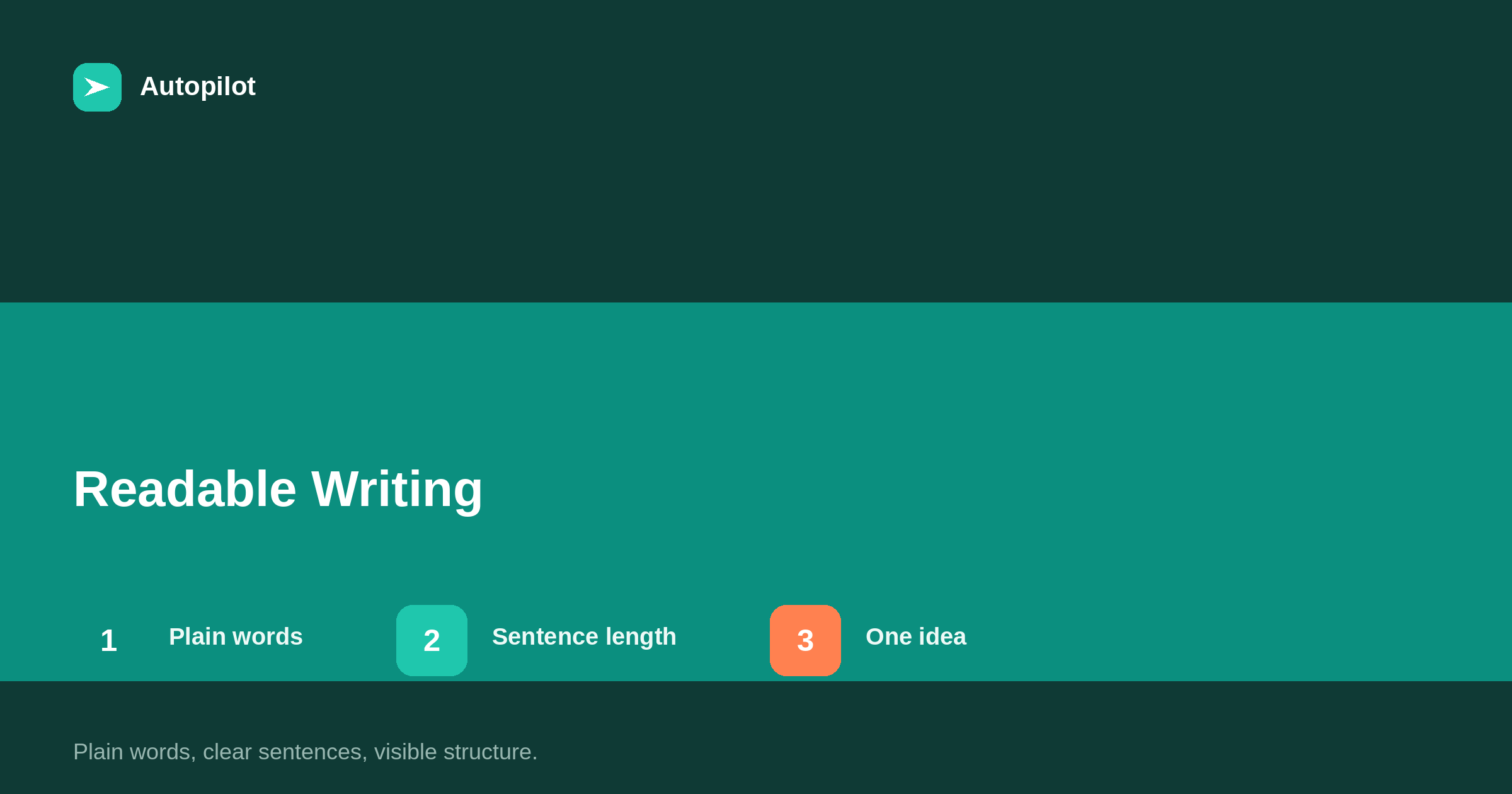
Short answer: readable writing uses the common word rather than the impressive one, keeps most sentences short while varying their length, puts one idea in each paragraph, uses active voice where it makes the actor clear, explains terms on first use, and gives the page visible structure so a skimmer can find what they need. Readability scores can flag long sentences, but they measure word and sentence length, not clarity; use them as a hint. The best test is reading the article aloud and noticing where you stumble.
Most readers do not read an article from start to finish. They skim, stop where something looks useful, and leave when the effort outweighs the reward. Readability is what keeps the effort low.
It is not the same as simplifying. A readable article on a complex subject keeps the complexity and removes the friction.
Plain words
Choose the common word when it means the same thing. Use rather than utilise, help rather than facilitate, start rather than commence.
Technical terms are fine when readers need them; explain each on first use. Jargon used to sound expert, when a plain word would do, makes the article harder and less convincing.
Sentence length
Long sentences are not wrong, but several in a row are tiring. Most sentences in a business article work well under about 25 words.
Vary the length. A run of identical short sentences reads as choppy; a run of long ones reads as dense. A long sentence explaining something, followed by a short one making the point, is a rhythm readers follow easily.
One idea per paragraph
A paragraph should carry one idea. When it carries three, readers skimming the first line miss two of them.
Short paragraphs — two to four sentences — suit screens, especially phones. Starting each with its point lets a skimmer read the first sentences and follow the argument.
Active voice, mostly
Active voice names who does what: the editor checks the claims. Passive voice can hide the actor: the claims are checked. When it matters who acts, active is clearer.
Passive voice is not an error; it is useful when the actor is unknown or unimportant. The goal is clarity, not a rule against a grammatical form.
Structure a skimmer can use
Readability at the level of the page matters as much as at the level of the sentence.
- A short answer near the top.
- Descriptive headings every few paragraphs.
- Lists for parallel items and steps.
- Tables for comparisons.
- Bold used sparingly for key terms.
how to structure an article covers building an article this way.
Readability scores
Readability formulas estimate difficulty from word and sentence length. They flag long sentences and long words reliably.
| Scores can tell you | Scores cannot tell you |
|---|---|
| Sentences are long on average | Whether the argument is clear |
| Many long words are used | Whether terms are explained |
| The text may be dense | Whether the structure helps skimmers |
| Changes made it shorter | Whether it is accurate or useful |
Use a score as a hint, not a target. Chasing a number can produce choppy writing that scores well and reads badly.
Reading aloud
The most reliable readability test is reading the article aloud. You stumble where readers stumble: sentences too long to say in one breath, clauses in a confusing order, words that do not fit.
It is the last pass in editing a draft for this reason. It takes a few minutes and catches what every other check misses.
Readability on a phone
On a small screen, dense paragraphs become long walls of text and tables overflow. Short paragraphs, adequate text size and line spacing make a large difference.
reading on a phone covers the layout side. Readable writing and a readable layout together are what keep a phone reader going.
Explaining technical subjects
Technical subjects are where readability matters most and is hardest. Three techniques help. Define terms on first use in plain words. Give an example immediately after an abstract statement. And build from what the reader already knows to what they do not, rather than starting with the most technical part.
A reader who meets a concrete example right after a definition understands both. A reader who meets three abstract paragraphs in a row usually skims past all of them.
Words that add nothing
Some words and phrases can almost always be removed without loss: very, really, basically, actually, in order to, the fact that, it is important to note that. Removing them shortens sentences and makes the remaining words stronger.
A quick search for these during editing is one of the fastest readability improvements available. Adding them to your style guide’s never list stops them appearing in the first place.
The same applies to stacked adjectives and hedges. One precise word usually does more than three approximate ones.
Paragraph openings
Read only the first sentence of each paragraph in an article. If those sentences, in order, tell the story of the article, a skimmer will follow it. If they are transitions, hedges or restatements, the key points are buried in the middle of paragraphs where skimmers miss them.
Rewriting paragraph openings so each states its point is one of the quickest structural improvements an editor can make, and it helps every reader, not only skimmers.
Numbers and lists in prose
Three or more numbers in one sentence are hard to hold in mind. Move them into a short list or table. Similarly, a sentence listing five items separated by commas is easier to read as a bulleted list, especially on a phone.
Headings as a summary
Read the headings alone, in order. They should summarise the article. If they do not, readers who skim headings will misunderstand it.
Readability and automated drafts
Automated drafts are often grammatically clean and still dense: long sentences, abstract nouns, paragraphs carrying several ideas. Instructions help — sentence length, paragraph length, plain-word preferences — and the style and voice guides are where they belong.
Readability does not guarantee rankings. It determines whether people who arrive actually read what you wrote, which is the point of writing it.
Related reading
If this was useful, these cover the questions that usually come next.
- How to structure an article — readability at the level of the page
- Editing a draft — the read-aloud pass
- Reading on a phone — readability on a small screen
The bottom line
Use plain words, keep most sentences short but varied, give each paragraph one idea, prefer active voice when the actor matters, and structure the page for skimmers. Treat readability scores as hints, read the article aloud before publishing, and check it on a phone.
FAQ
What makes writing readable?
Plain words, mostly short and varied sentences, one idea per paragraph, clear actors, explained terms, and structure that lets skimmers find the point.
How long should sentences be?
Most under about 25 words, with variation. Several long sentences in a row are tiring to read.
Are readability scores useful?
As hints about sentence and word length. They cannot measure clarity, accuracy or structure, so do not treat them as targets.
Is passive voice always wrong?
No. It is useful when the actor is unknown or unimportant. Use active voice when it matters who acts.
Does readable mean simple?
No. Readable writing keeps the substance of a complex subject while removing unnecessary friction.
What is the best readability test?
Reading the article aloud. You stumble where readers would.